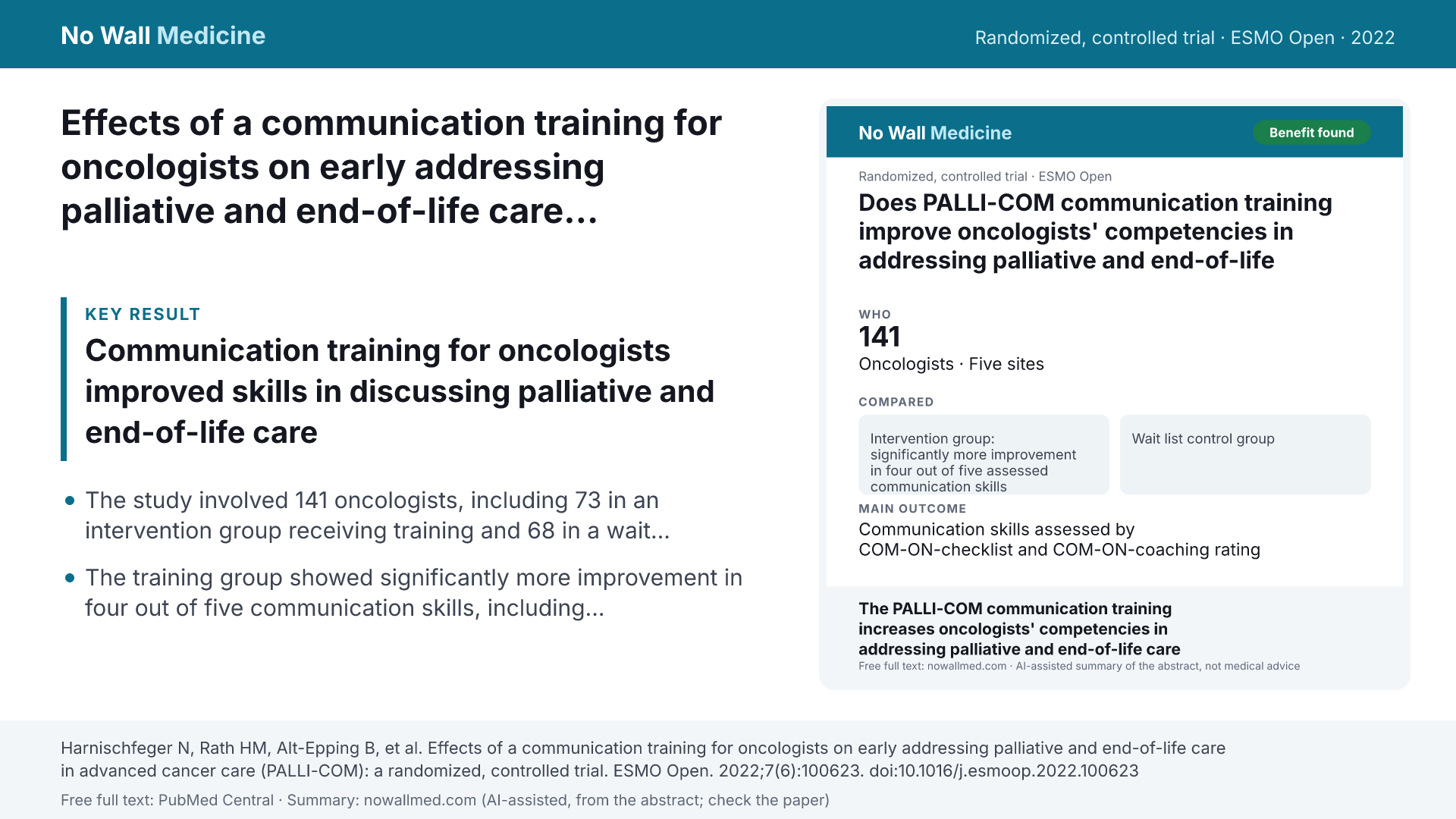
Communication training for oncologists improved skills in discussing palliative and end-of-life care
Effects of a communication training for oncologists on early addressing palliative and end-of-life care in advanced cancer care (PALLI-COM): a randomized, controlled trial
Randomized, controlled trialBenefit found
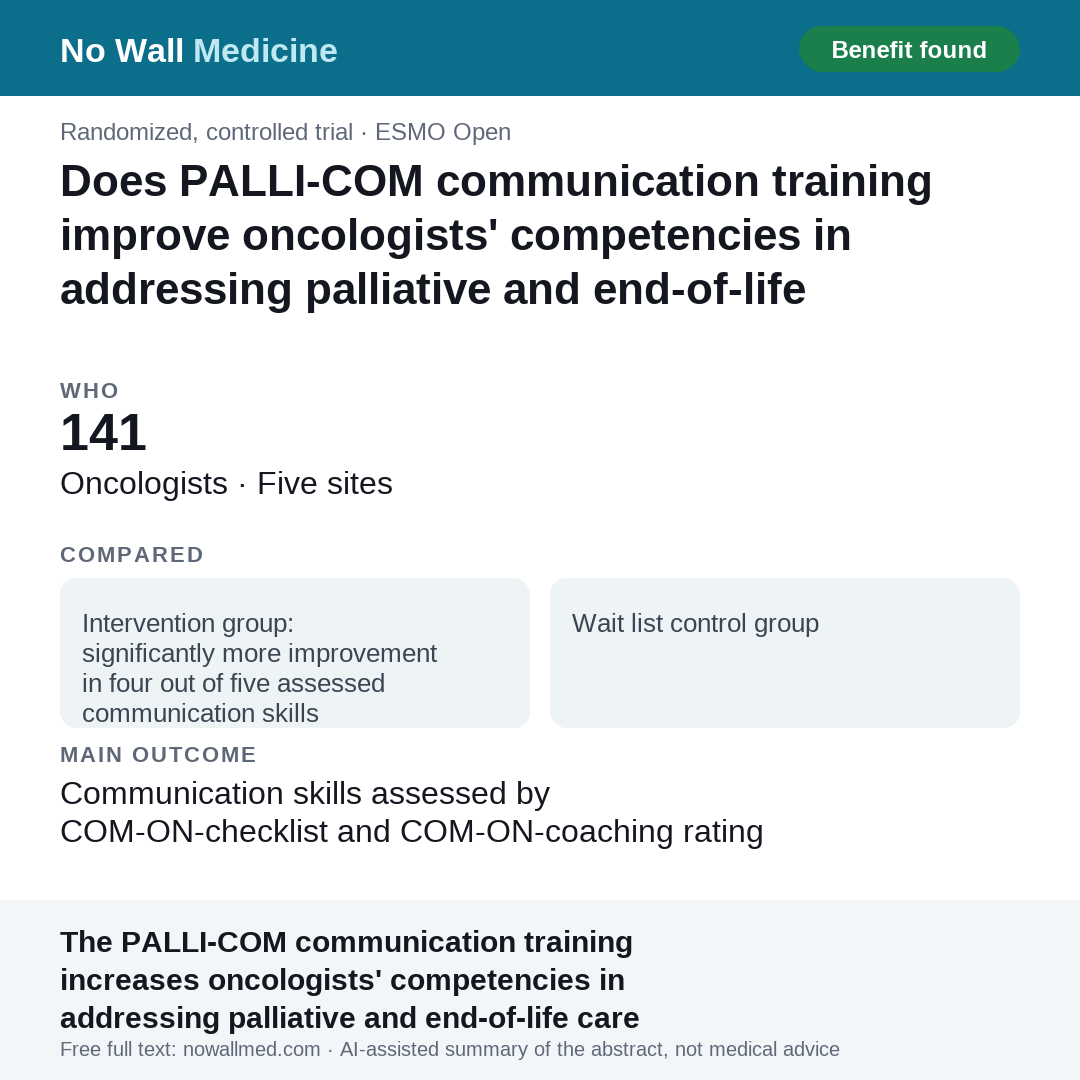
Does PALLI-COM communication training improve oncologists' competencies in addressing palliative and end-of-life care?
Who
141
Oncologists · Five sites
Compared
Intervention group: significantly more improvement in four out of five assessed communication skills
Wait list control group
Main outcome
Communication skills assessed by COM-ON-checklist and COM-ON-coaching rating scales
Bottom line: The PALLI-COM communication training increases oncologists' competencies in addressing palliative and end-of-life care issues.
ESMO Open · 2022-11-07Download image
Clinical question: Does PALLI-COM communication training improve oncologists' competencies in addressing palliative and end-of-life care?
Why it matters: Physicians' communication insecurities often impede early discussions regarding palliative care and end-of-life issues in advanced cancer care.
Key points
- The study involved 141 oncologists, including 73 in an intervention group receiving training and 68 in a wait list control group.
- The training group showed significantly more improvement in four out of five communication skills, including empathy, giving hope, addressing end-of-life issues, and explaining palliative care.
- Participants in the training group also showed more improvement in self-reported confidence, attitudes toward terminally ill patients, and communication quality as rated by simulated patients.
Headline and key points written with AI from the paper’s abstract, with every number checked against it. Read the paper before relying on them.
Was this summary helpful?
Subject terms
Cite this article
Harnischfeger N, Rath HM, Alt-Epping B, Brand H, Haller K, Letsch A. Effects of a communication training for oncologists on early addressing palliative and end-of-life care in advanced cancer care (PALLI-COM): a randomized, controlled trial. ESMO Open. 2022. doi:10.1016/j.esmoop.2022.100623
Spotted a mistake? Suggest a correction
Top studies every Monday
The week’s key trials and guidelines in your specialties, plus any topics you follow. By email, free.
Get the weekly digest