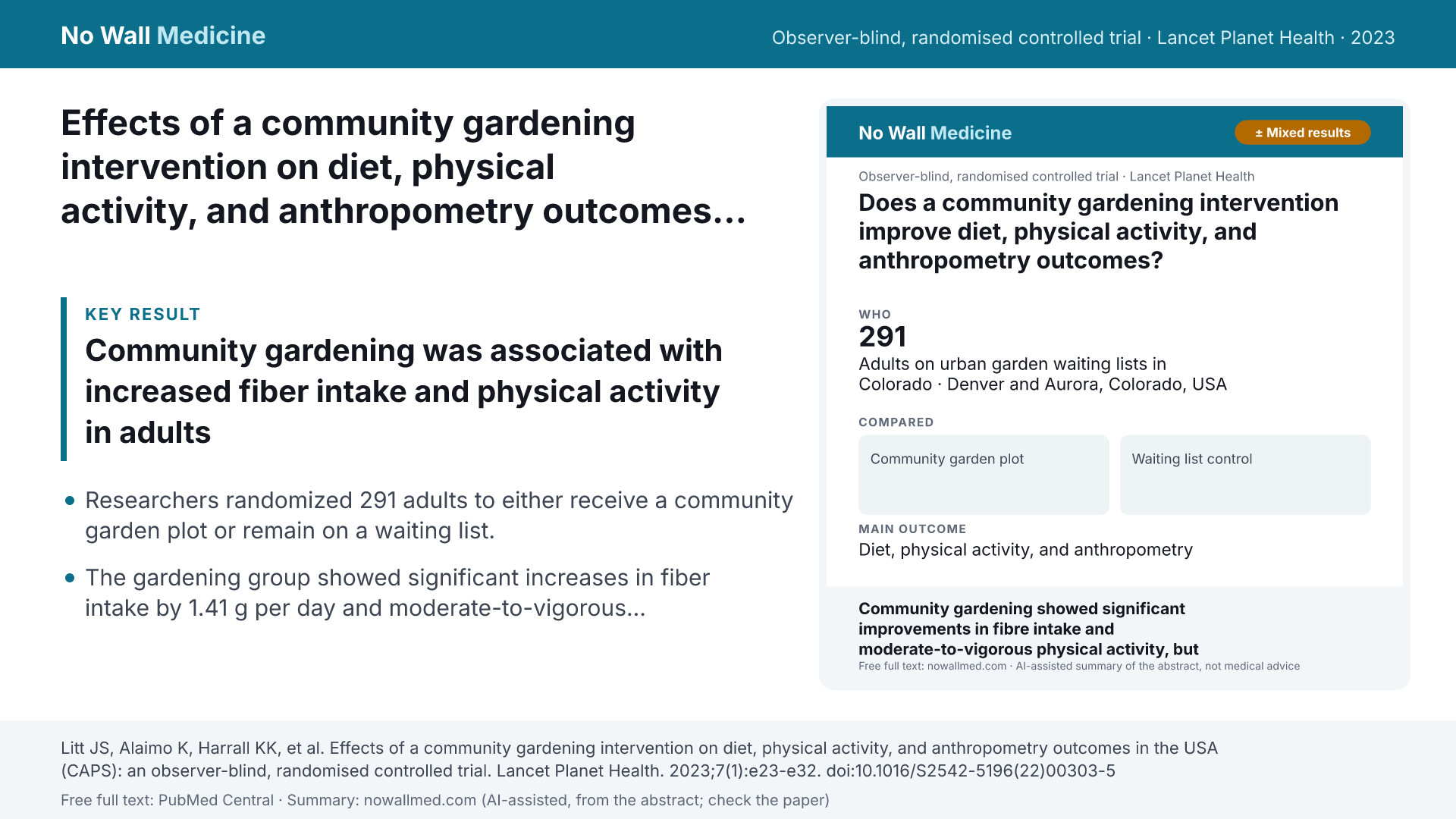
Community gardening was associated with increased fiber intake and physical activity in adults
Effects of a community gardening intervention on diet, physical activity, and anthropometry outcomes in the USA (CAPS): an observer-blind, randomised controlled trial
Observer-blind, randomised controlled trialMixed results
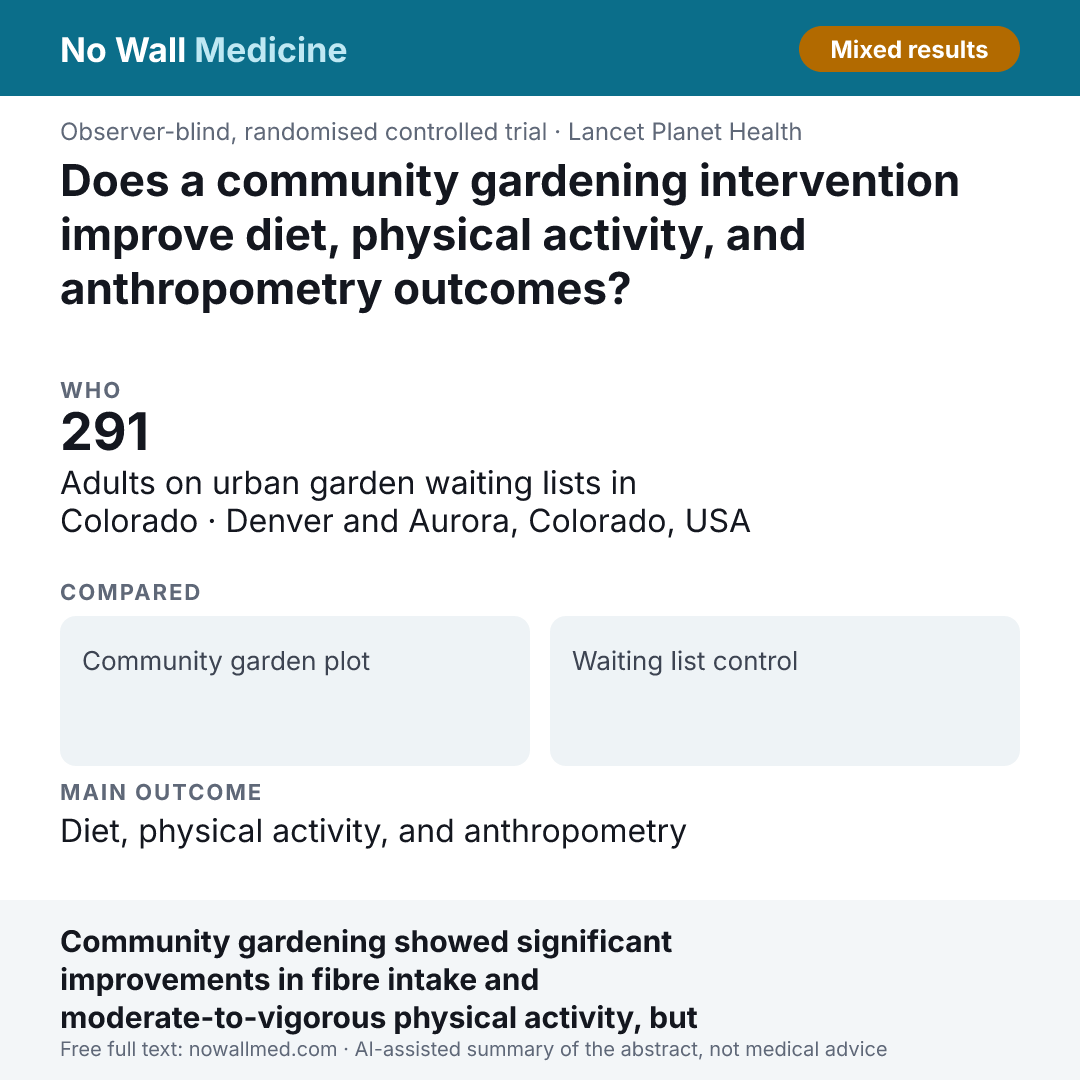
Does a community gardening intervention improve diet, physical activity, and anthropometry outcomes?
Who
291
Adults on urban garden waiting lists in Colorado · Denver and Aurora, Colorado, USA
Compared
Community garden plot
Waiting list control
Main outcome
Diet, physical activity, and anthropometry
Result: fibre intake difference 1.41 g per day (99.5% CI -2.09 to 4.92)
Bottom line: Community gardening showed significant improvements in fibre intake and moderate-to-vigorous physical activity, but no significant changes in anthropometry.
Funded by: American Cancer Society, University of Colorado, NIH, USDA
Lancet Planet Health · 2023-01-07 · Save PNG
Clinical question: Does a community gardening intervention improve diet, physical activity, and anthropometry outcomes?
Key points
- Researchers randomized 291 adults to either receive a community garden plot or remain on a waiting list.
- The gardening group showed significant increases in fiber intake by 1.41 g per day and moderate-to-vigorous physical activity by 5.80 min per day.
- No significant differences were found between groups for fruit and vegetable intake, sedentary time, body mass index, or waist circumference.
Headline and key points written with AI from the paper’s abstract, with every number checked against it. Read the paper before relying on them.
Was this summary helpful?
Abstract
Background
Unhealthy diet, physical inactivity, and social disconnection are important modifiable risk factors for non-communicable and other chronic diseases, which might be alleviated through nature-based community interventions. We tested whether a community gardening intervention could reduce these common health risks in an adult population that is diverse in terms of age, ethnicity, and socioeconomic status. Methods
In this observer-blind, randomised, controlled trial, we recruited individuals who were on Denver Urban Garden waiting lists for community gardens in Denver and Aurora (CO, USA), aged 18 years or older, and had not gardened in the past 2 years. Participants were randomly assigned (1:1), using a randomised block design in block sizes of two, four, or six, to receive a community garden plot (intervention group) or remain on a waiting list and not garden (control group). Researchers were masked to group allocation. Primary outcomes were diet, physical activity, and anthropometry; secondary outcomes were perceived stress and anxiety. During spring (April to early June, before randomisation; timepoint 1 [T1]), autumn (late August to October; timepoint 2 [T2]), and winter (January to March, after the intervention; timepoint 3 [T3]), participants completed three diet recalls, 7-day accelerometry, surveys, and anthropometry. Analyses were done using the intention-to-treat principle (ie, including all participants randomly assigned to groups, and assessed as randomised). We used mixed models to test time-by-intervention hypotheses at an α level of 0·04, with T2 and T3 intervention effects at an α level of 0·005 (99·5% CI). Due to potential effects of the COVID-19 pandemic on outcomes, we excluded all participant data collected after Feb 1, 2020. This study is registered with ClinicalTrials.gov, NCT03089177, and data collection is now complete. Findings
Between Jan 1, 2017, and June 15, 2019, 493 adults were screened and 291 completed baseline measures and were randomly assigned to the intervention (n=145) or control (n=146) groups. Mean age was 41·5 years (SD 13·5), 238 (82%) of 291 participants were female, 52 (18%) were male, 99 (34%) identified as Hispanic, and 191 (66%) identified as non-Hispanic. 237 (81%) completed measurements before the beginning of the COVID-19 pandemic. One (<1%) participant in the intervention group had an adverse allergic event in the garden. Significant time-by-intervention effects were observed for fibre intake (p=0·034), with mean between-group difference (intervention minus control) at T2 of 1·41 g per day (99·5% CI -2·09 to 4·92), and for moderate-to-vigorous physical activity (p=0·012), with mean between-group difference of 5·80 min per day (99·5% CI -4·44 to 16·05). We found no significant time-by-intervention interactions for combined fruit and vegetable intake, Healthy Eating Index (measured using Healthy Eating Index-2010), sedentary time, BMI, and waist circumference (all p>0·04). Difference score models showed greater reductions between T1 and T2 in perceived stress and anxiety among participants in the intervention group than among those in the control group. Interpretation
Community gardening can provide a nature-based solution, accessible to a diverse population including new gardeners, to improve wellbeing and important behavioural risk factors for non-communicable and chronic diseases. Funding
American Cancer Society, University of Colorado Cancer Centre, University of Colorado Boulder, National Institutes of Health, US Department of Agriculture National Institute of Food and Agriculture, Michigan AgBioResearch Hatch projects.
Abstract reproduced under the article’s CC BY licence.
Subject terms
Headline, design, result, key points, caveat and citation as plain text.
Cite this article
Litt JS, Alaimo K, Harrall KK, et al. Effects of a community gardening intervention on diet, physical activity, and anthropometry outcomes in the USA (CAPS): an observer-blind, randomised controlled trial. Lancet Planet Health. 2023;7(1):e23-e32. doi:10.1016/S2542-5196(22)00303-5
Spotted a mistake? Suggest a correction