Multimodal intervention in German general practices reduced second line antibiotic prescriptions for urinary tract infections
Effects of a multimodal intervention in primary care to reduce second line antibiotic prescriptions for urinary tract infections in women: parallel, cluster randomised, controlled trial
Parallel, cluster randomised, controlled trialBenefit found
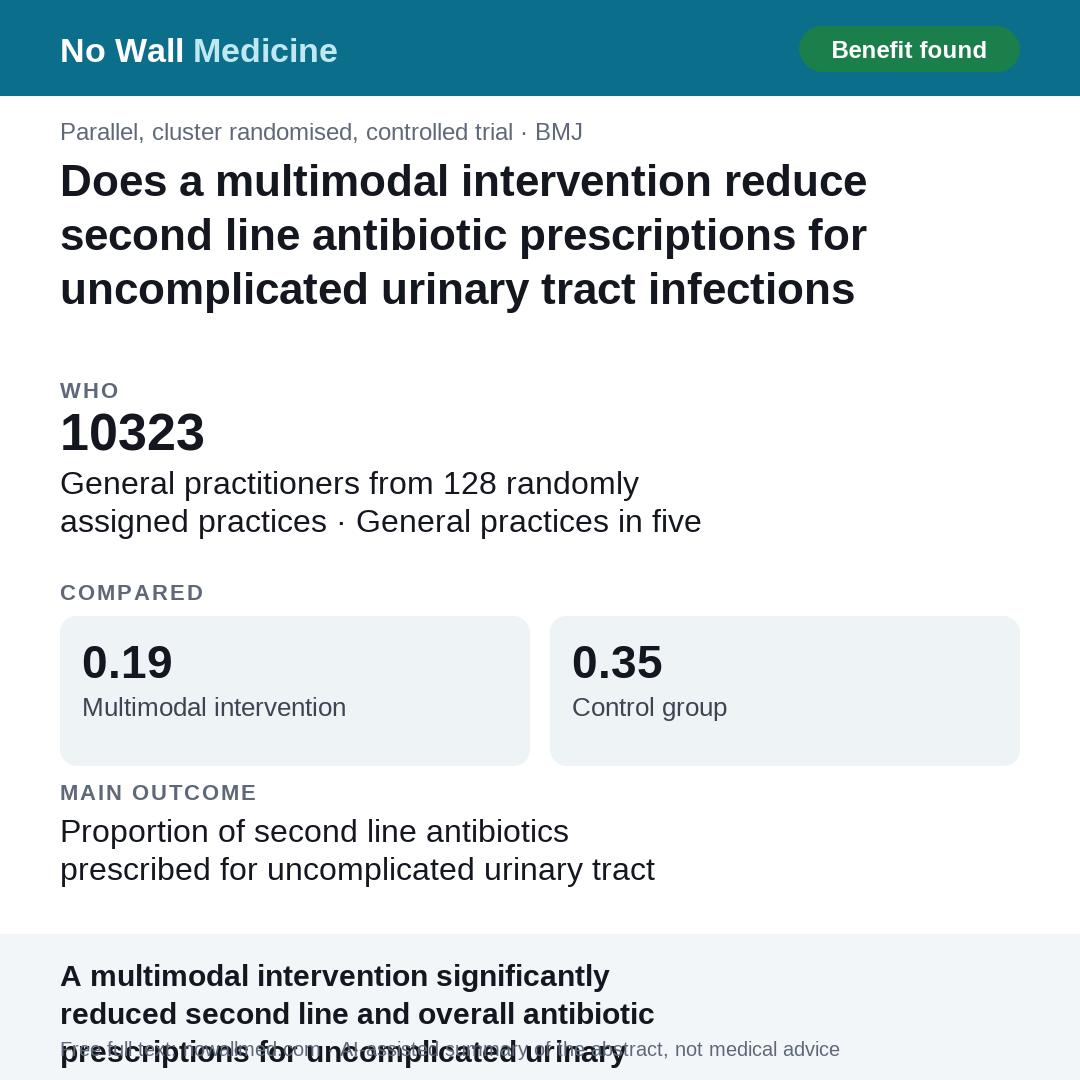
Does a multimodal intervention reduce second line antibiotic prescriptions for uncomplicated urinary tract infections in women?
Who
10323
General practitioners from 128 randomly assigned practices · General practices in five regions in Germany
Compared
0.19Multimodal intervention (standard deviation 0.20)
0.35Control group (0.25)
Main outcome
Proportion of second line antibiotics prescribed for uncomplicated urinary tract infections
Result: -0.13 (95% confidence interval -0.21 to -0.06)
Bottom line: A multimodal intervention significantly reduced second line and overall antibiotic prescriptions for uncomplicated urinary tract infections in women.
BMJ · 2023-11-02Download image
Clinical question: Does a multimodal intervention reduce second line antibiotic prescriptions for uncomplicated urinary tract infections in women?
Why it matters: It is unclear if providing guideline recommendations, resistance data, and quarterly feedback can reduce the use of second line antibiotics in primary care.
Key points
- Researchers studied 110 general practices and 10,323 cases of uncomplicated urinary tract infections in women over 15 months.
- The intervention resulted in a mean proportion of 0.19 for second line antibiotics compared to 0.35 in the control group.
- The overall proportion of all antibiotic prescriptions was 0.74 in the intervention group and 0.80 in the control group.
Headline and key points written with AI from the paper’s abstract, with every number checked against it. Read the paper before relying on them.
Was this summary helpful?
Abstract
Objectives
To evaluate whether a multimodal intervention in general practice reduces the proportion of second line antibiotic prescriptions and the overall proportion of antibiotic prescriptions for uncomplicated urinary tract infections in women. Design
Parallel, cluster randomised, controlled trial. Setting
General practices in five regions in Germany. Data were collected between 1 April 2021 and 31 March 2022. Participants
General practitioners from 128 randomly assigned practices. Interventions
Multimodal intervention consisting of guideline recommendations for general practitioners and patients, provision of regional data for antibiotic resistance, and quarterly feedback, which included individual first line and second line proportions of antibiotic prescribing, benchmarking with regional or supra-regional practices, and telephone counselling. Participants in the control group received no information on the intervention. Main outcome measures
Primary outcome was the proportion of second line antibiotics prescribed by general practices, in relation to all antibiotics prescribed, for uncomplicated urinary tract infections after one year between the intervention and control group. General practices were randomly assigned in blocks (1:1), with a block size of four, into the intervention or control group using SAS version 9.4; randomisation was stratified by region. The secondary outcome was the prescription proportion of all antibiotics, relative within all cases (instances of UTI diagnosis), for the treatment of urinary tract infections after one year between the groups. Adverse events were assessed as exploratory outcomes. Results
110 practices with full datasets identified 10 323 cases during five quarters (ie, 15 months). The mean proportion of second line antibiotics prescribed was 0.19 (standard deviation 0.20) in the intervention group and 0.35 (0.25) in the control group after 12 months. After adjustment for preintervention proportions, the mean difference was -0.13 (95% confidence interval -0.21 to -0.06, P<0.001). The overall proportion of all antibiotic prescriptions for urinary tract infections over 12 months was 0.74 (standard deviation 0.22) in the intervention and 0.80 (0.15) in the control group with a mean difference of -0.08 (95% confidence interval -0.15 to -0.02, P<0.029). No differences were noted in the number of complications (ie, pyelonephritis, admission to hospital, or fever) between the groups. Conclusions
The multimodal intervention in general practice significantly reduced the proportion of second line antibiotics and all antibiotic prescriptions for uncomplicated urinary tract infections in women. Trial registration
German Clinical Trials Register (DRKS), DRKS00020389.
Abstract reproduced under the article’s CC BY licence.
Subject terms
Cite this article
Schmiemann G, Greser A, Maun A, Bleidorn J, Schuster A, Miljukov O. Effects of a multimodal intervention in primary care to reduce second line antibiotic prescriptions for urinary tract infections in women: parallel, cluster randomised, controlled trial. BMJ. 2023. doi:10.1136/bmj-2023-076305
Spotted a mistake? Suggest a correction
Top studies every Monday
The week’s key trials and guidelines in your specialties, plus any topics you follow. By email, free.
Get the weekly digest