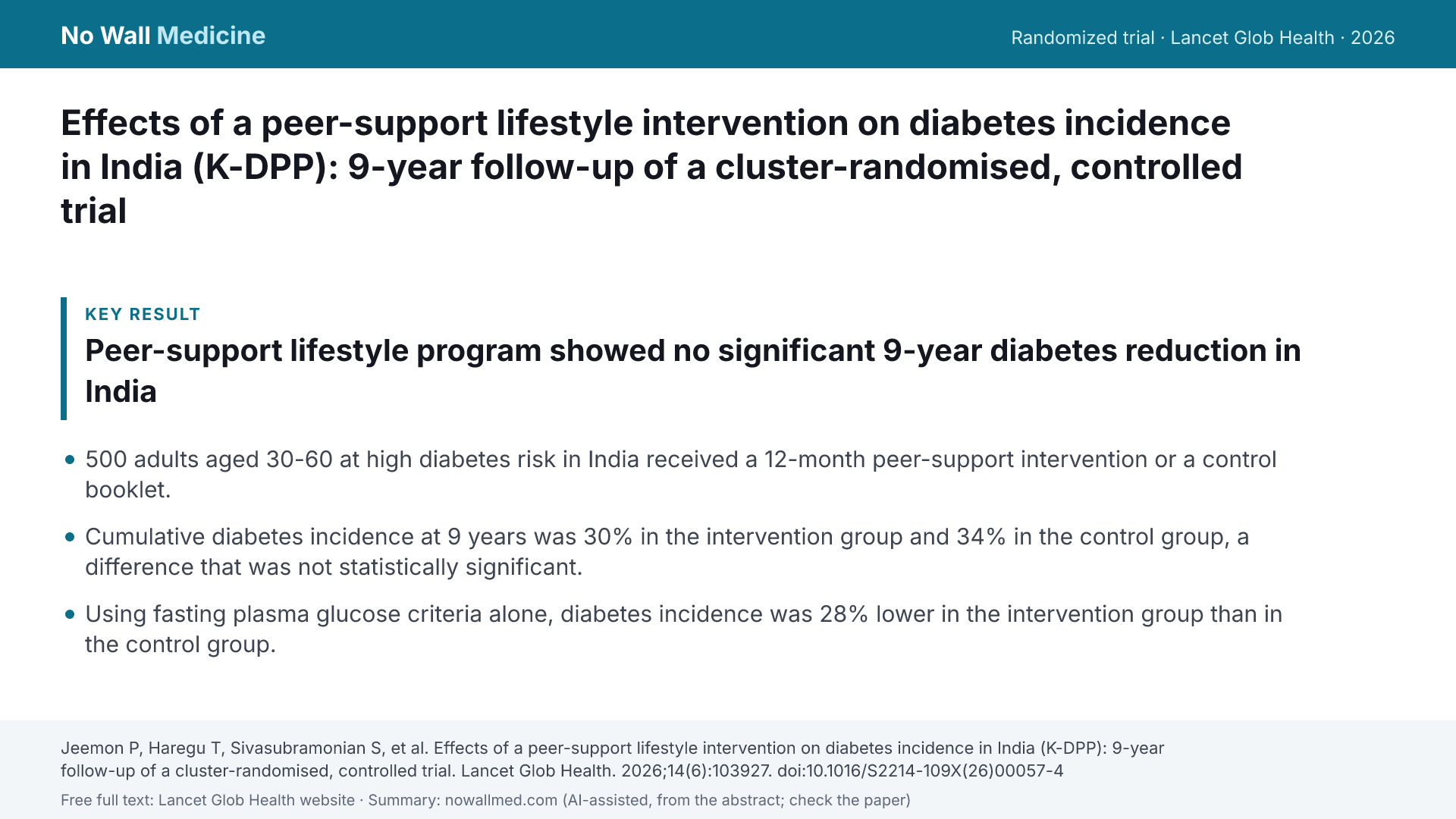
Peer-support lifestyle program showed no significant 9-year diabetes reduction in India
Effects of a peer-support lifestyle intervention on diabetes incidence in India (K-DPP): 9-year follow-up of a cluster-randomised, controlled trial
Why it matters: Evidence on the long-term effectiveness of lifestyle interventions for diabetes prevention in low-income and middle-income countries is scarce.
Key points
- 500 adults aged 30-60 at high diabetes risk in India received a 12-month peer-support intervention or a control booklet.
- Cumulative diabetes incidence at 9 years was 30% in the intervention group and 34% in the control group, a difference that was not statistically significant.
- Using fasting plasma glucose criteria alone, diabetes incidence was 28% lower in the intervention group than in the control group.
Limitation the authors note: The overall decrease in diabetes incidence based on FPG and HbA1c criteria was not statistically significant compared with the control group.
Headline and key points written with AI from the paper’s abstract, with every number checked against it. Read the paper before relying on them.
Was this summary helpful?
Abstract
Background
Evidence on the long-term effectiveness of lifestyle interventions for diabetes prevention in low-income and middle-income countries is scarce. We aimed to evaluate the 9-year effect of a peer-support lifestyle intervention on the incidence of diabetes in India. Methods
The Kerala Diabetes Prevention Program (K-DPP) was a cluster-randomised, controlled trial of a peer-support, group-based lifestyle intervention conducted in a community setting in adults aged 30-60 years at high risk for diabetes (with an Indian Diabetes Risk score ≥60 and without diabetes on an oral glucose tolerance test) in Kerala, India. Clusters (polling areas) were randomly assigned (1:1) to the intervention group or the control group. The intervention consisted of a 12-month peer-support programme delivered by trained lay peer leaders through monthly sessions. The control group received an education booklet with lifestyle change advice at baseline. Participants were followed up at 1 year, 2 years, and 9 years. Diabetes was diagnosed using American Diabetes Association criteria (fasting plasma glucose [FPG] ≥126 mg/dL [7·0 mmol/L] or glycated haemoglobin [HbA1c] ≥6·5% [48 mmol/mol]). We considered both physician-diagnosed diabetes and individuals who were initiated on antidiabetic medications during the follow-up period in the calculation of diabetes incidence. The primary outcome of the follow-up study was the cumulative incidence of diabetes at 9 years. Long-term effects were assessed using generalised linear models and generalised estimating equations. The trial was registered with the Australia and New Zealand Clinical Trials Registry (updated from the original trial, number ACTRN12611000262909) and the Clinical Trial Registry of India (CTRI/2021/10/037191), and follow-up is ongoing. Findings
Between Jan 20 and Oct 27, 2013, 60 polling areas were randomly assigned to the intervention group (n=30) or the control group (n=30). 500 participants were enrolled in the intervention group and 507 were enrolled in the control group. 475 (47%) participants were female and 532 (53%) were male. 863 (86%) participants were followed up at 9 years. The cumulative incidence of diabetes was 125 (30%) of 419 in the intervention group and 142 (34%) of 422 in the control group (relative risk [RR] 0·88 [95% CI 0·73-1·08]; p=0·24). When assessed using FPG criteria alone, the incidence of diabetes was 28% lower in the intervention group than in the control group (RR 0·72 [0·53-0·98]; p=0·036). No significant subgroup differences were observed in terms of age, sex, or baseline glycaemic status. Interpretation
K-DPP achieved a modest overall reduction in diabetes incidence over a 9-year period. However, the overall decrease in diabetes incidence based on FPG and HbA1c criteria was not statistically significant compared with the control group. The consistency of effects based on incidence of diabetes across subgroups supports the broad preventive potential of community-based, peer-led lifestyle interventions. Funding
The Australian National Health and Medical Research Council. Translation
For the Malayalam translation of the abstract see Supplementary Materials section.
Abstract reproduced under the article’s CC BY licence.
Subject terms
Headline, design, result, key points, caveat and citation as plain text.
Cite this article
Jeemon P, Haregu T, Sivasubramonian S, et al. Effects of a peer-support lifestyle intervention on diabetes incidence in India (K-DPP): 9-year follow-up of a cluster-randomised, controlled trial. Lancet Glob Health. 2026;14(6):103927. doi:10.1016/S2214-109X(26)00057-4
Spotted a mistake? Suggest a correction