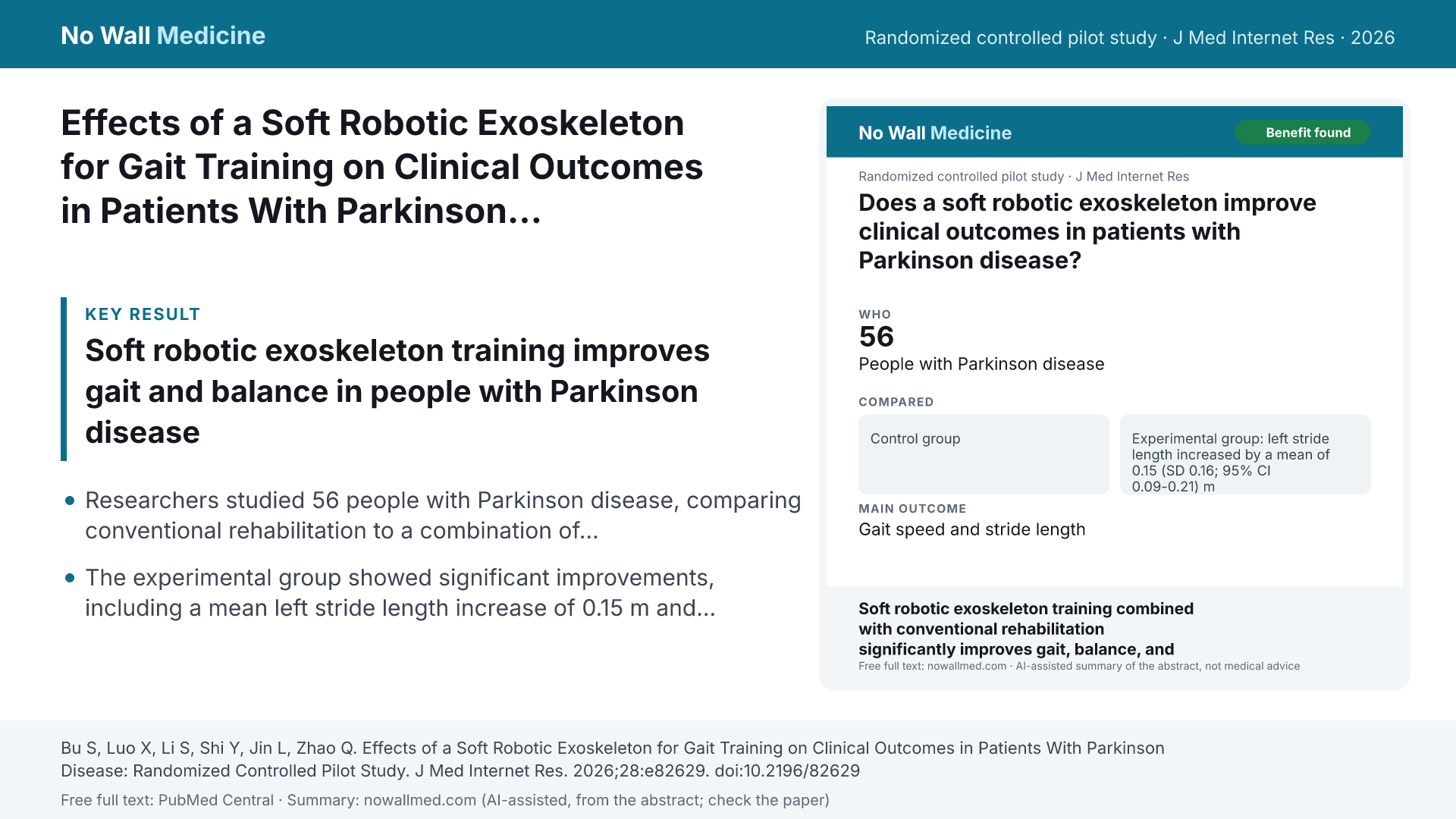
Effects of a Soft Robotic Exoskeleton for Gait Training on Clinical Outcomes in Patients With Parkinson Disease: Randomized Controlled Pilot Study
Key result: Soft robotic exoskeleton training improves gait and balance in people with Parkinson disease
Randomized controlled pilot studyBenefit found
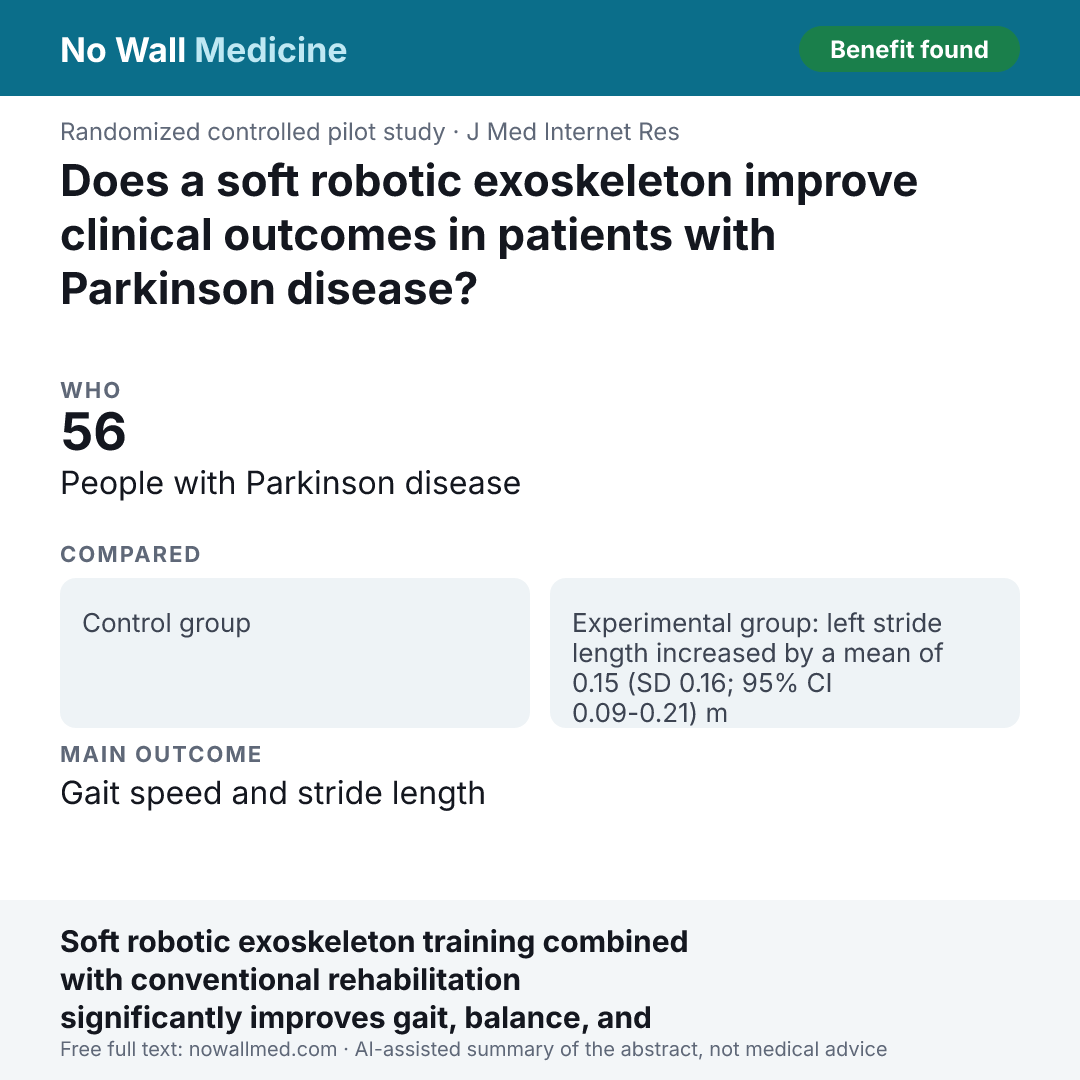
Does a soft robotic exoskeleton improve clinical outcomes in patients with Parkinson disease?
Who
56
People with Parkinson disease
Compared
Control group
Experimental group: left stride length increased by a mean of 0.15 (SD 0.16; 95% CI 0.09-0.21) m
Main outcome
Gait speed and stride length
Bottom line: Soft robotic exoskeleton training combined with conventional rehabilitation significantly improves gait, balance, and Parkinson disease symptoms.
J Med Internet Res · 2026-04-28 · Save PNG
Key points
- Researchers studied 56 people with Parkinson disease, comparing conventional rehabilitation to a combination of conventional rehabilitation and soft robotic exoskeleton training.
- The experimental group showed significant improvements, including a mean left stride length increase of 0.15 m and a mean left ankle dorsiflexion increase of 2.84 degrees.
- Compared to the control group, the exoskeleton group demonstrated greater improvements in gait speed, balance reaction time, and maximum movement distance.
Why it matters: Evidence on using soft exoskeleton robots for rehabilitation in people with Parkinson disease is limited.
Discussion prompts
- Would these patients look like yours? Who was left out?
- Is the main outcome one that matters to patients?
- Is the difference large enough to change what you do?
Cite: Bu S, Luo X, Li S, Shi Y, Jin L, Zhao Q. Effects of a Soft Robotic Exoskeleton for Gait Training on Clinical Outcomes in Patients With Parkinson Disease: Randomized Controlled Pilot Study. J Med Internet Res. 2026;28:e82629. doi:10.2196/82629
Free full text: PubMed Central · Summary and visual abstract: nowallmed.com/a/effects-of-a-soft-robotic-exoskeleton-for-gait-training-on-clinical-19220be/ (AI-assisted from the abstract; check the paper before relying on it).