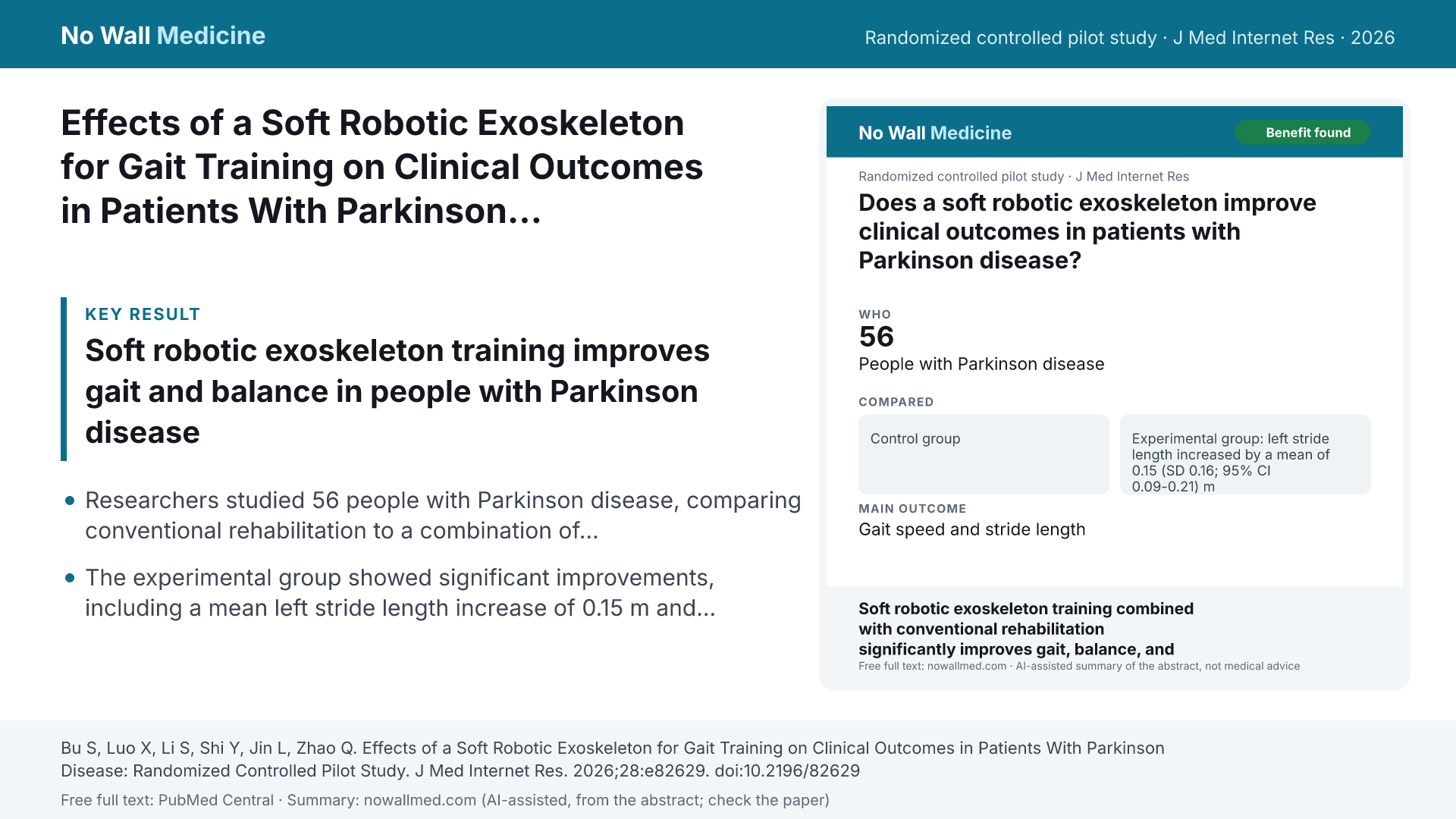
Soft robotic exoskeleton training improves gait and balance in people with Parkinson disease
Effects of a Soft Robotic Exoskeleton for Gait Training on Clinical Outcomes in Patients With Parkinson Disease: Randomized Controlled Pilot Study
Randomized controlled pilot studyBenefit found
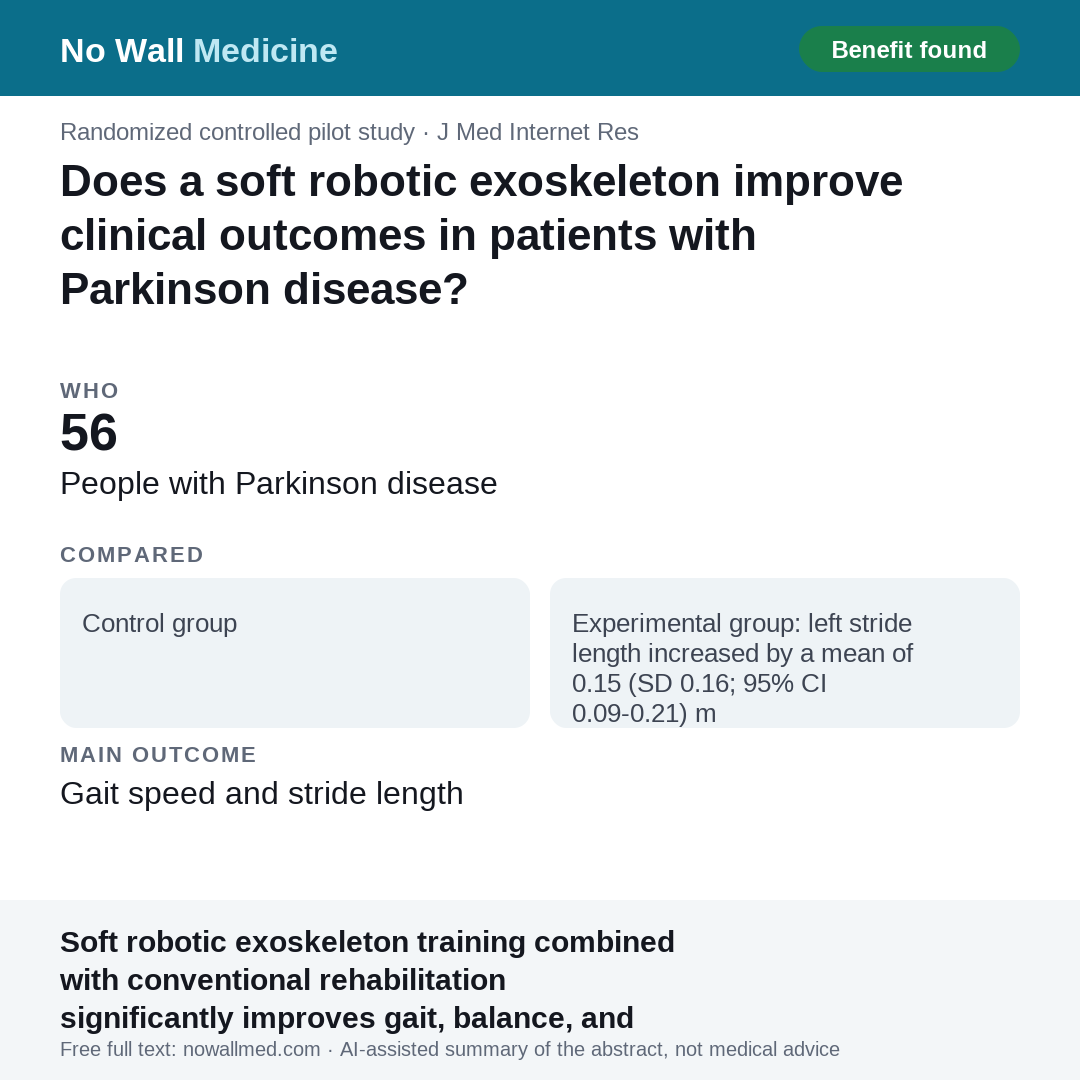
Does a soft robotic exoskeleton improve clinical outcomes in patients with Parkinson disease?
Who
56
People with Parkinson disease
Compared
Control group
Experimental group: left stride length increased by a mean of 0.15 (SD 0.16; 95% CI 0.09-0.21) m
Main outcome
Gait speed and stride length
Bottom line: Soft robotic exoskeleton training combined with conventional rehabilitation significantly improves gait, balance, and Parkinson disease symptoms.
J Med Internet Res · 2026-04-28Download image
Clinical question: Does a soft robotic exoskeleton improve clinical outcomes in patients with Parkinson disease?
Why it matters: Evidence on using soft exoskeleton robots for rehabilitation in people with Parkinson disease is limited.
Key points
- Researchers studied 56 people with Parkinson disease, comparing conventional rehabilitation to a combination of conventional rehabilitation and soft robotic exoskeleton training.
- The experimental group showed significant improvements, including a mean left stride length increase of 0.15 m and a mean left ankle dorsiflexion increase of 2.84 degrees.
- Compared to the control group, the exoskeleton group demonstrated greater improvements in gait speed, balance reaction time, and maximum movement distance.
Headline and key points written with AI from the paper’s abstract, with every number checked against it. Read the paper before relying on them.
Was this summary helpful?
Subject terms
Cite this article
Bu S, Luo X, Li S, Shi Y, Jin L, Zhao Q. Effects of a Soft Robotic Exoskeleton for Gait Training on Clinical Outcomes in Patients With Parkinson Disease: Randomized Controlled Pilot Study. J Med Internet Res. 2026. doi:10.2196/82629
Spotted a mistake? Suggest a correction