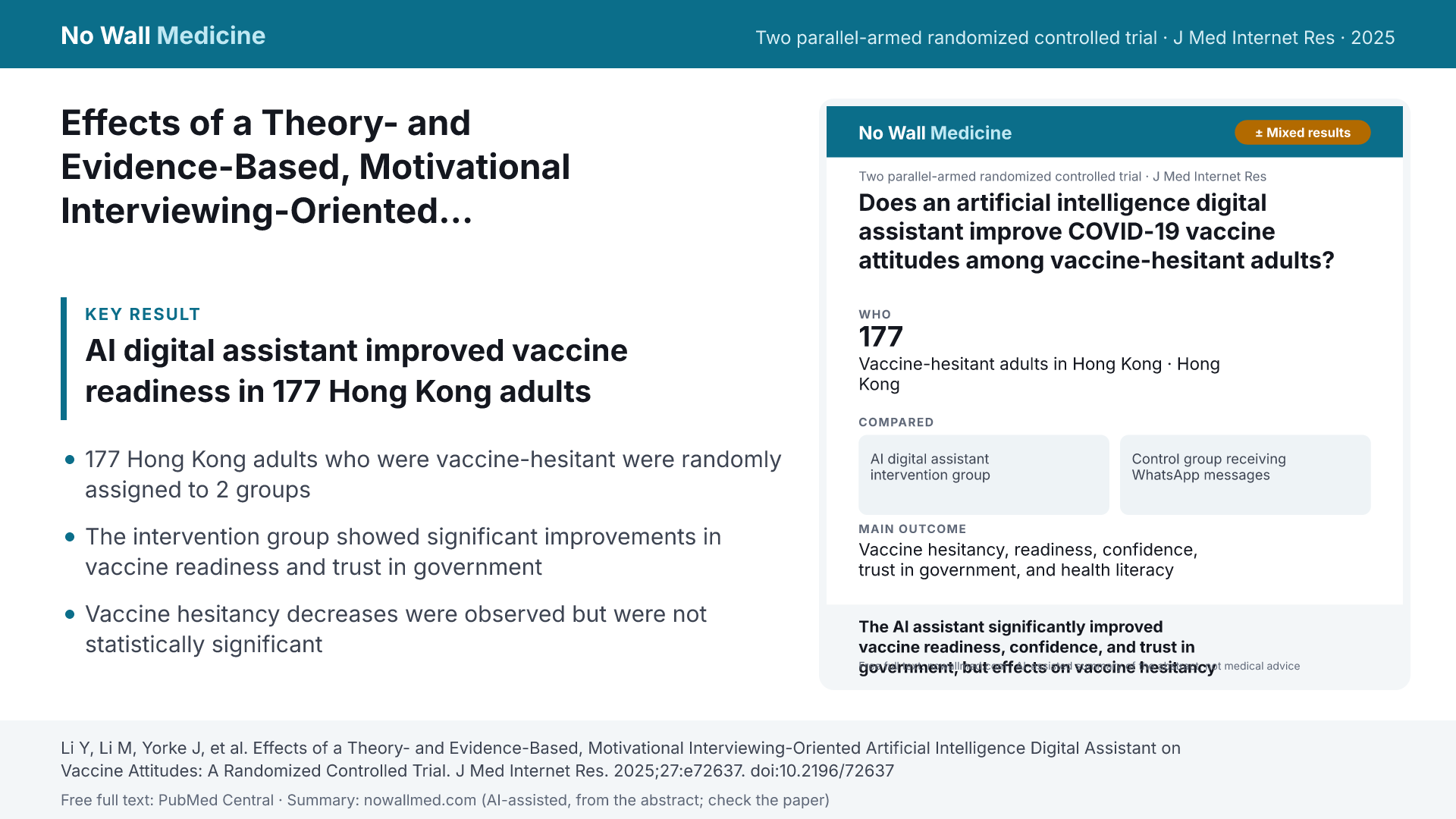
AI digital assistant improved vaccine readiness in 177 Hong Kong adults
Effects of a Theory- and Evidence-Based, Motivational Interviewing-Oriented Artificial Intelligence Digital Assistant on Vaccine Attitudes: A Randomized Controlled Trial
Two parallel-armed randomized controlled trialMixed results
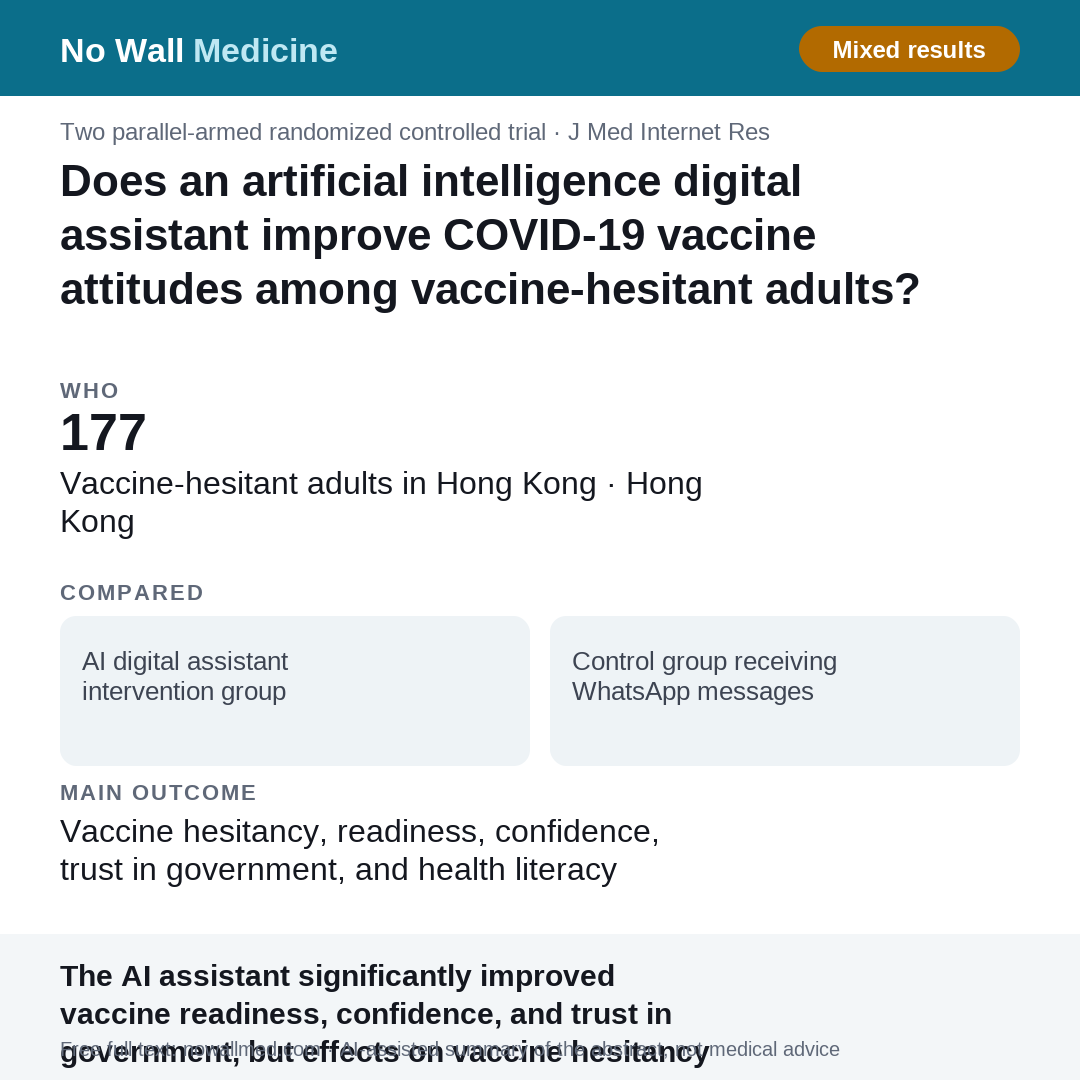
Does an artificial intelligence digital assistant improve COVID-19 vaccine attitudes among vaccine-hesitant adults?
Who
177
Vaccine-hesitant adults in Hong Kong · Hong Kong
Compared
AI digital assistant intervention group
Control group receiving WhatsApp messages
Main outcome
Vaccine hesitancy, readiness, confidence, trust in government, and health literacy
Bottom line: The AI assistant significantly improved vaccine readiness, confidence, and trust in government, but effects on vaccine hesitancy require further confirmation.
Limitation: The effects on vaccine hesitancy require further confirmation.
J Med Internet Res · 2025-08-08Download image
Clinical question: Does an artificial intelligence digital assistant improve COVID-19 vaccine attitudes among vaccine-hesitant adults?
Why it matters: Educational approaches alone may not effectively cultivate positive vaccine attitudes
Key points
- 177 Hong Kong adults who were vaccine-hesitant were randomly assigned to 2 groups.
- The intervention group showed significant improvements in vaccine readiness and trust in government.
- Vaccine hesitancy decreases were observed but were not statistically significant.
Limitation the authors note: The effects on vaccine hesitancy require further confirmation
Headline and key points written with AI from the paper’s abstract, with every number checked against it. Read the paper before relying on them.
Was this summary helpful?
Subject terms
Cite this article
Li Y, Li M, Yorke J, Bressington D, Chung J, Xie YJ. Effects of a Theory- and Evidence-Based, Motivational Interviewing-Oriented Artificial Intelligence Digital Assistant on Vaccine Attitudes: A Randomized Controlled Trial. J Med Internet Res. 2025. doi:10.2196/72637
Spotted a mistake? Suggest a correction
Top studies every Monday
The week’s key trials and guidelines in your specialties, plus any topics you follow. By email, free.
Get the weekly digest