Effects of a Theory- and Evidence-Based, Motivational Interviewing-Oriented Artificial Intelligence Digital Assistant on Vaccine Attitudes: A Randomized Controlled Trial
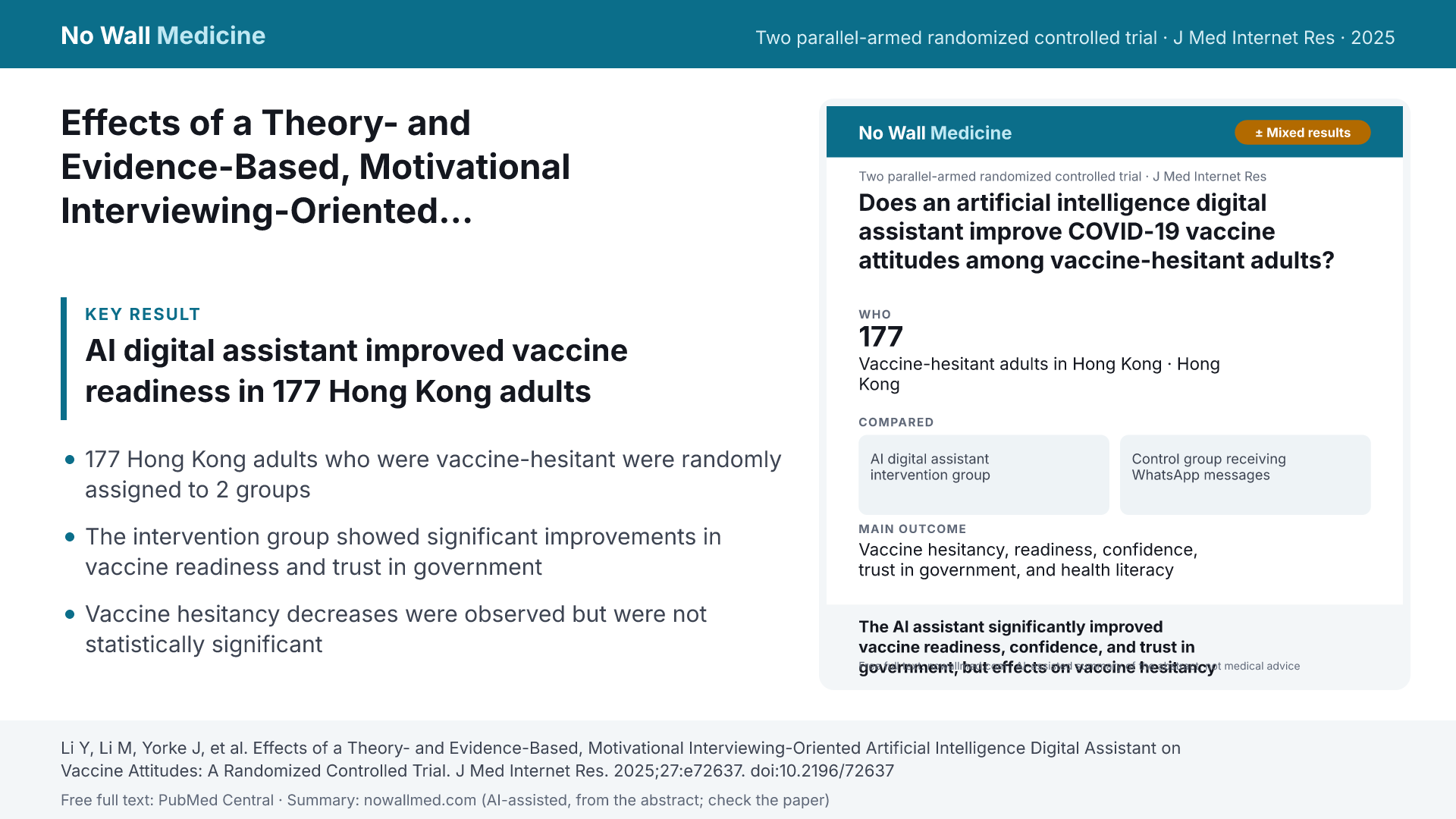
Key result: AI digital assistant improved vaccine readiness in 177 Hong Kong adults
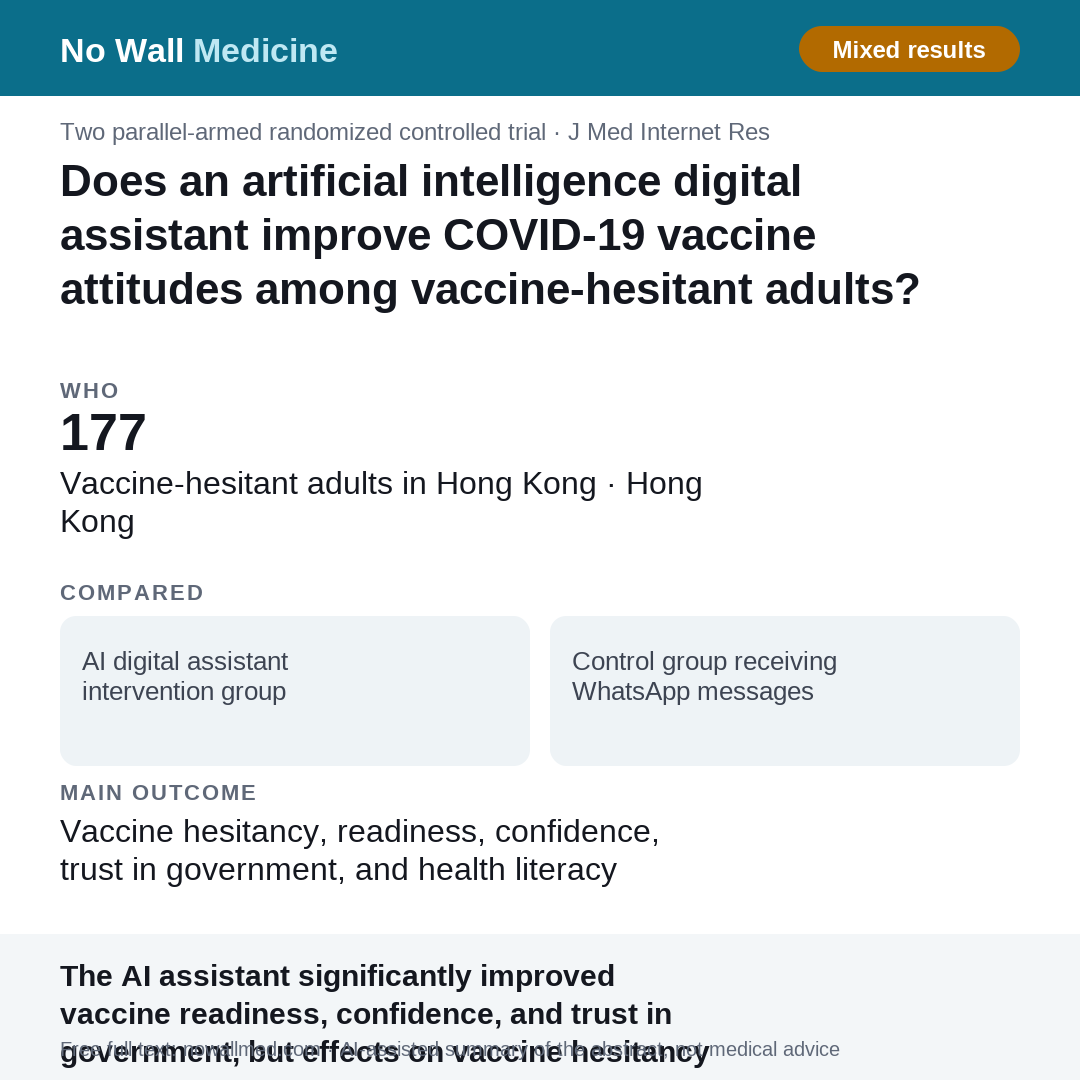
Two parallel-armed randomized controlled trialMixed results
Does an artificial intelligence digital assistant improve COVID-19 vaccine attitudes among vaccine-hesitant adults?
Who
177
Vaccine-hesitant adults in Hong Kong · Hong Kong
Compared
AI digital assistant intervention group
Control group receiving WhatsApp messages
Main outcome
Vaccine hesitancy, readiness, confidence, trust in government, and health literacy
Bottom line: The AI assistant significantly improved vaccine readiness, confidence, and trust in government, but effects on vaccine hesitancy require further confirmation.
Limitation: The effects on vaccine hesitancy require further confirmation.
J Med Internet Res · 2025-08-08Download image
Key points
- 177 Hong Kong adults who were vaccine-hesitant were randomly assigned to 2 groups.
- The intervention group showed significant improvements in vaccine readiness and trust in government.
- Vaccine hesitancy decreases were observed but were not statistically significant.
Why it matters: Educational approaches alone may not effectively cultivate positive vaccine attitudes
Limitation the authors note: The effects on vaccine hesitancy require further confirmation
Discussion prompts
- Would these patients look like yours? Who was left out?
- Is the main outcome one that matters to patients?
- Is the difference large enough to change what you do?
Cite: Li Y, Li M, Yorke J, et al. Effects of a Theory- and Evidence-Based, Motivational Interviewing-Oriented Artificial Intelligence Digital Assistant on Vaccine Attitudes: A Randomized Controlled Trial. J Med Internet Res. 2025. doi:10.2196/72637
Free full text: PubMed Central · Summary and visual abstract: nowallmed.com/a/effects-of-a-theory-and-evidence-based-motivational-interviewing-zjs32c/ (AI-assisted from the abstract; check the paper before relying on it).