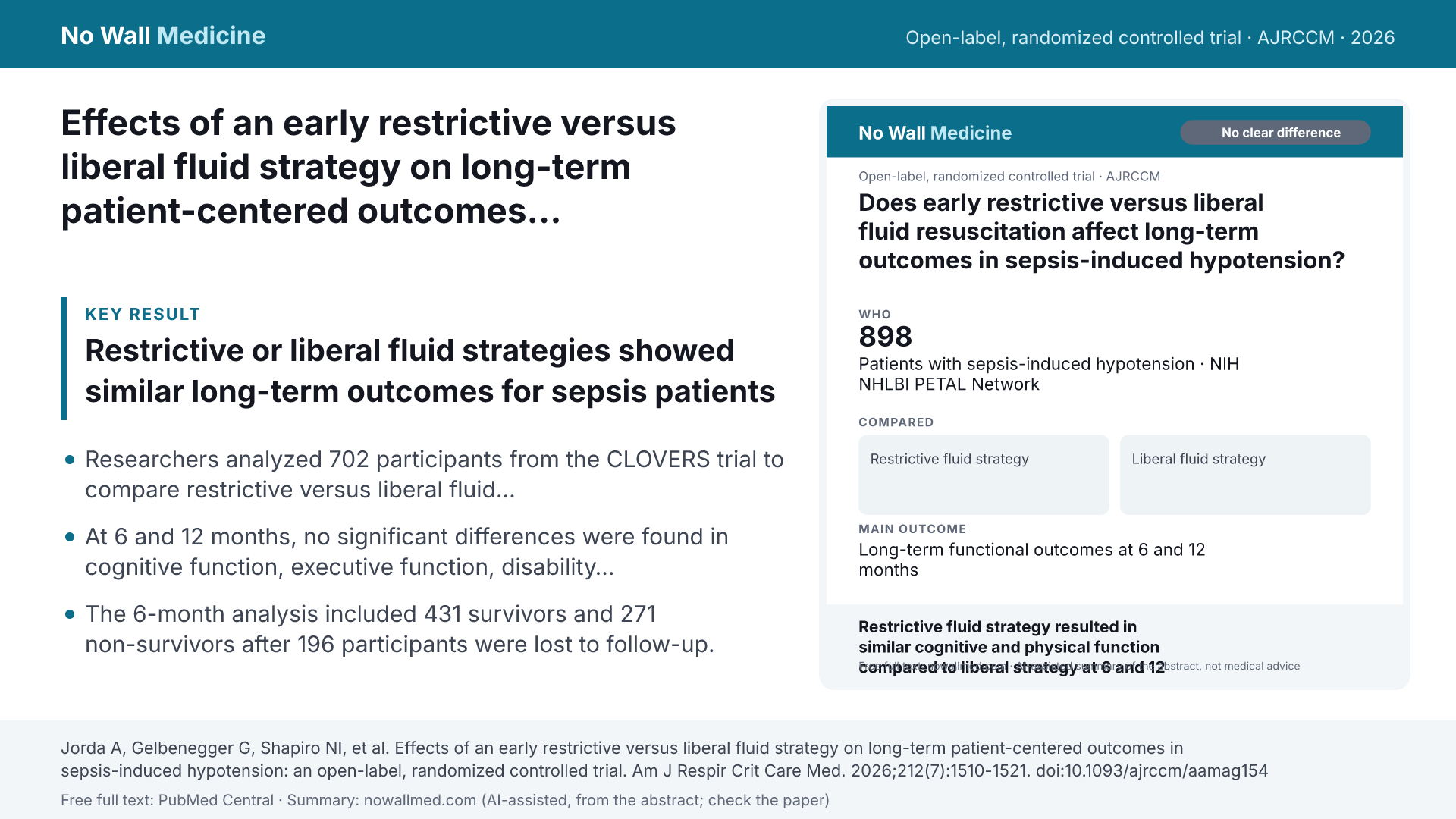
Restrictive or liberal fluid strategies showed similar long-term outcomes for sepsis patients
Effects of an early restrictive versus liberal fluid strategy on long-term patient-centered outcomes in sepsis-induced hypotension: an open-label, randomized controlled trial
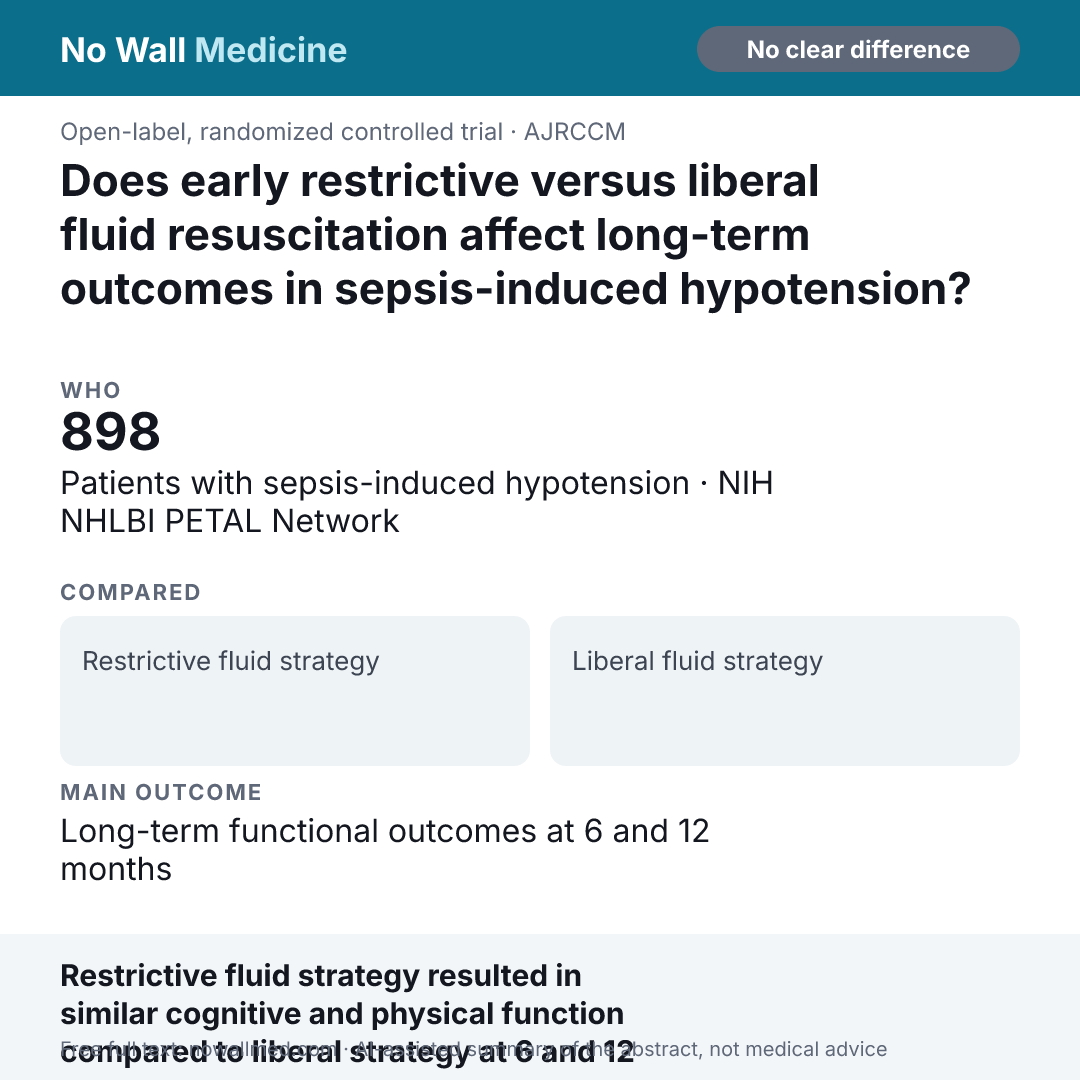
Open-label, randomized controlled trialNo clear difference
Does early restrictive versus liberal fluid resuscitation affect long-term outcomes in sepsis-induced hypotension?
Who
898
Patients with sepsis-induced hypotension · NIH NHLBI PETAL Network
Compared
Restrictive fluid strategy
Liberal fluid strategy
Main outcome
Long-term functional outcomes at 6 and 12 months
Bottom line: Restrictive fluid strategy resulted in similar cognitive and physical function compared to liberal strategy at 6 and 12 months.
AJRCCM · 2026-05-07 · Save PNG
Same trial (NCT03434028)
Papers we list that report this registered trial, oldest first. Read a secondary analysis alongside the main results.
- Related analysis No clear difference
Restrictive fluid strategy did not lower 90-day mortality in sepsis patients NEJM 2023-01 - Secondary analysis Benefit found
Restrictive fluid management was associated with lower death rates in patients with advanced kidney disease Crit Care 2024-07 - Main results No clear difference
This paper AJRCCM 2026-05
Clinical question: Does early restrictive versus liberal fluid resuscitation affect long-term outcomes in sepsis-induced hypotension?
Why it matters: The impact of different fluid resuscitation strategies on the long-term functional outcomes of sepsis survivors was previously unknown.
Key points
- Researchers analyzed 702 participants from the CLOVERS trial to compare restrictive versus liberal fluid resuscitation strategies for sepsis-induced low blood pressure.
- At 6 and 12 months, no significant differences were found in cognitive function, executive function, disability status, mobility, or health-related quality of life.
- The 6-month analysis included 431 survivors and 271 non-survivors after 196 participants were lost to follow-up.
Headline and key points written with AI from the paper’s abstract, with every number checked against it. Read the paper before relying on them.
Was this summary helpful?
Subject terms
Headline, design, result, key points, caveat and citation as plain text.
Cite this article
Jorda A, Gelbenegger G, Shapiro NI, et al. Effects of an early restrictive versus liberal fluid strategy on long-term patient-centered outcomes in sepsis-induced hypotension: an open-label, randomized controlled trial. Am J Respir Crit Care Med. 2026;212(7):1510-1521. doi:10.1093/ajrccm/aamag154
Spotted a mistake? Suggest a correction