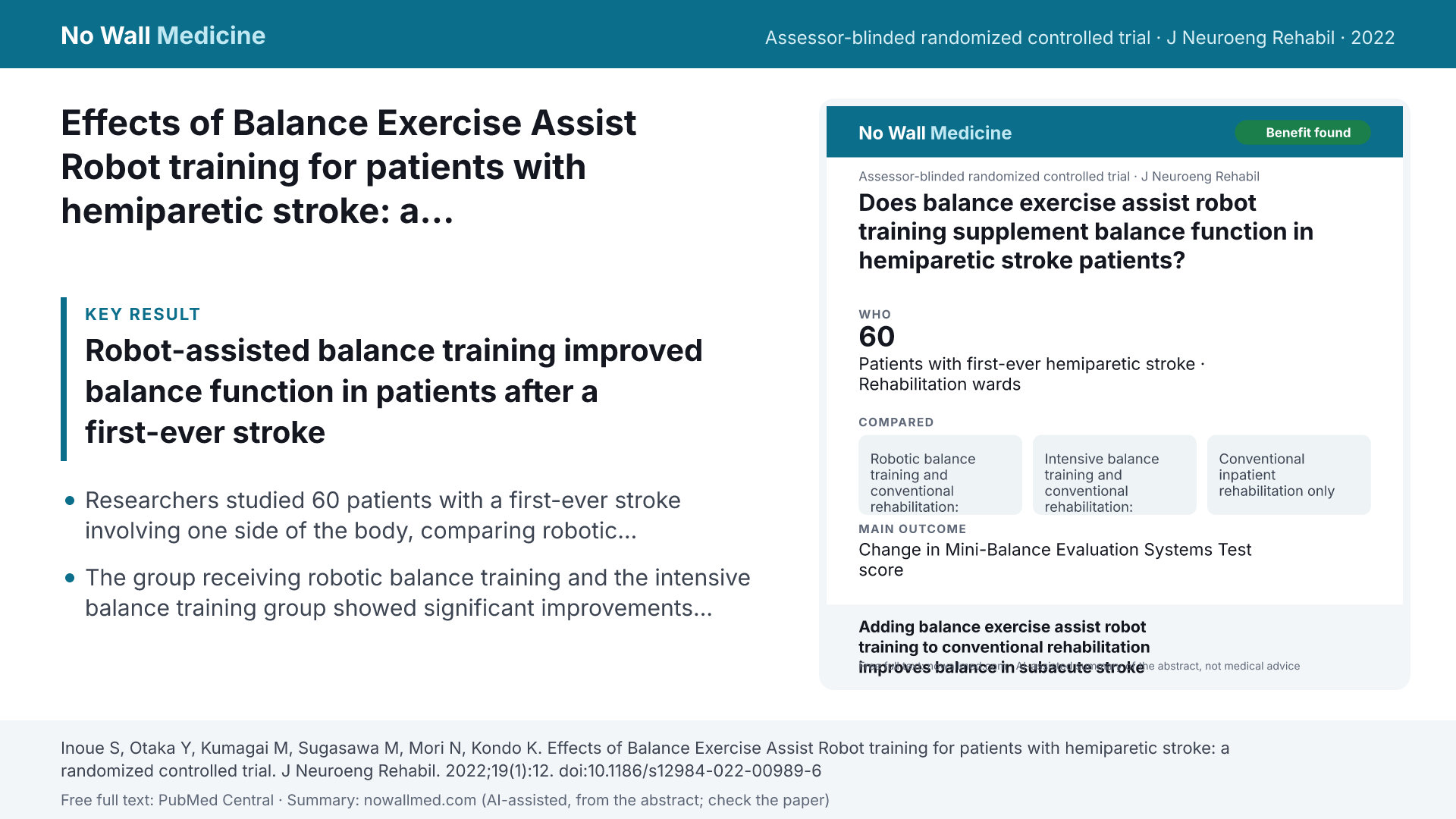
Robot-assisted balance training improved balance function in patients after a first-ever stroke
Effects of Balance Exercise Assist Robot training for patients with hemiparetic stroke: a randomized controlled trial
Assessor-blinded randomized controlled trialBenefit found
Does balance exercise assist robot training supplement balance function in hemiparetic stroke patients?
Who
60
Patients with first-ever hemiparetic stroke · Rehabilitation wards
Compared
Robotic balance training and conventional rehabilitation: Significant improvements
Intensive balance training and conventional rehabilitation: Significant improvements
Conventional inpatient rehabilitation only
Main outcome
Change in Mini-Balance Evaluation Systems Test score
Bottom line: Adding balance exercise assist robot training to conventional rehabilitation improves balance in subacute stroke patients.
J Neuroeng Rehabil · 2022-01-28Download image
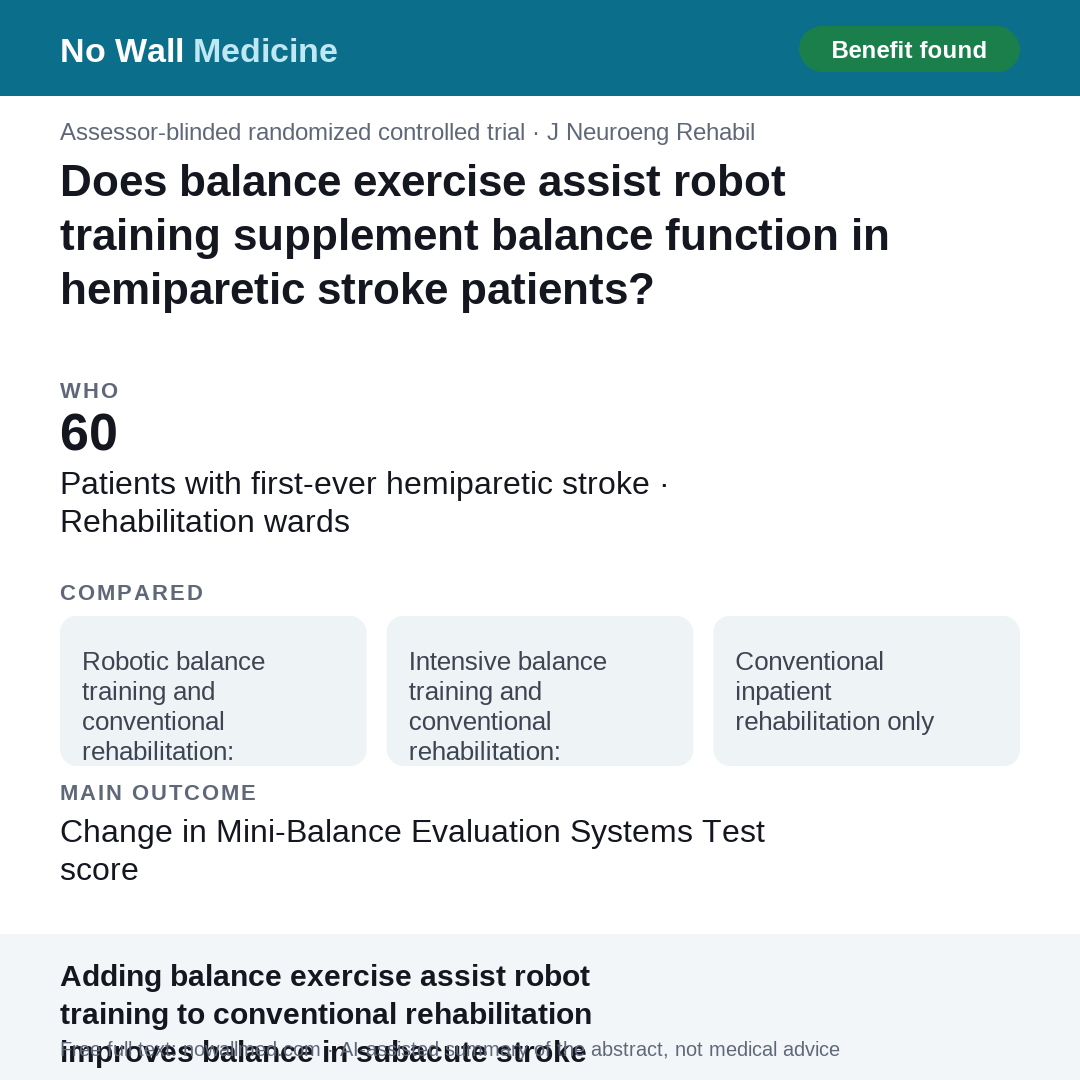
Clinical question: Does balance exercise assist robot training supplement balance function in hemiparetic stroke patients?
Why it matters: It was unclear if adding balance-focused robot training to conventional rehabilitation programs supplements balance function in patients with stroke.
Key points
- Researchers studied 60 patients with a first-ever stroke involving one side of the body, comparing robotic balance training, intensive balance training, and conventional rehabilitation.
- The group receiving robotic balance training and the intensive balance training group showed significant improvements in Mini-Balance Evaluation Systems Test scores compared to the conventional rehabilitation group.
- Significant improvements in balance scores were maintained through the 2-week follow-up period.
Headline and key points written with AI from the paper’s abstract, with every number checked against it. Read the paper before relying on them.
Was this summary helpful?
Subject terms
Cite this article
Inoue S, Otaka Y, Kumagai M, Sugasawa M, Mori N, Kondo K. Effects of Balance Exercise Assist Robot training for patients with hemiparetic stroke: a randomized controlled trial. J Neuroeng Rehabil. 2022. doi:10.1186/s12984-022-00989-6
Spotted a mistake? Suggest a correction