Effects of Combined and Alone Transcranial Motor Cortex Stimulation and Mirror Therapy in Phantom Limb Pain: A Randomized Factorial Trial
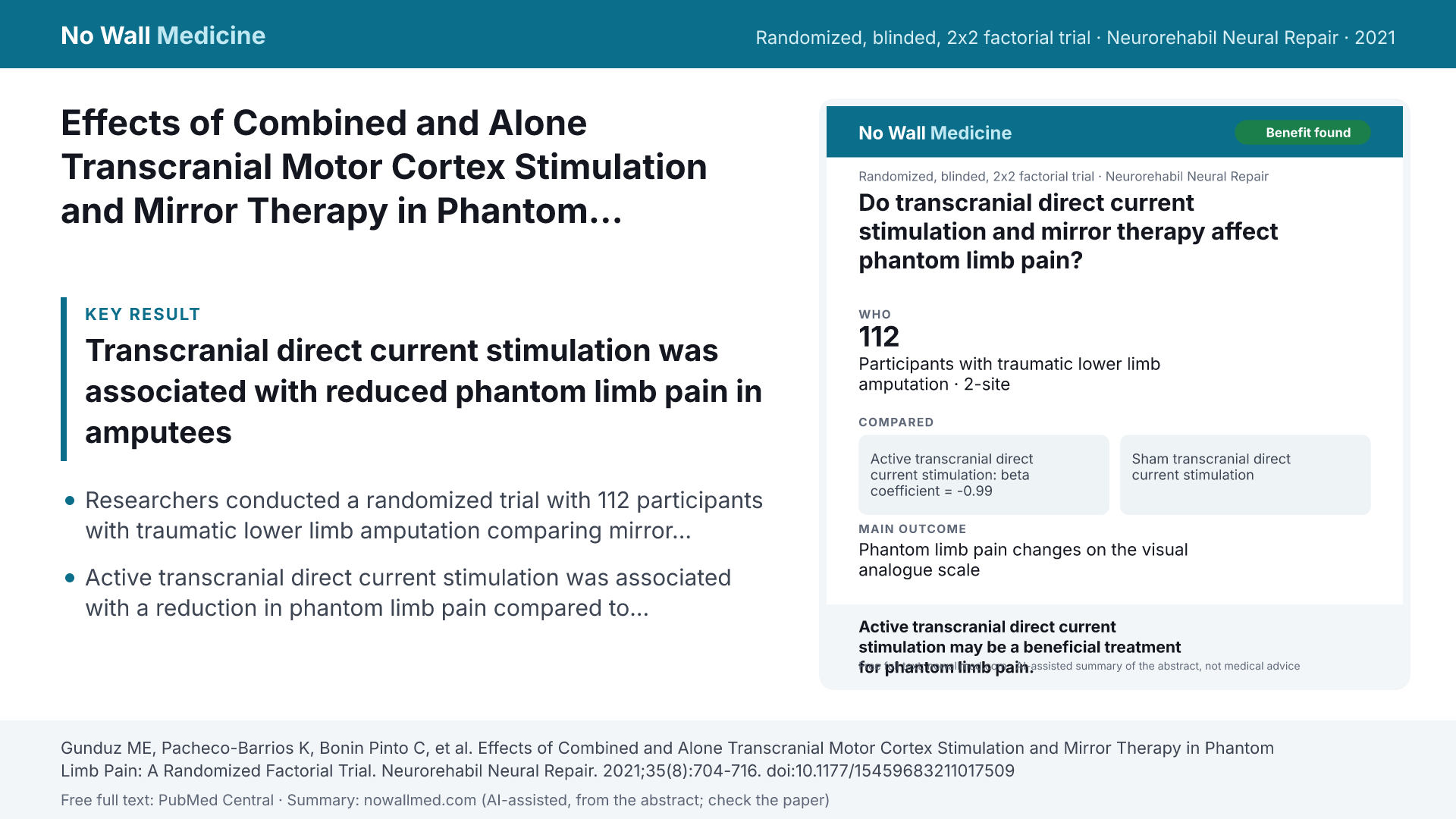
Key result: Transcranial direct current stimulation was associated with reduced phantom limb pain in amputees
Randomized, blinded, 2x2 factorial trialBenefit found
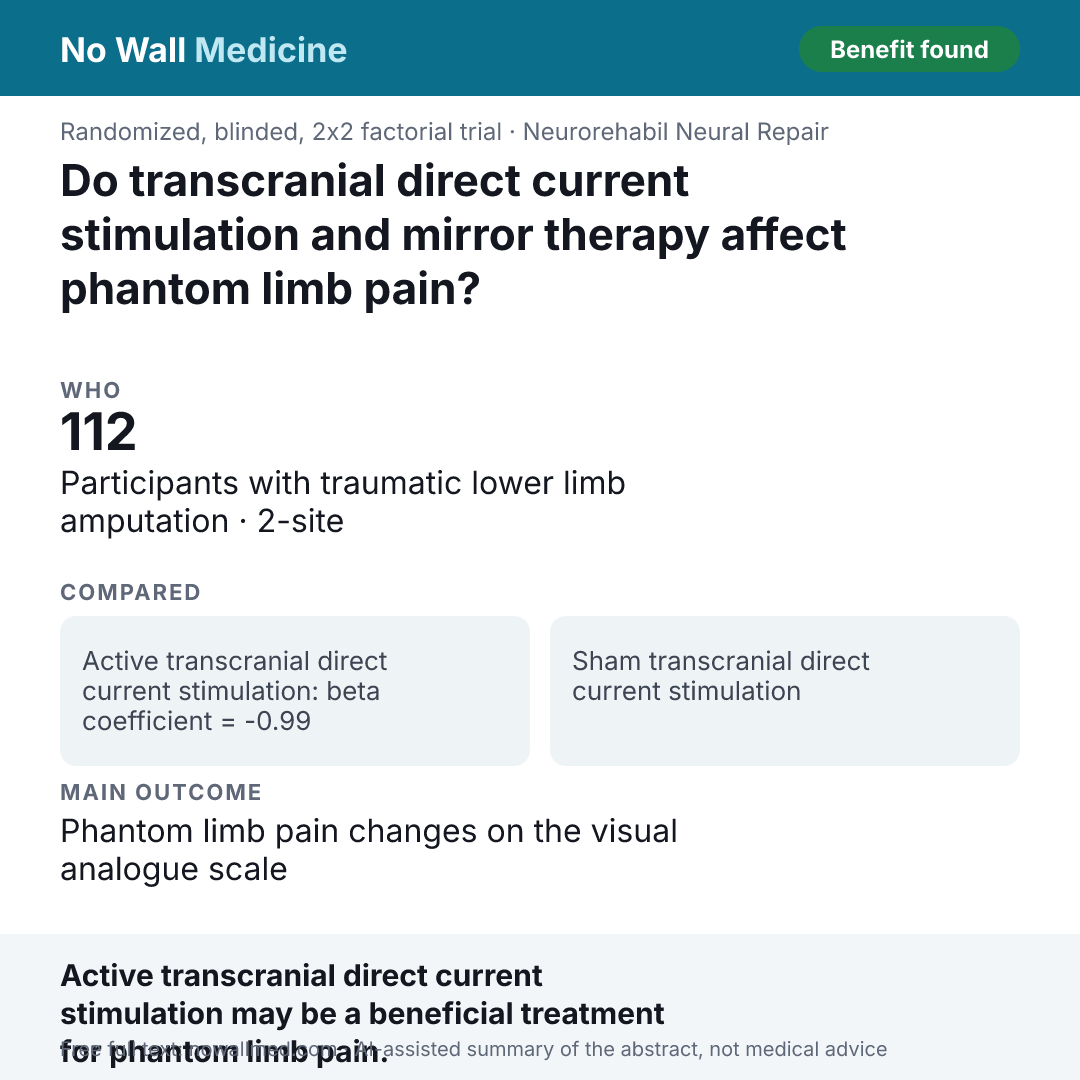
Do transcranial direct current stimulation and mirror therapy affect phantom limb pain?
Who
112
Participants with traumatic lower limb amputation · 2-site
Compared
Active transcranial direct current stimulation: beta coefficient = -0.99
Sham transcranial direct current stimulation
Main outcome
Phantom limb pain changes on the visual analogue scale
Result: overall effect size 1.19 (95% confidence interval: 0.90, 1.47)
Bottom line: Active transcranial direct current stimulation may be a beneficial treatment for phantom limb pain.
Neurorehabil Neural Repair · 2021-06-01 · Save PNG
Key points
- Researchers conducted a randomized trial with 112 participants with traumatic lower limb amputation comparing mirror therapy and transcranial direct current stimulation (a non-invasive brain stimulation technique).
- Active transcranial direct current stimulation was associated with a reduction in phantom limb pain compared to sham stimulation, with an overall effect size of 1.19.
- The transcranial direct current stimulation was associated with increased intracortical inhibition and facilitation, while mirror therapy induced no changes in motor cortex plasticity.
Discussion prompts
- Would these patients look like yours? Who was left out?
- Is the main outcome one that matters to patients?
- Is the difference large enough to change what you do?
Cite: Gunduz ME, Pacheco-Barrios K, Bonin Pinto C, et al. Effects of Combined and Alone Transcranial Motor Cortex Stimulation and Mirror Therapy in Phantom Limb Pain: A Randomized Factorial Trial. Neurorehabil Neural Repair. 2021;35(8):704-716. doi:10.1177/15459683211017509
Free full text: PubMed Central · Summary and visual abstract: nowallmed.com/a/effects-of-combined-and-alone-transcranial-motor-cortex-stimulation-1boi7lc/ (AI-assisted from the abstract; check the paper before relying on it).