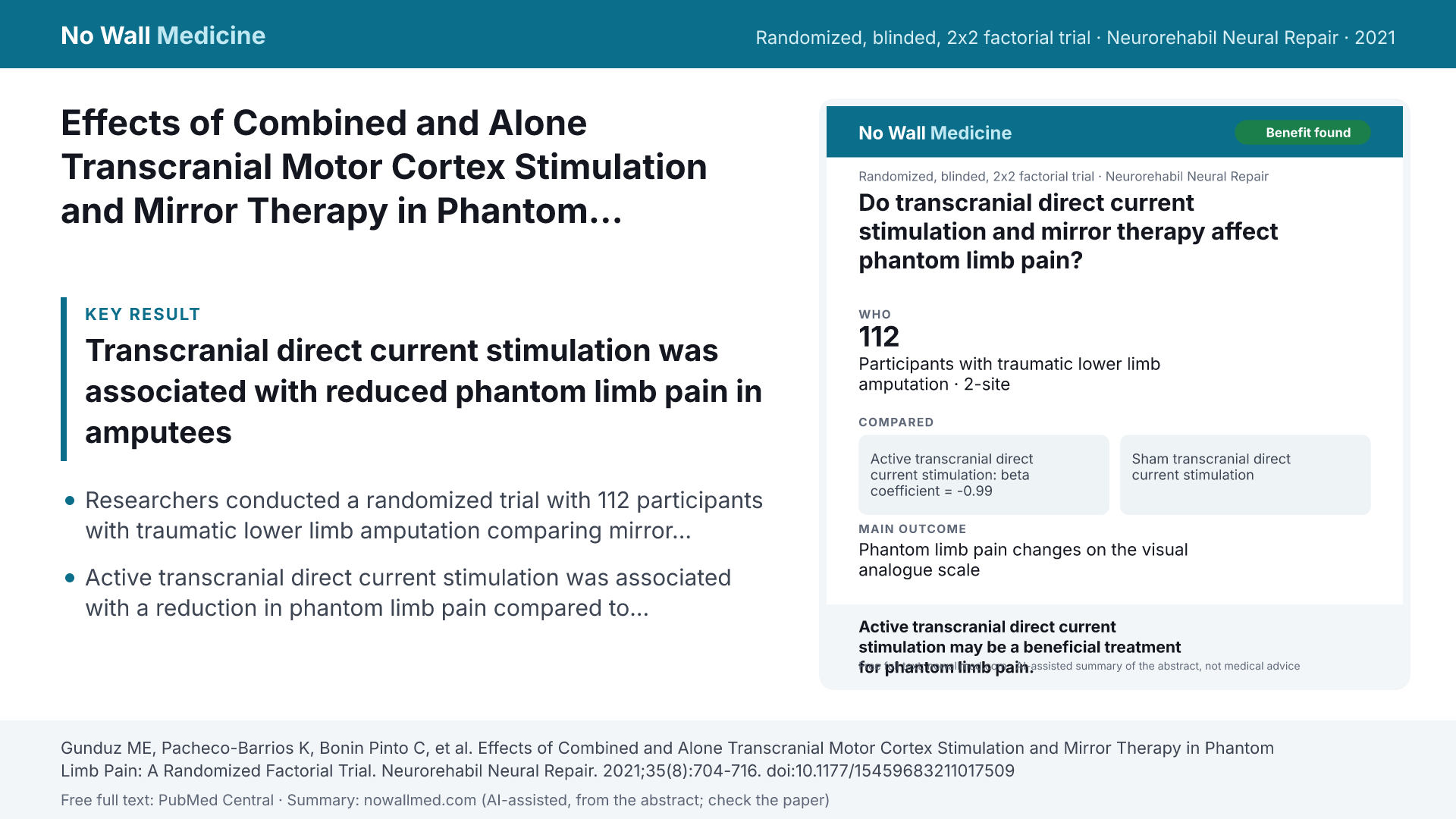
Transcranial direct current stimulation was associated with reduced phantom limb pain in amputees
Effects of Combined and Alone Transcranial Motor Cortex Stimulation and Mirror Therapy in Phantom Limb Pain: A Randomized Factorial Trial
Randomized, blinded, 2x2 factorial trialBenefit found
Do transcranial direct current stimulation and mirror therapy affect phantom limb pain?
Who
112
Participants with traumatic lower limb amputation · 2-site
Compared
Active transcranial direct current stimulation: beta coefficient = -0.99
Sham transcranial direct current stimulation
Main outcome
Phantom limb pain changes on the visual analogue scale
Result: overall effect size 1.19 (95% confidence interval: 0.90, 1.47)
Bottom line: Active transcranial direct current stimulation may be a beneficial treatment for phantom limb pain.
Neurorehabil Neural Repair · 2021-06-01Download image
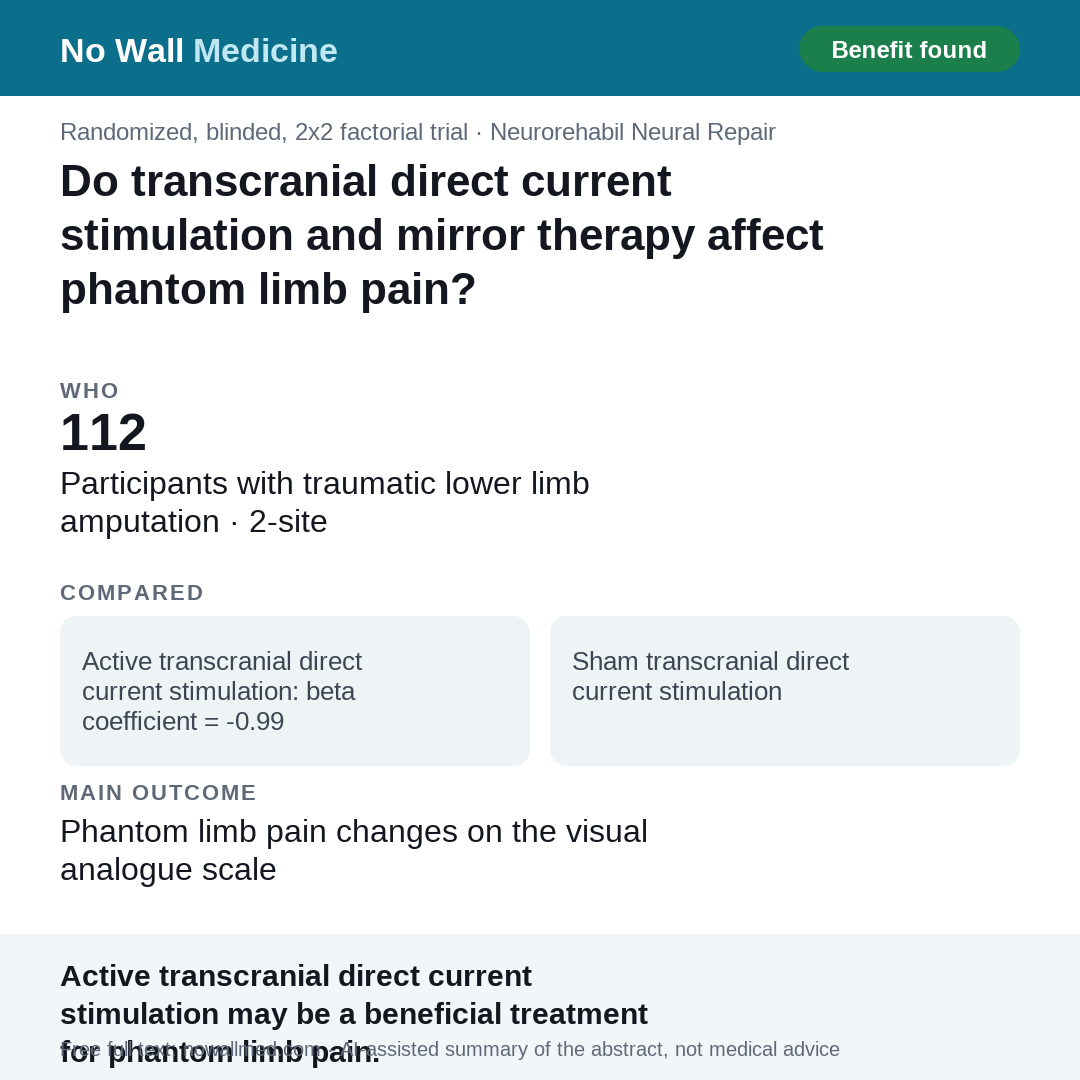
Clinical question: Do transcranial direct current stimulation and mirror therapy affect phantom limb pain?
Why it matters: It is unknown if combining transcranial direct current stimulation with mirror therapy provides better results for phantom limb pain than using either treatment alone.
Key points
- Researchers conducted a randomized trial with 112 participants with traumatic lower limb amputation comparing mirror therapy and transcranial direct current stimulation (a non-invasive brain stimulation technique).
- Active transcranial direct current stimulation was associated with a reduction in phantom limb pain compared to sham stimulation, with an overall effect size of 1.19.
- The transcranial direct current stimulation was associated with increased intracortical inhibition and facilitation, while mirror therapy induced no changes in motor cortex plasticity.
Headline and key points written with AI from the paper’s abstract, with every number checked against it. Read the paper before relying on them.
Was this summary helpful?
Subject terms
Cite this article
Gunduz ME, Pacheco-Barrios K, Bonin Pinto C, et al. Effects of Combined and Alone Transcranial Motor Cortex Stimulation and Mirror Therapy in Phantom Limb Pain: A Randomized Factorial Trial. Neurorehabil Neural Repair. 2021. doi:10.1177/15459683211017509
Spotted a mistake? Suggest a correction