Single long stimulation sessions of transcranial direct current stimulation affect brain plasticity for 6 hours
Lasting effects of transcranial direct current stimulation on the inducibility of synaptic plasticity by paired-associative stimulation in humans
Randomized trialBenefit found
How do different transcranial direct current stimulation paradigms influence long term potentiation-like plasticity?
Who
36
36 healthy participants
Compared
Anode on primary motor cortex: significantly increased motor evoked potentials amplitudes
Other stimulation protocols
Main outcome
Amplitude changes of motor evoked potentials following paired associative stimulation
Bottom line: Anodal transcranial direct current stimulation significantly increases motor evoked potential amplitudes six hours after stimulation.
J Neuroeng Rehabil · 2024-09-18Download image
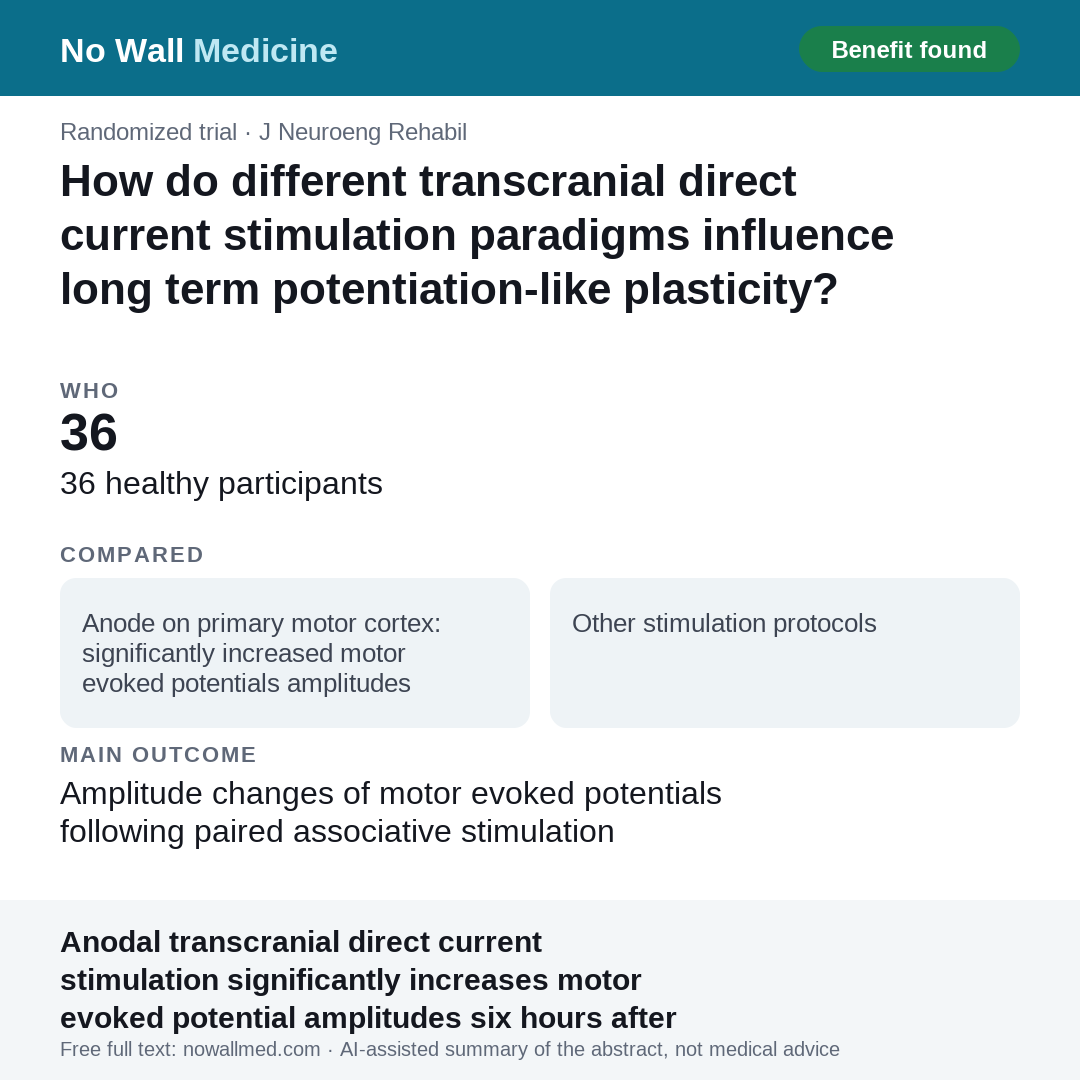
Clinical question: How do different transcranial direct current stimulation paradigms influence long term potentiation-like plasticity?
Why it matters: It is unknown how different stimulation durations, repetition frequencies, or changing polarities influence long-term potentiation-like plasticity in the human motor cortex.
Key points
- Researchers studied 36 healthy participants randomized into three groups to compare different transcranial direct current stimulation protocols.
- Stimulation with the anode on the primary motor cortex significantly increased motor evoked potential amplitudes 6 h after stimulation.
- The duration of a single stimulation block was more important for efficacy than using repetitive stimulation protocols.
Headline and key points written with AI from the paper’s abstract, with every number checked against it. Read the paper before relying on them.
Was this summary helpful?
Subject terms
Cite this article
Vestring S, Wolf E, Dinkelacker J, Frase S, Hessling-Zeinen C, Insan S. Lasting effects of transcranial direct current stimulation on the inducibility of synaptic plasticity by paired-associative stimulation in humans. J Neuroeng Rehabil. 2024. doi:10.1186/s12984-024-01459-x
Spotted a mistake? Suggest a correction
Top studies every Monday
The week’s key trials and guidelines in your specialties, plus any topics you follow. By email, free.
Get the weekly digest