Effects of transcranial magnetic stimulation in modulating cortical excitability in patients with stroke: a systematic review and meta-analysis
Systematic review and meta-analysisBenefit found
How do repetitive transcranial magnetic stimulation and theta burst stimulation modulate cortical excitability after stroke?
Who
Patients with stroke
Compared
Low frequency repetitive transcranial magnetic stimulation
High frequency repetitive transcranial magnetic stimulation
Intermittent theta burst stimulation
Continuous theta burst stimulation: inconclusive
Main outcome
Cortical excitability measures
Bottom line: Most repetitive transcranial magnetic stimulation and theta burst stimulation protocols effectively modulate cortical excitability in stroke patients.
Limitation: The effects of continuous theta burst stimulation remained inconclusive due to limited studies.
J Neuroeng Rehabil · 2022-02-22Download image
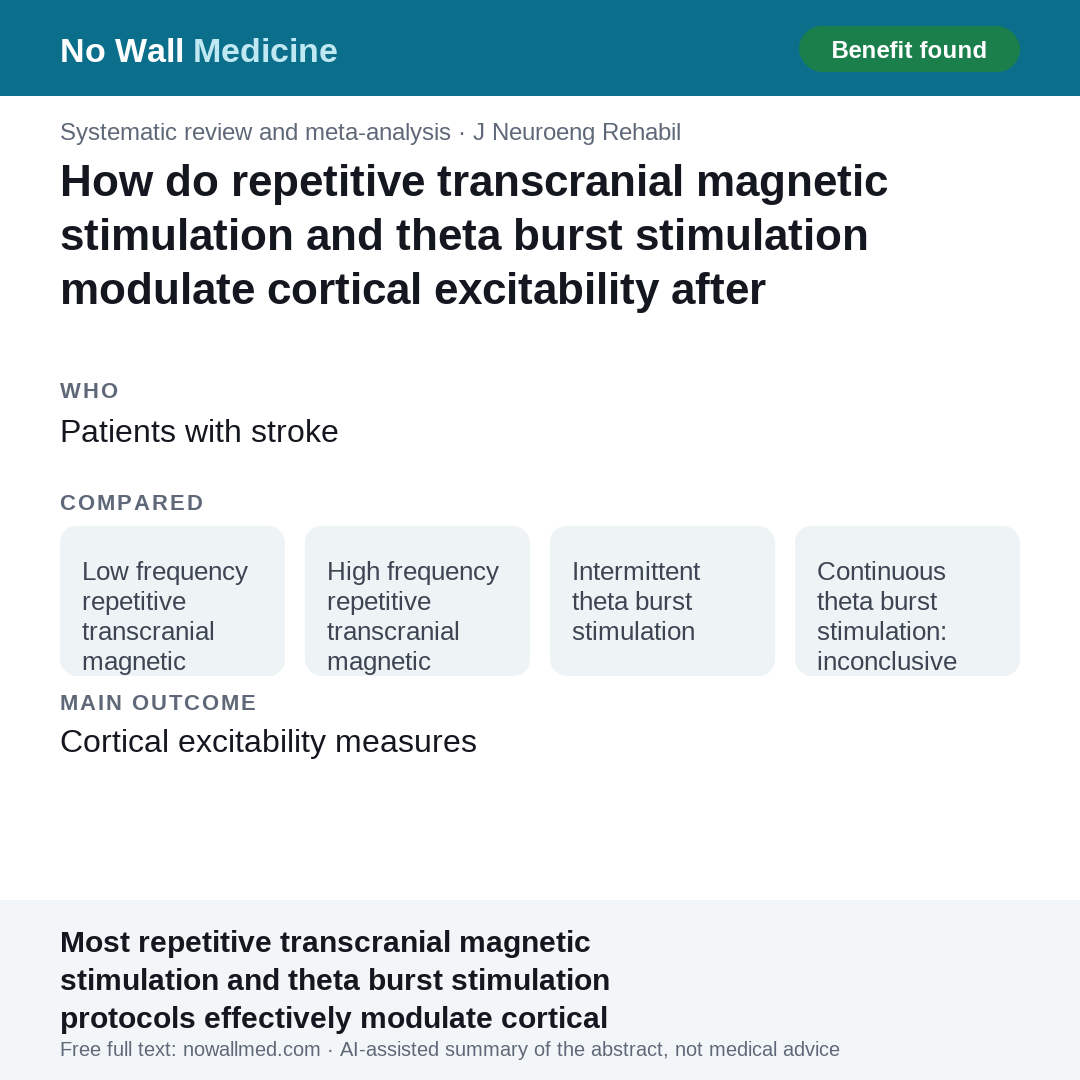
Clinical question: How do repetitive transcranial magnetic stimulation and theta burst stimulation modulate cortical excitability after stroke?
Abstract
Background
Transcranial magnetic stimulation (TMS) has attracted plenty of attention as it has been proved to be effective in facilitating motor recovery in patients with stroke. The aim of this study was to systematically review the effects of repetitive TMS (rTMS) and theta burst stimulation (TBS) protocols in modulating cortical excitability after stroke. Methods
A literature search was carried out using PubMed, Medline, EMBASE, CINAHL, and PEDro, to identify studies that investigated the effects of four rTMS protocols-low and high frequency rTMS, intermittent and continuous TBS, on TMS measures of cortical excitability in stroke. A random-effects model was used for all meta-analyses. Results
Sixty-one studies were included in the current review. Low frequency rTMS was effective in decreasing individuals' resting motor threshold and increasing the motor-evoked potential of the non-stimulated M1 (affected M1), while opposite effects occurred in the stimulated M1 (unaffected M1). High frequency rTMS enhanced the cortical excitability of the affected M1 alone. Intermittent TBS also showed superior effects in rebalancing bilateral excitability through increasing and decreasing excitability within the affected and unaffected M1, respectively. Due to the limited number of studies found, the effects of continuous TBS remained inconclusive. Motor impairment was significantly correlated with various forms of TMS measures. Conclusions
Except for continuous TBS, it is evident that these protocols are effective in modulating cortical excitability in stroke. Current evidence does support the effects of inhibitory stimulation in enhancing the cortical excitability of the affected M1.
Subject terms
Cite this article
Bai Z, Zhang J, Fong KNK. Effects of transcranial magnetic stimulation in modulating cortical excitability in patients with stroke: a systematic review and meta-analysis. J Neuroeng Rehabil. 2022. doi:10.1186/s12984-022-00999-4
Spotted a mistake? Suggest a correction
Top studies every Monday
The week’s key trials and guidelines in your specialties, plus any topics you follow. By email, free.
Get the weekly digest