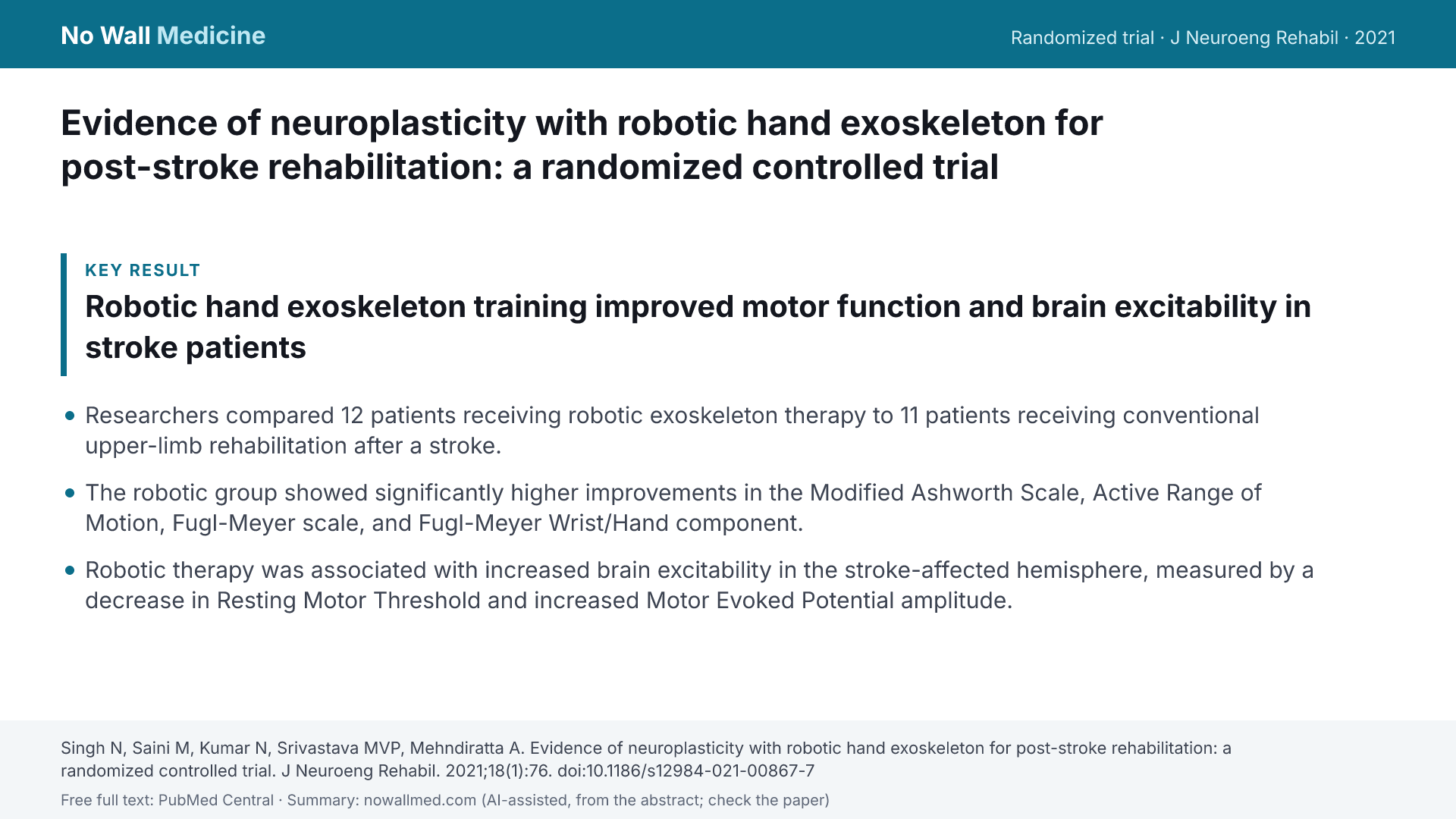
Robotic hand exoskeleton training improved motor function and brain excitability in stroke patients
Evidence of neuroplasticity with robotic hand exoskeleton for post-stroke rehabilitation: a randomized controlled trial
Why it matters: It was unknown if a novel electromechanical robotic exoskeleton for the wrist and finger joints provides better functional rehabilitation or neurophysiological changes than conventional therapy.
Key points
- Researchers compared 12 patients receiving robotic exoskeleton therapy to 11 patients receiving conventional upper-limb rehabilitation after a stroke.
- The robotic group showed significantly higher improvements in the Modified Ashworth Scale, Active Range of Motion, Fugl-Meyer scale, and Fugl-Meyer Wrist/Hand component.
- Robotic therapy was associated with increased brain excitability in the stroke-affected hemisphere, measured by a decrease in Resting Motor Threshold and increased Motor Evoked Potential amplitude.
Headline and key points written with AI from the paper’s abstract, with every number checked against it. Read the paper before relying on them.
Was this summary helpful?
Subject terms
Cite this article
Singh N, Saini M, Kumar N, Srivastava MVP, Mehndiratta A. Evidence of neuroplasticity with robotic hand exoskeleton for post-stroke rehabilitation: a randomized controlled trial. J Neuroeng Rehabil. 2021. doi:10.1186/s12984-021-00867-7
Spotted a mistake? Suggest a correction