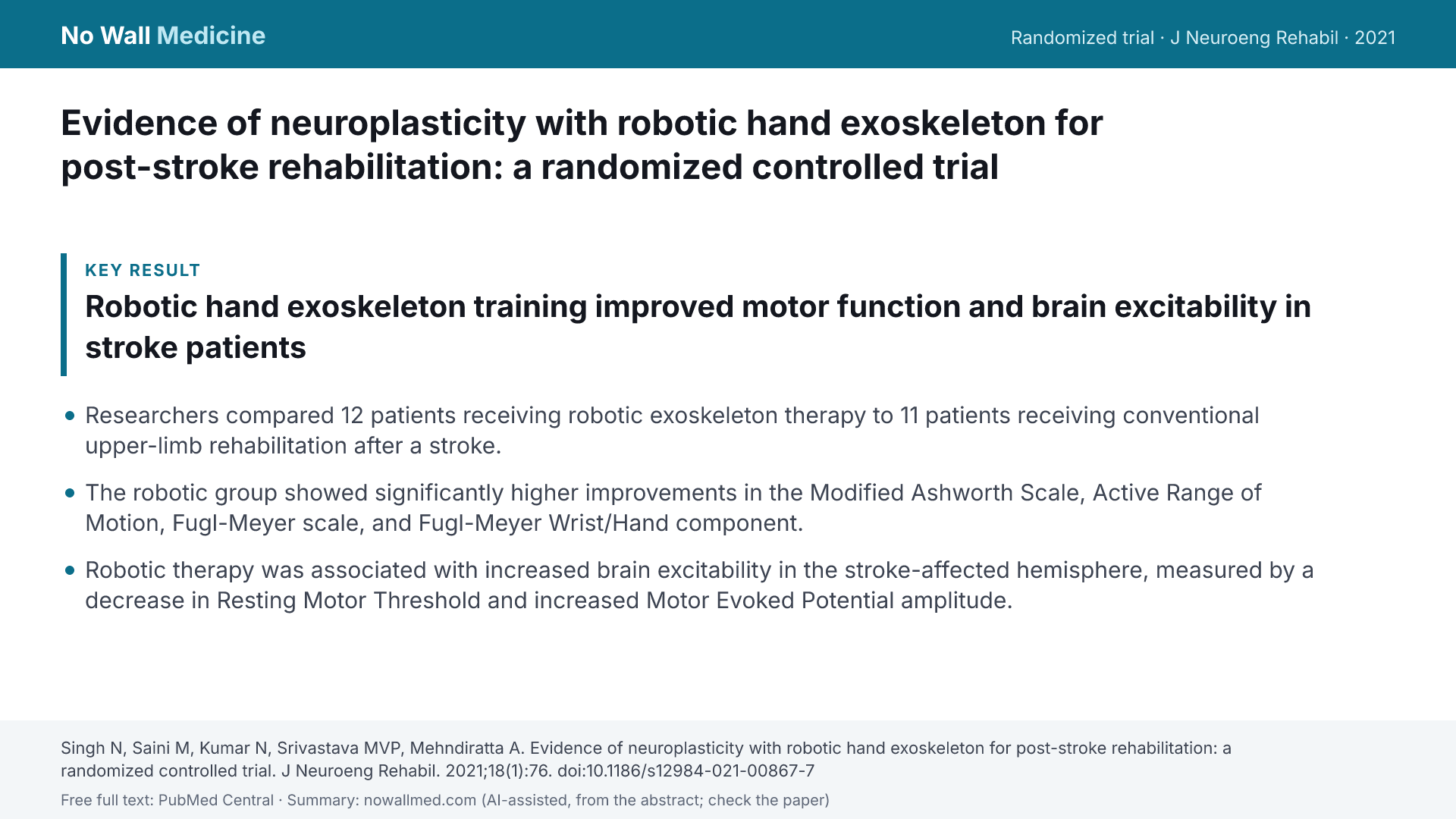
Evidence of neuroplasticity with robotic hand exoskeleton for post-stroke rehabilitation: a randomized controlled trial
Key result: Robotic hand exoskeleton training improved motor function and brain excitability in stroke patients
Key points
- Researchers compared 12 patients receiving robotic exoskeleton therapy to 11 patients receiving conventional upper-limb rehabilitation after a stroke.
- The robotic group showed significantly higher improvements in the Modified Ashworth Scale, Active Range of Motion, Fugl-Meyer scale, and Fugl-Meyer Wrist/Hand component.
- Robotic therapy was associated with increased brain excitability in the stroke-affected hemisphere, measured by a decrease in Resting Motor Threshold and increased Motor Evoked Potential amplitude.
Discussion prompts
- Would these patients look like yours? Who was left out?
- Is the main outcome one that matters to patients?
- Is the difference large enough to change what you do?
Cite: Singh N, Saini M, Kumar N, Srivastava MVP, Mehndiratta A. Evidence of neuroplasticity with robotic hand exoskeleton for post-stroke rehabilitation: a randomized controlled trial. J Neuroeng Rehabil. 2021;18(1):76. doi:10.1186/s12984-021-00867-7
Free full text: PubMed Central · Summary and visual abstract: nowallmed.com/a/evidence-of-neuroplasticity-with-robotic-hand-exoskeleton-for-post-1mlbwlo/ (AI-assisted from the abstract; check the paper before relying on it).