Low-frequency magnetic stimulation intensity affects brain excitability and inhibition in older healthy adults
Intensity-Dependent Effects of Low-Frequency Subthreshold rTMS on Primary Motor Cortex Excitability and Interhemispheric Inhibition in Elderly Participants: A Randomized Trial
Randomized, double-blind crossover studyNo clear difference
What is the dose-response of low-frequency repetitive transcranial magnetic stimulation on motor cortex?
Who
20
20 right-handed older healthy participants
Compared
90% of motor threshold: increased MEPMAX in the stimulated motor cortex
80% of motor threshold: decreased interhemispheric inhibition
Sham stimulation
Main outcome
motor cortex excitability and interhemispheric inhibition
Bottom line: Low-frequency subthreshold stimulation effects were small and not significantly different from sham stimulation.
Neurorehabil Neural Repair · 2024-10-27Download image
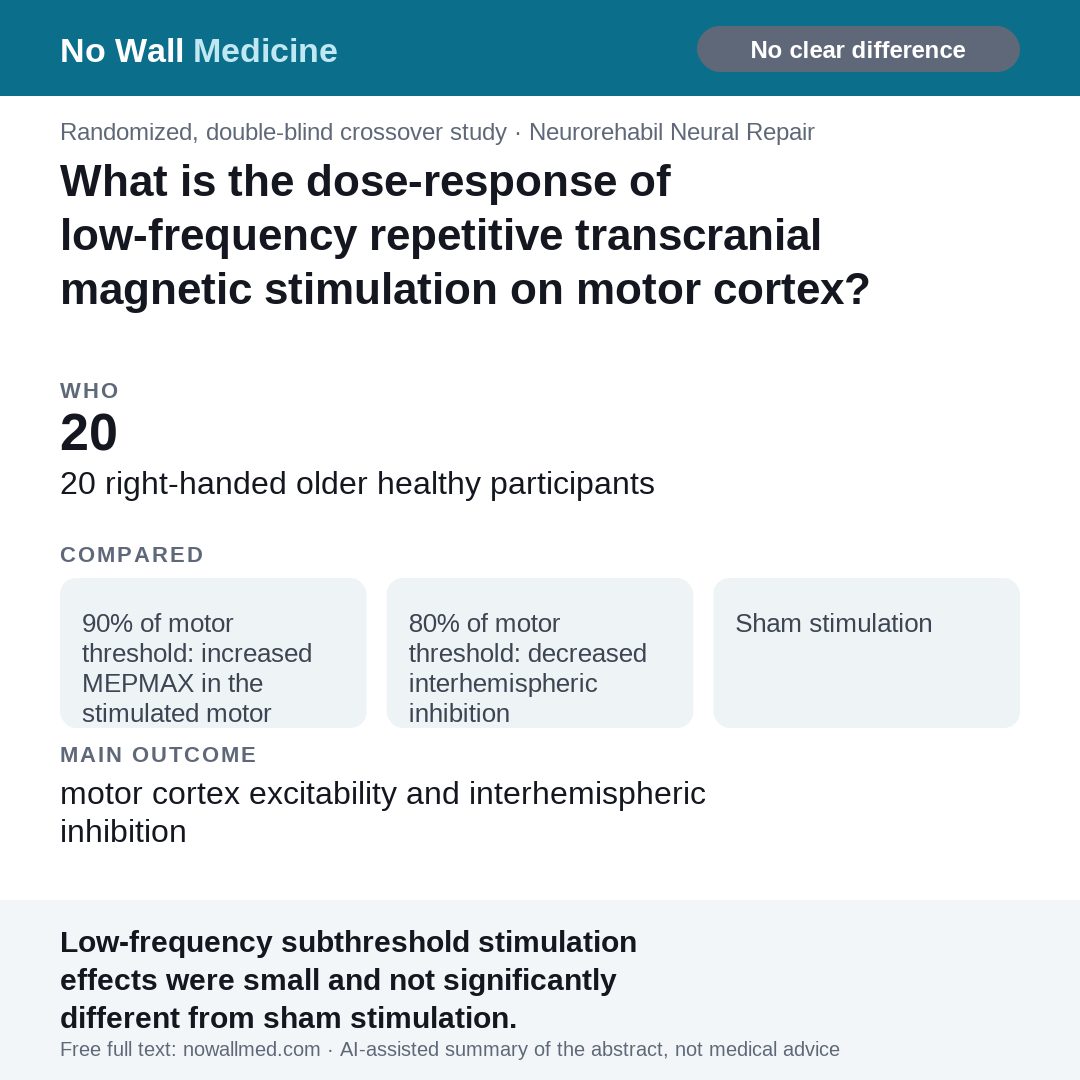
Clinical question: What is the dose-response of low-frequency repetitive transcranial magnetic stimulation on motor cortex?
Why it matters: It was unknown how different intensities of low-frequency repetitive transcranial magnetic stimulation affect the neurophysiology of the primary motor cortex in older adults.
Key points
- Researchers conducted a randomized crossover trial with 20 right-handed older healthy participants comparing 1 Hz repetitive transcranial magnetic stimulation at 80% and 90% of motor threshold to sham stimulation.
- At 90% intensity, maximum motor evoked potential increased in the stimulated motor cortex and the slope increased in the non-stimulated motor cortex.
- The 90% intensity increased while the 80% intensity decreased interhemispheric inhibition, though these changes were not different when compared to sham stimulation.
Headline and key points written with AI from the paper’s abstract, with every number checked against it. Read the paper before relying on them.
Topics
Cite this article
Wischnewski M, Edwards L, Revill KP, Drake D, Hobbs G, Buetefisch CM. Intensity-Dependent Effects of Low-Frequency Subthreshold rTMS on Primary Motor Cortex Excitability and Interhemispheric Inhibition in Elderly Participants: A Randomized Trial. Neurorehabil Neural Repair. 2024. doi:10.1177/15459683241292615
Spotted a mistake? Suggest a correction
Top studies every Monday
The week’s key trials and guidelines in your specialties, by email. Free.
Get the weekly digest