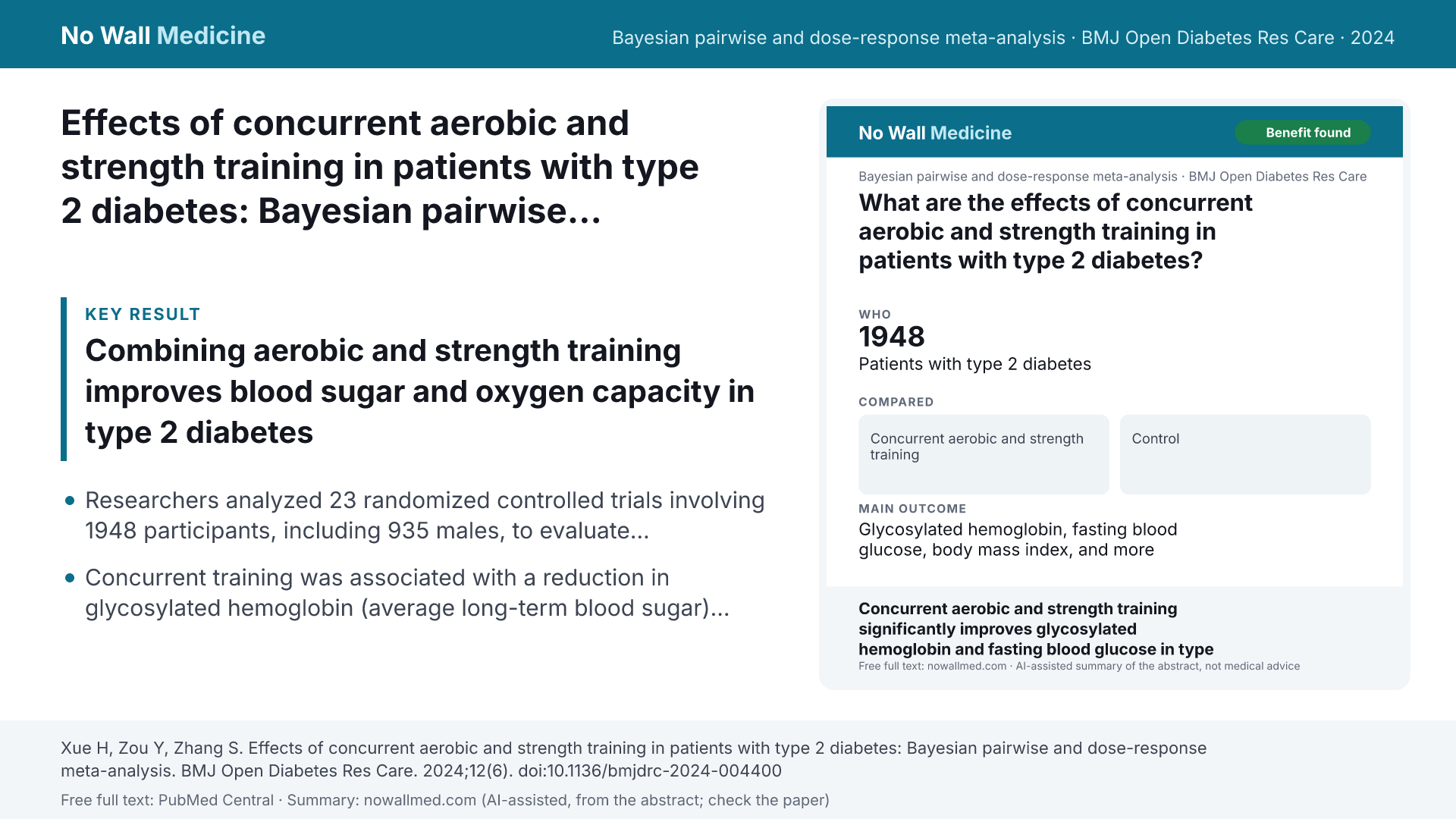
Combining aerobic and strength training improves blood sugar and oxygen capacity in type 2 diabetes
Effects of concurrent aerobic and strength training in patients with type 2 diabetes: Bayesian pairwise and dose-response meta-analysis
Bayesian pairwise and dose-response meta-analysisBenefit found
What are the effects of concurrent aerobic and strength training in patients with type 2 diabetes?
Who
1948
Patients with type 2 diabetes
Compared
Concurrent aerobic and strength training
Control
Main outcome
Glycosylated hemoglobin, fasting blood glucose, body mass index, and more
Result: MD=-0.48%, 95% CrI: -0.55 to -0.40 for HbA1c
Bottom line: Concurrent aerobic and strength training significantly improves glycosylated hemoglobin and fasting blood glucose in type 2 diabetes patients.
BMJ Open Diabetes Res Care · 2024-11-28 · Save PNG
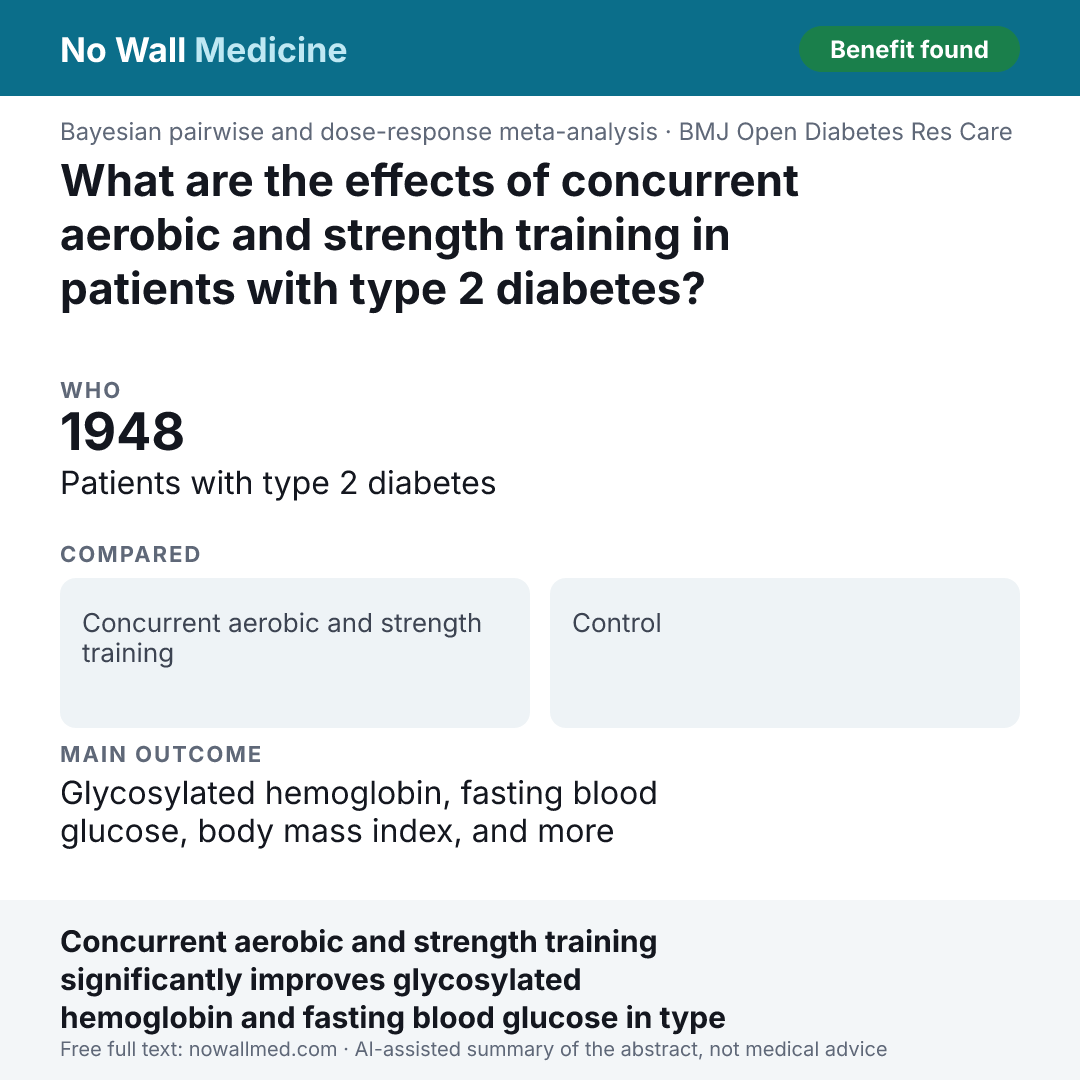
Clinical question: What are the effects of concurrent aerobic and strength training in patients with type 2 diabetes?
Key points
- Researchers analyzed 23 randomized controlled trials involving 1948 participants, including 935 males, to evaluate concurrent aerobic and strength training.
- Concurrent training was associated with a reduction in glycosylated hemoglobin (average long-term blood sugar) by -0.48% and fasting blood glucose by -0.48 mmol/L.
- An optimal training dose for glycosylated hemoglobin was identified as 1030 METs-min/week, which is a measure of metabolic energy expenditure.
Headline and key points written with AI from the paper’s abstract, with every number checked against it. Read the paper before relying on them.
Was this summary helpful?
Abstract
This study aimed to investigate the effects of concurrent aerobic and strength training (CT) in patients with type 2 diabetes and determine the most effective dose of CT. From the inception of the databases to March 2024, we conducted a systematic search of four electronic databases (PubMed, Embase, Web of Science, and Cochrane Library) to identify randomized controlled trials (RCTs) on CT intervention in patients with type 2 diabetes. Two independent authors assessed the risk of bias of the study using the Cochrane Risk of Bias Assessment Tools. Results analyzed included glycosylated hemoglobin (HbA1c), fasting blood glucose (FBG), body mass index, body fat percentage, blood pressure, and VO2max. Pairwise and dose-response meta-analyses using Bayesian hierarchical random-effects modeling were performed to analyze the effects of CT in patients with type 2 diabetes. From the inception of the databases to March 2024, we conducted a systematic search of four electronic databases (PubMed, Embase, Web of Science, and Cochrane Library) to identify randomized controlled trials (RCTs) on CT intervention in patients with type 2 diabetes. Two independent authors assessed the risk of bias of the study using the Cochrane Risk of Bias Assessment Tools. Results analyzed included glycosylated hemoglobin (HbA1c), fasting blood glucose (FBG), body mass index, body fat percentage, blood pressure, and VO2max. Pairwise and dose-response meta-analyses using Bayesian hierarchical random-effects modeling were performed to analyze the effects of CT in patients with type 2 diabetes. A total of 1948 participants (935 males) were included in 23 RCTs. The male/female ratio of participants was 52/48; the mean age range was 50-65 years. The results show that CT significantly reduced HbA1c levels (MD=-0.48%, 95% CrI: -0.55 to -0.40), with some heterogeneity among different levels (SD=0.31, 95% CrI: 0.17 to 0.51), and the model converged well. Similarly, FBG levels were also significantly improved (MD=-0.48 mmol/L, 95% CrI: -0.55 to -0.40), with greater heterogeneity (SD=17.73, 95% CrI: 11.23 to 28.09). Additionally, we found a non-linear dose-response relationship between CT and HbA1c levels, with an optimal dose of 1030 METs-min/week (MD=-0.47%, 95% CrI: -0.68 to -0.26, SE=0.11). CT significantly improves several health indicators in patients with type 2 diabetes. A non-linear dose-response relationship was observed between the training dose of CT and HbA1c, and it is recommended that 270 min of moderate-intensity CT or 160 min of vigorous-intensity CT be performed weekly.PROSPERO registration number: CRD42024547119.Keywords: meta-analysis; concurrent aerobic and strength training.
Abstract reproduced under the article’s CC BY NC licence.
Subject terms
Headline, design, result, key points, caveat and citation as plain text.
Cite this article
Xue H, Zou Y, Zhang S. Effects of concurrent aerobic and strength training in patients with type 2 diabetes: Bayesian pairwise and dose-response meta-analysis. BMJ Open Diabetes Res Care. 2024;12(6). doi:10.1136/bmjdrc-2024-004400
Spotted a mistake? Suggest a correction