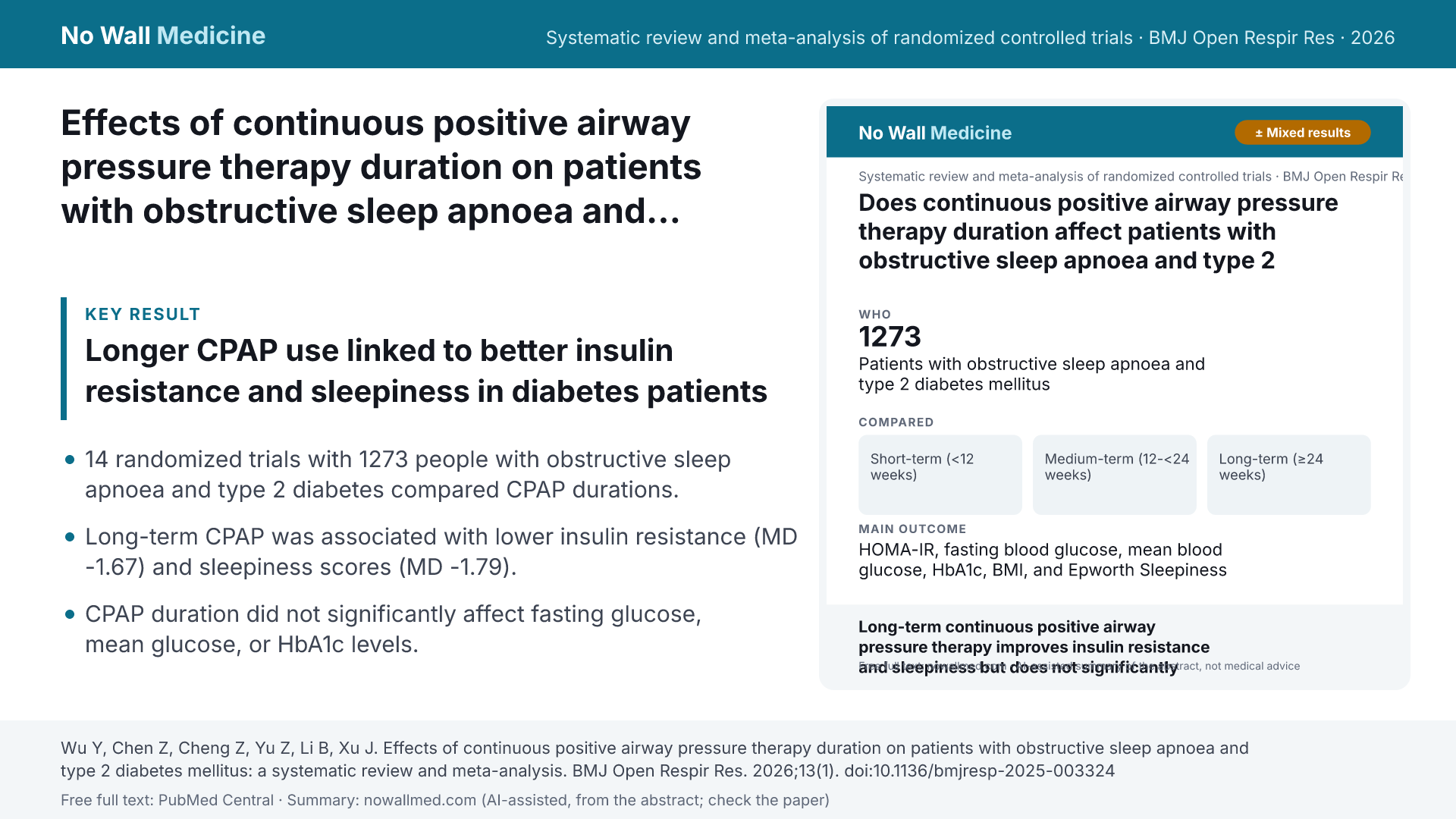
Longer CPAP use linked to better insulin resistance and sleepiness in diabetes patients
Effects of continuous positive airway pressure therapy duration on patients with obstructive sleep apnoea and type 2 diabetes mellitus: a systematic review and meta-analysis
Systematic review and meta-analysis of randomized controlled trialsMixed results
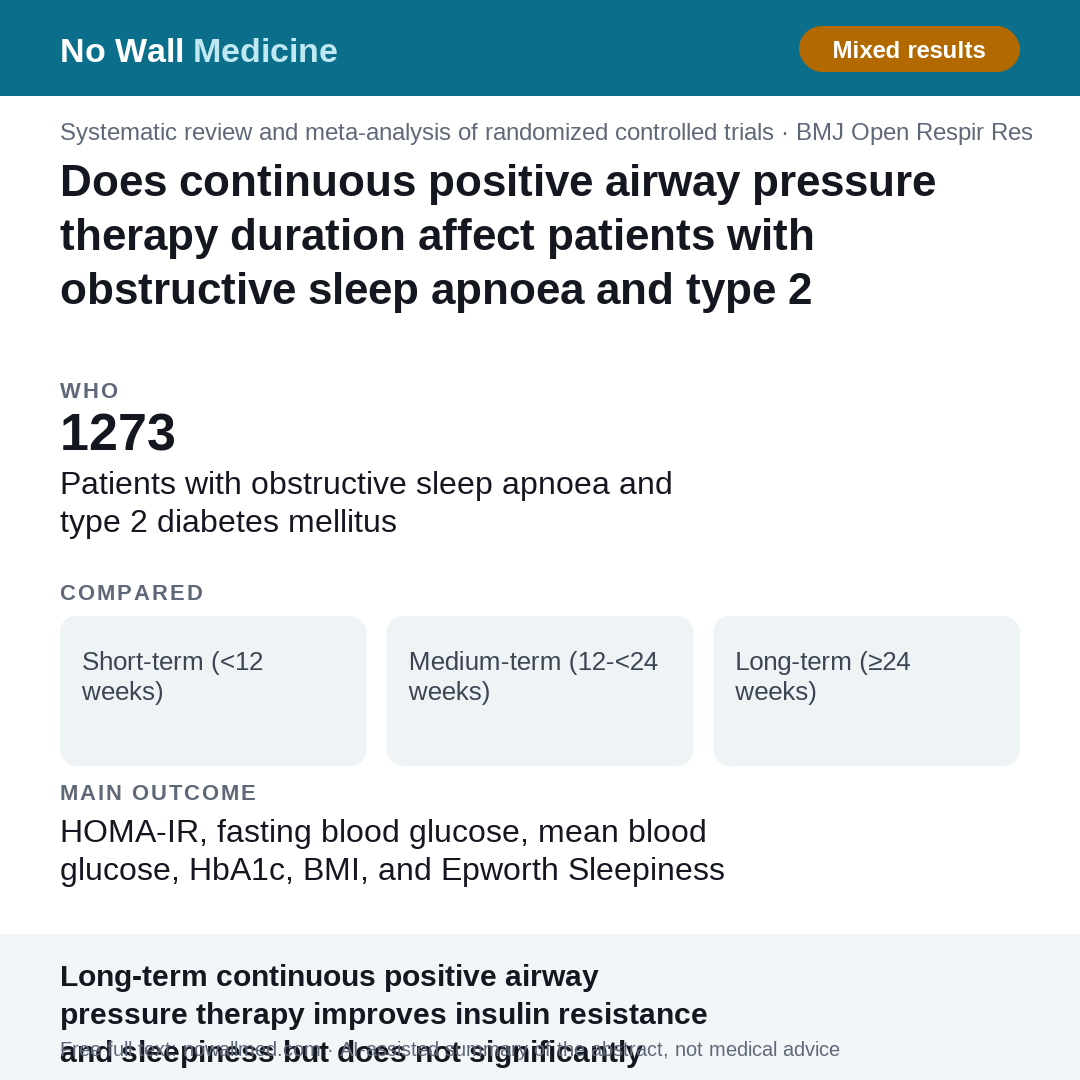
Does continuous positive airway pressure therapy duration affect patients with obstructive sleep apnoea and type 2 diabetes mellitus?
Who
1273
Patients with obstructive sleep apnoea and type 2 diabetes mellitus
Compared
Short-term (<12 weeks)
Medium-term (12-<24 weeks)
Long-term (≥24 weeks)
Main outcome
HOMA-IR, fasting blood glucose, mean blood glucose, HbA1c, BMI, and Epworth Sleepiness Scale
Result: MD -1.67 (95% CI -2.57 to -0.77) for HOMA-IR in long-term intervention
Bottom line: Long-term continuous positive airway pressure therapy improves insulin resistance and sleepiness but does not significantly affect glycaemic markers.
BMJ Open Respir Res · 2026-03-13Download image
Clinical question: Does continuous positive airway pressure therapy duration affect patients with obstructive sleep apnoea and type 2 diabetes mellitus?
Why it matters: It was unclear whether the effectiveness of continuous positive airway pressure therapy changes depending on how long patients use it.
Key points
- 14 randomized trials with 1273 people with obstructive sleep apnoea and type 2 diabetes compared CPAP durations.
- Long-term CPAP was associated with lower insulin resistance (MD -1.67) and sleepiness scores (MD -1.79).
- CPAP duration did not significantly affect fasting glucose, mean glucose, or HbA1c levels.
Headline and key points written with AI from the paper’s abstract, with every number checked against it. Read the paper before relying on them.
Was this summary helpful?
Abstract
Background
Whether the efficacy of continuous positive airway pressure (CPAP) therapy differs by duration in patients with obstructive sleep apnoea (OSA) and type 2 diabetes mellitus (T2DM) is unclear. This study aimed to evaluate the effects of CPAP therapy duration on these patients. Methods
We conducted a systematic review and meta-analysis of randomised controlled trials (RCTs) published up to 27 December 2024. We searched MEDLINE, EMBASE and the Cochrane Library for studies on patients with OSA and T2DM treated with CPAP. Outcomes of interest were haemoglobin A1c (HbA1c), fasting blood glucose (FBG), mean blood glucose (MBG), Homeostasis Model of Assessment of Insulin Resistance Index (HOMA-IR), body mass index (BMI) and Epworth Sleepiness Scale (ESS) score. Two reviewers independently screened studies, extracted data and assessed the risk of bias using the Cochrane risk of bias tool 2 tool. Data were synthesised using a random-effects model based on heterogeneity, and results were expressed as mean differences (MDs) with 95% CIs. Results
14 studies enrolling 1273 participants were included in the meta-analysis. The included trials were categorised into short-term (<12 weeks), medium-term (12-<24 weeks) and long-term (≥24 weeks) based on the duration of the CPAP intervention. Analysis showed that long-term CPAP intervention was associated with a significant reduction in HOMA-IR levels (MD -1.67; 95% CI -2.57 to -0.77). CPAP was associated with increases in BMI levels after medium-term (MD 0.31 kg/m2; 95% CI 0.06 to 0.57) and long-term (MD 0.74 kg/m2; 95% CI 0.20 to 1.27) intervention. Similarly, ESS levels showed a significant reduction after medium-term (MD -1.45; 95% CI -2.84 to -0.06) and long-term (MD -1.79; 95% CI -3.45 to -0.13) CPAP intervention. The duration of CPAP intervention did not significantly affect changes in FBG, MBG or HbA1c levels. Conclusion
Evidence from multiple RCTs indicates that the efficacy of CPAP therapy varies with treatment duration in patients with OSA and T2DM, showing benefits for insulin resistance and sleepiness with longer use but no significant effect on key glycaemic markers. Trial registration number
The study protocol was prospectively registered with PROSPERO (https://www.crd.york.ac.uk/) (registration number: CRD42025633203).
Abstract reproduced under the article’s CC BY NC licence.
Subject terms
Cite this article
Wu Y, Chen Z, Cheng Z, Yu Z, Li B, Xu J. Effects of continuous positive airway pressure therapy duration on patients with obstructive sleep apnoea and type 2 diabetes mellitus: a systematic review and meta-analysis. BMJ Open Respir Res. 2026. doi:10.1136/bmjresp-2025-003324
Spotted a mistake? Suggest a correction