Counselling and cash transfers reduce risk of unsuccessful tuberculosis patient outcomes in South Africa
Effects of conditional cash transfers and pre-test and post-test tuberculosis counselling on patient outcomes and loss to follow-up across the continuum of care in South Africa: a randomised controlled trial
Pragmatic, open-label, individual randomised controlled trialBenefit found
Do conditional cash transfers and tuberculosis counselling improve patient outcomes?
Who
4110
Adults undergoing investigation for pulmonary tuberculosis · Nine clinics in Johannesburg, South Africa
Compared
82.0%Intervention group
66.9%Control group
Main outcome
Successful patient outcome
Result: RR in weighted population 0.52, 95% CI 0.33 to 0.82
Bottom line: Counselling and conditional cash transfers significantly reduced the risk of unsuccessful tuberculosis patient outcomes.
Lancet Infect Dis · 2025-02-06Download image
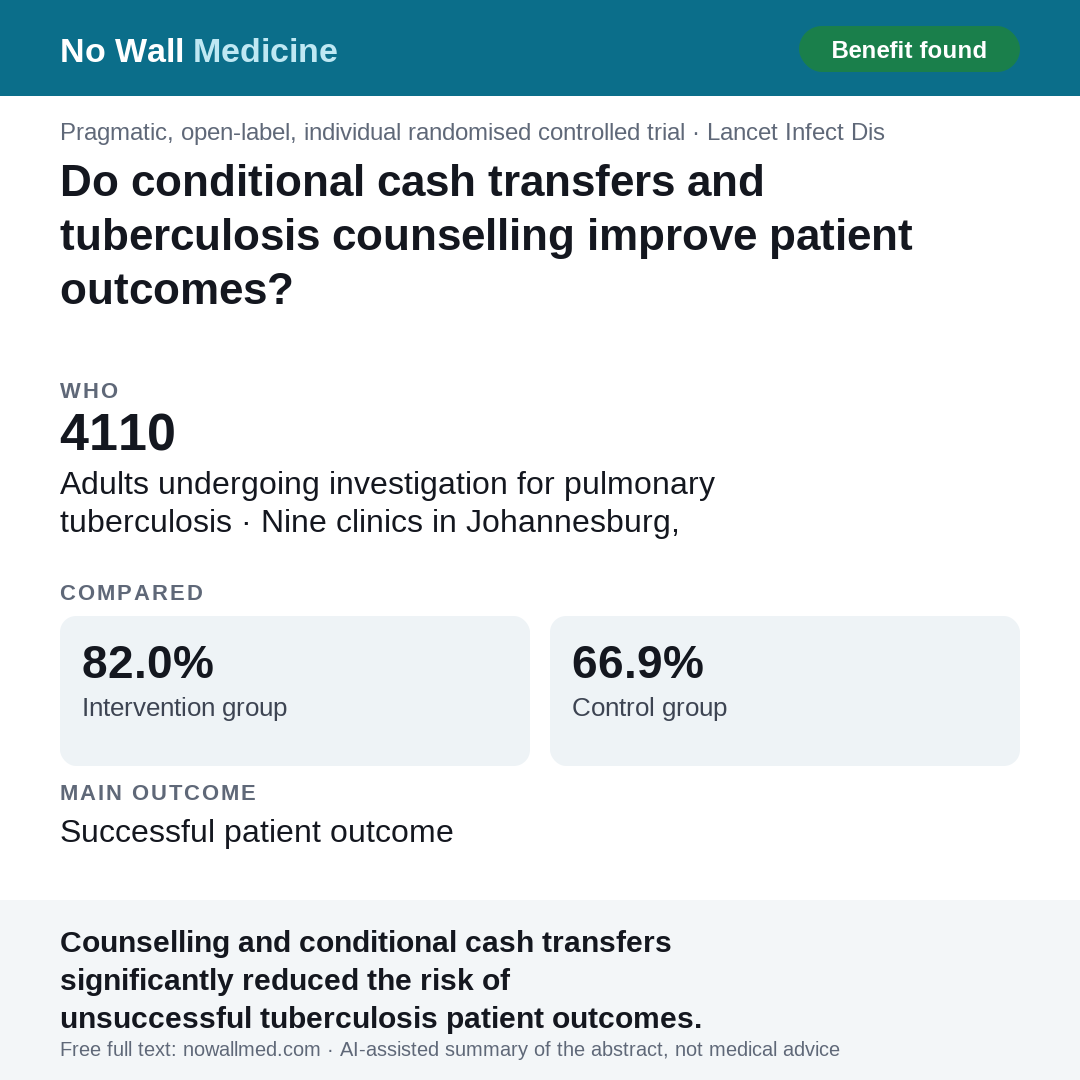
Clinical question: Do conditional cash transfers and tuberculosis counselling improve patient outcomes?
Why it matters: Economic and behavioural factors can lead to poor outcomes for patients undergoing investigation for pulmonary tuberculosis.
In absolute numbers
Intervention group: 82% · Control group: 66.9% → a difference of 15.1 percentage points, so about 7 people would need the treatment for 1 more to benefit (number needed to treat) over the trial’s follow-up.
Worked out by us from the two group results above, not reported by the authors. Check the paper for the exact outcome and timing.
Key points
- Researchers studied 4110 adults in Johannesburg, comparing standard care to a package of counselling and cash transfers for those with rifampicin-susceptible tuberculosis.
- The intervention group had a weighted prevalence of unsuccessful outcomes at 15.9% compared to 28.6% in the control group.
- Pretreatment loss to follow-up, where patients stop seeking care before starting treatment, was lower in the intervention group at 3.9% versus 15.8%.
Headline and key points written with AI from the paper’s abstract, with every number checked against it. Read the paper before relying on them.
Was this summary helpful?
Abstract
Background
Economic and behavioural factors lead to poor outcomes in patients with tuberculosis. We investigated the effects of a package of interventions consisting of pre-test and post-test tuberculosis counselling with conditional cash transfers on patient outcomes in adults undergoing investigation for pulmonary tuberculosis. Methods
This pragmatic, open-label, individual randomised controlled trial was done in nine clinics in Johannesburg, South Africa. Participants (aged ≥18 years) undergoing investigation for tuberculosis were randomly assigned (1:1) to the intervention group or control group (standard of care) via permuted block randomisation, stratified by clinic; group assignment was concealed using opaque envelopes. The intervention group received pre-test and post-test tuberculosis counselling, and for participants diagnosed with rifampicin-susceptible tuberculosis, a digital payment (R150; approximately US$10) at treatment initiation and each monthly treatment visit. Payments were contingent on timely attendance: 14 days from initial sputum sample collection and within 7 days on either side of their scheduled monthly appointment. The primary endpoint was successful patient outcome (patients who were cured or completed treatment) or unsuccessful patient outcome (pretreatment loss-to-follow-up, on-treatment loss-to-follow-up, development of rifampicin-resistant tuberculosis while on treatment, treatment failure [ie, smear or culture positive at 5 months or later after commencing treatment], or death). The primary outcome was analysed in the modified intention-to-treat population, defined as all randomly assigned participants with rifampicin-susceptible tuberculosis confirmed before the commencement of tuberculosis treatment. Weighted outcome prevalence, relative risks (RRs), and risk differences were calculated using a multivariable Poisson model with robust standard errors. This trial is registered with the Pan African Clinical Trials Registry (PACTR202410708311054) and is completed. Findings
Between Oct 25, 2018, and Dec 9, 2019, 4110 participants were enrolled and randomly assigned, 2059 to the intervention group and 2051 to the control group. 381 (9·3%) participants had microbiologically confirmed rifampicin-susceptible pulmonary tuberculosis (195 [9·5%] of 2059 in the intervention group vs 186 [9·1%] of 2051 in the control group; median age 37 years [IQR 30 to 45], 257 [67·5%] male, 124 [32·5%] female). At study closure, primary outcome data were available for 128 (65·6%) of 195 participants in the intervention group and 139 (74·7%) of 186 participants in the control group. 105 (82·0%) of 128 participants in the intervention group and 93 (66·9%) of 139 participants in the control group had a successful patient outcome; 23 (18·0%) of 128 participants in the intervention group and 46 (33·1%) of 139 participants in the control group had an unsuccessful patient outcome. The weighted regression analysis showed a substantial reduction in the risk of unsuccessful patient outcomes in the intervention group compared with the control group (weighted prevalence 15·9% vs 28·6%; RR in weighted population 0·52, 95% CI 0·33 to 0·82; risk difference in weighted population -14·1 percentage points, 95% CI -23·3 to -4·8). Pretreatment loss to follow-up was lower in the intervention group than in the control group (unweighted population: five [3·9%] of 128 participants vs 22 [15·8%] of 139 participants; risk difference in weighted population -9·6 percentage points, 95% CI -14·9 to -4·2). Interpretation
The package of interventions consisting of pre-test and post-test tuberculosis counselling with conditional cash transfers significantly reduced the risk of unsuccessful tuberculosis patient outcomes, bringing one of the 90-90-90 targets within reach (ie, achieving 90% tuberculosis treatment success). Furthermore, reduction in pretreatment loss to follow-up is expected to reduce transmission and lower incidence of the disease over time. Funding
South African Medical Research Council, UK Medical Research Council, and Newton Fund.
Abstract reproduced under the article’s CC BY NC ND licence.
Subject terms
Cite this article
Ismail N, Moultrie H, Mwansa-Kambafwile J, Copas A, Izu A, Moyo S. Effects of conditional cash transfers and pre-test and post-test tuberculosis counselling on patient outcomes and loss to follow-up across the continuum of care in South Africa: a randomised controlled trial. Lancet Infect Dis. 2025. doi:10.1016/S1473-3099(24)00816-8
Spotted a mistake? Suggest a correction
Top studies every Monday
The week’s key trials and guidelines in your specialties, plus any topics you follow. By email, free.
Get the weekly digest