Many patients stop tuberculosis treatment early within the first two months of care
Quantifying non-adherence to anti-tuberculosis treatment due to early discontinuation: a systematic literature review of timings to loss to follow-up
Systematic literature reviewHarm found
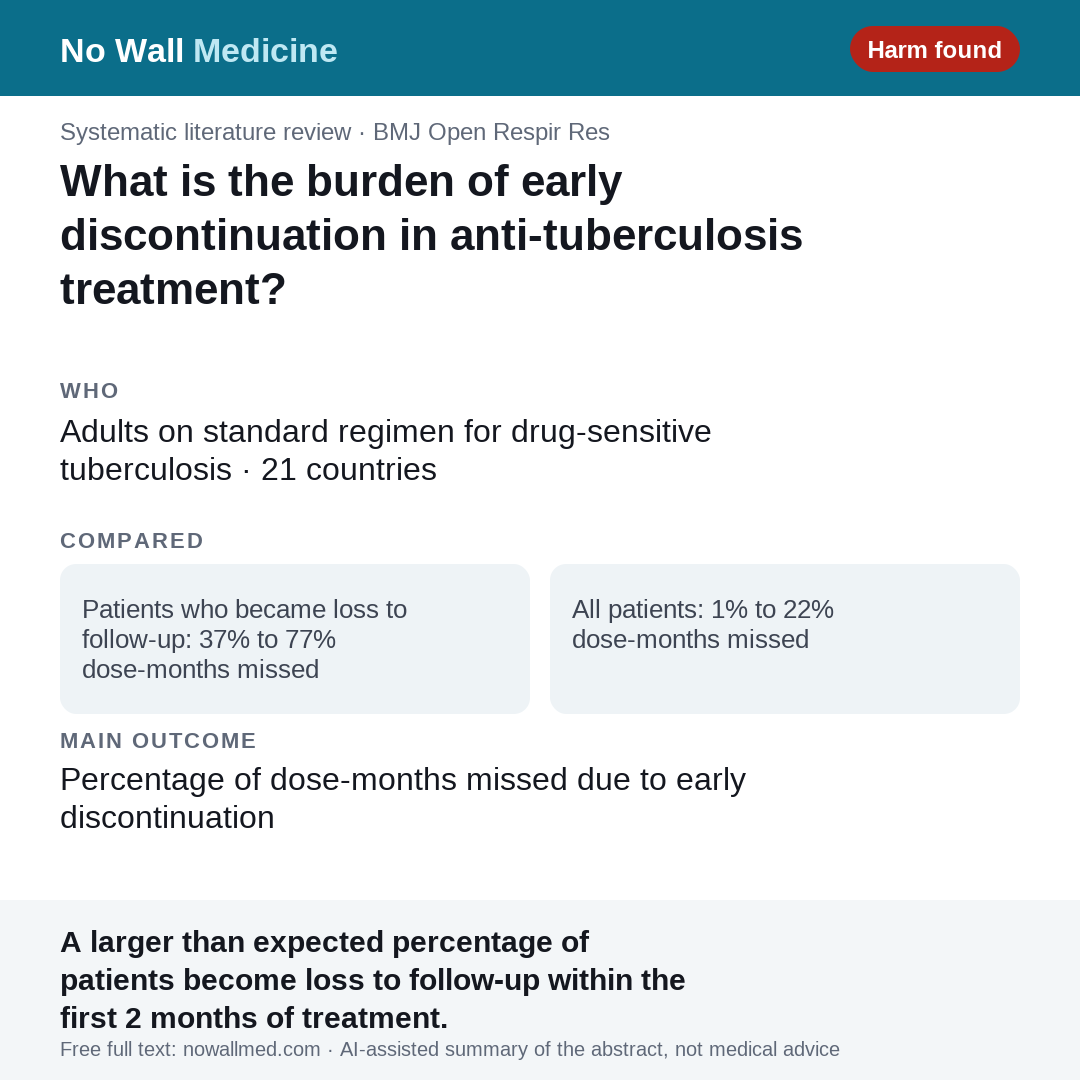
What is the burden of early discontinuation in anti-tuberculosis treatment?
Who
Adults on standard regimen for drug-sensitive tuberculosis · 21 countries
Compared
Patients who became loss to follow-up: 37% to 77% dose-months missed
All patients: 1% to 22% dose-months missed
Main outcome
Percentage of dose-months missed due to early discontinuation
Bottom line: A larger than expected percentage of patients become loss to follow-up within the first 2 months of treatment.
BMJ Open Respir Res · 2024-02-15Download image
Clinical question: What is the burden of early discontinuation in anti-tuberculosis treatment?
Why it matters: The burden and specific timing of early discontinuation in tuberculosis treatment is poorly understood.
Key points
- Researchers reviewed 40 studies from 21 countries involving adults on standard regimens for drug-sensitive tuberculosis.
- In 86.1% of the 36 studies reporting early loss to follow-up, a higher than expected percentage of patients stopped treatment by 2 months.
- Patients who stopped early missed between 37% and 77% of their required treatment doses.
Headline and key points written with AI from the paper’s abstract, with every number checked against it. Read the paper before relying on them.
Was this summary helpful?
Abstract
Background
The burden of non-adherence to anti-tuberculosis (TB) treatment is poorly understood. One type is early discontinuation, that is, stopping treatment early. Given the implications of early discontinuation for treatment outcomes, we undertook a systematic review to estimate its burden, using the timing of loss to follow-up (LFU) as a proxy measure. Methods
Web of Science, Embase and Medline were searched up to 14 January 2021 using terms covering LFU, TB and treatment. Studies of adults (≥ 18 years) on the standard regimen for drug-sensitive TB reporting the timing of LFU (WHO definition) were included. A narrative synthesis was conducted and quality assessment undertaken using an adapted version of Downs and Black. Papers were grouped by the percentage of those who were ultimately LFU who were LFU by 2 months. Three groups were created: <28.3% LFU by 2 months, ≥28.3-<38.3%, ≥38.3%). The percentage of dose-months missed due to early discontinuation among (1) those LFU, and (2) all patients was calculated. Results
We found 40 relevant studies from 21 countries. The timing of LFU was variable within and between countries. 36/40 papers (90.0%) reported the percentage of patients LFU by the end of 2 months. 31/36 studies (86.1%) reported a higher than or as expected percentage of patients becoming LFU by 2 months. The percentage of dose-months missed by patients who became LFU ranged between 37% and 77% (equivalent to 2.2-4.6 months). Among all patients, the percentage of dose-months missed ranged between 1% and 22% (equivalent to 0.1-1.3 months). Conclusions
A larger than expected percentage of patients became LFU within the first 2 months of treatment. These patients missed high percentages of dose months of treatment due to early discontinuation. Interventions to promote adherence and retain patients in care must not neglect the early months of treatment. Prospero registration number
CRD42021218636.
Abstract reproduced under the article’s CC BY licence.
Subject terms
Cite this article
Walker EF, Flook M, Rodger AJ, Fielding KL, Stagg HR. Quantifying non-adherence to anti-tuberculosis treatment due to early discontinuation: a systematic literature review of timings to loss to follow-up. BMJ Open Respir Res. 2024. doi:10.1136/bmjresp-2023-001894
Spotted a mistake? Suggest a correction
Top studies every Monday
The week’s key trials and guidelines in your specialties, plus any topics you follow. By email, free.
Get the weekly digest