Accelerated pacing was associated with reduced heart wall thickness and lower ejection fraction in heart failure patients
Effects of Continuous Accelerated Pacing on Cardiac Structure and Function in Patients With Heart Failure With Preserved Ejection Fraction: Insights From the myPACE Randomized Clinical Trial
Randomized clinical trialMixed results
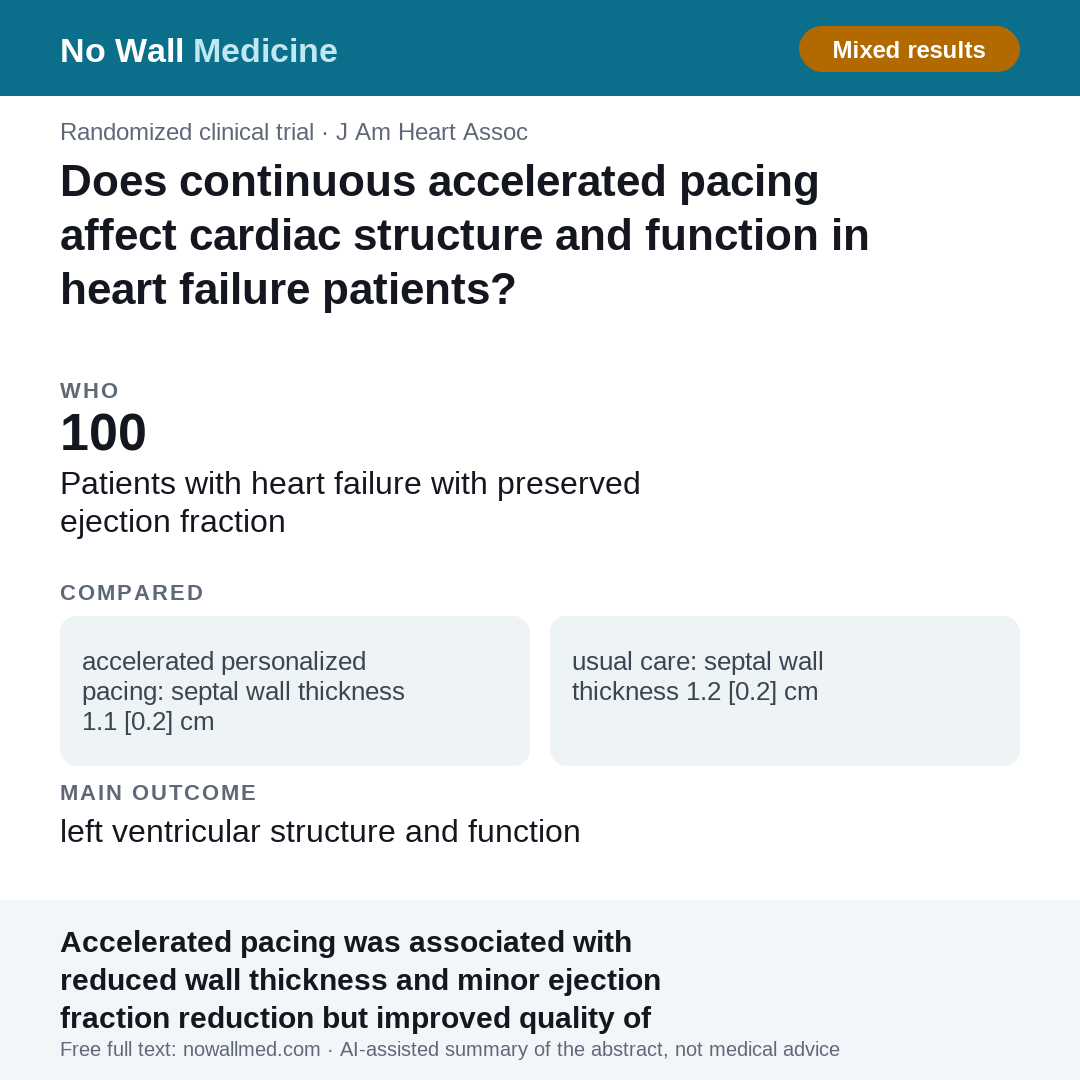
Does continuous accelerated pacing affect cardiac structure and function in heart failure patients?
Who
100
Patients with heart failure with preserved ejection fraction
Compared
accelerated personalized pacing: septal wall thickness 1.1 [0.2] cm
usual care: septal wall thickness 1.2 [0.2] cm
Main outcome
left ventricular structure and function
Bottom line: Accelerated pacing was associated with reduced wall thickness and minor ejection fraction reduction but improved quality of life.
J Am Heart Assoc · 2023-12-29Download image
Clinical question: Does continuous accelerated pacing affect cardiac structure and function in heart failure patients?
Why it matters: It was unknown how continuous accelerated pacing affects the physical structure and pumping function of the heart in patients with heart failure and preserved ejection fraction.
Key points
- Researchers analyzed 100 participants, including 16 in the accelerated pacing group and 20 in the usual care group, using echocardiograms performed a mean 3 (SD 2.0) years apart.
- Accelerated pacing was associated with reduced septal wall thickness of 1.1 [0.2] cm versus 1.2 [0.2] cm in usual care and a minor reduction in ejection fraction of 55 [5]% versus 60 [5]%.
- The myPACE group showed a 16.1 [13.9] point improvement in heart failure quality of life scores, while the usual care group scores worsened by 6.9 [11.6] points.
Limitation the authors note: The study was an exploratory analysis with a small number of participants who had qualifying sets of echocardiograms.
Headline and key points written with AI from the paper’s abstract, with every number checked against it. Read the paper before relying on them.
Was this summary helpful?
Subject terms
Cite this article
Wahlberg KJ, Infeld M, Plante TB, Novelli AE, Habel N, Burkhoff D. Effects of Continuous Accelerated Pacing on Cardiac Structure and Function in Patients With Heart Failure With Preserved Ejection Fraction: Insights From the myPACE Randomized Clinical Trial. J Am Heart Assoc. 2023. doi:10.1161/JAHA.123.032873
Spotted a mistake? Suggest a correction
Top studies every Monday
The week’s key trials and guidelines in your specialties, plus any topics you follow. By email, free.
Get the weekly digest