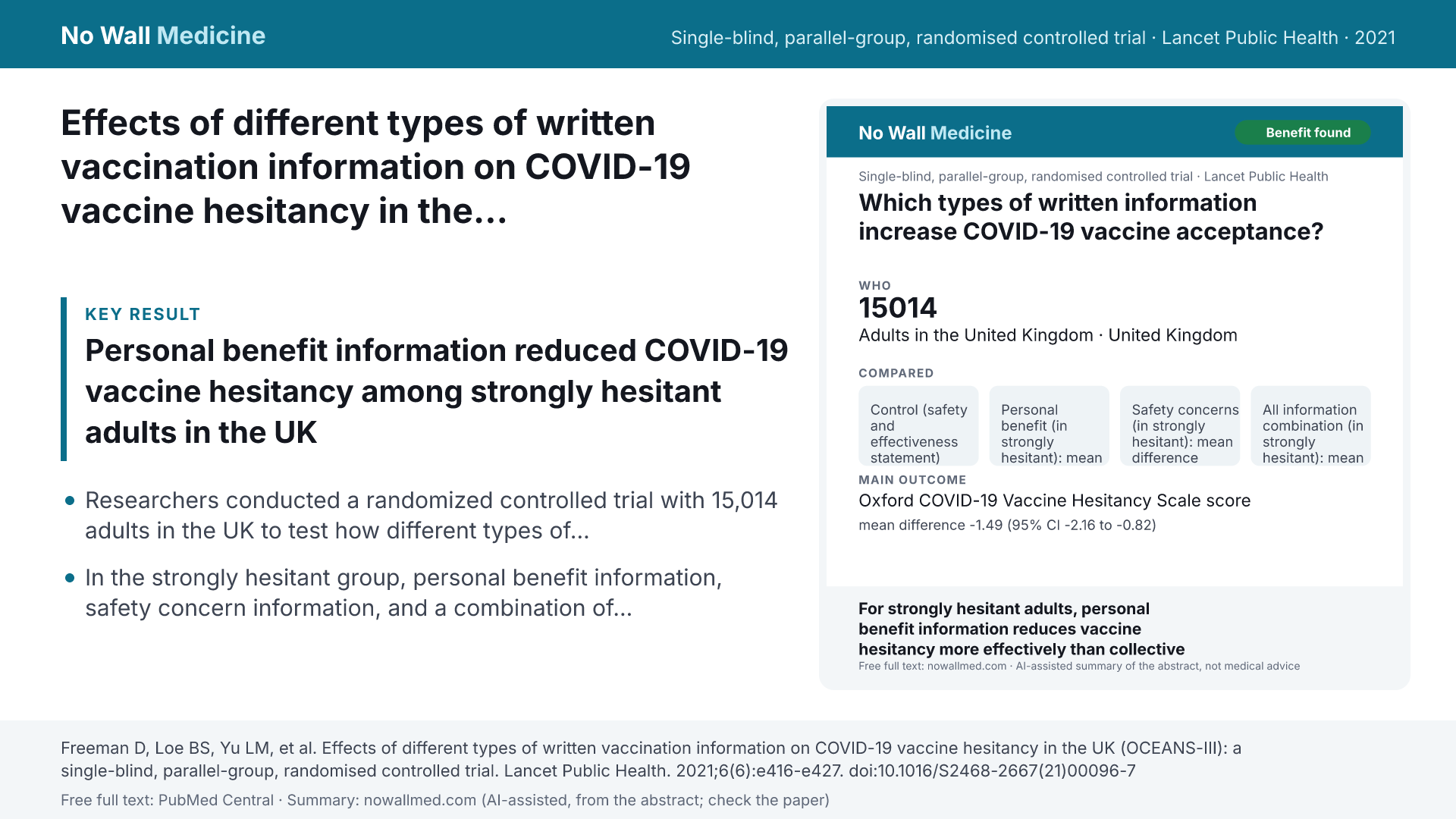
Effects of different types of written vaccination information on COVID-19 vaccine hesitancy in the UK (OCEANS-III): a single-blind, parallel-group, randomised controlled trial
Key result: Personal benefit information reduced COVID-19 vaccine hesitancy among strongly hesitant adults in the UK
Single-blind, parallel-group, randomised controlled trialBenefit found
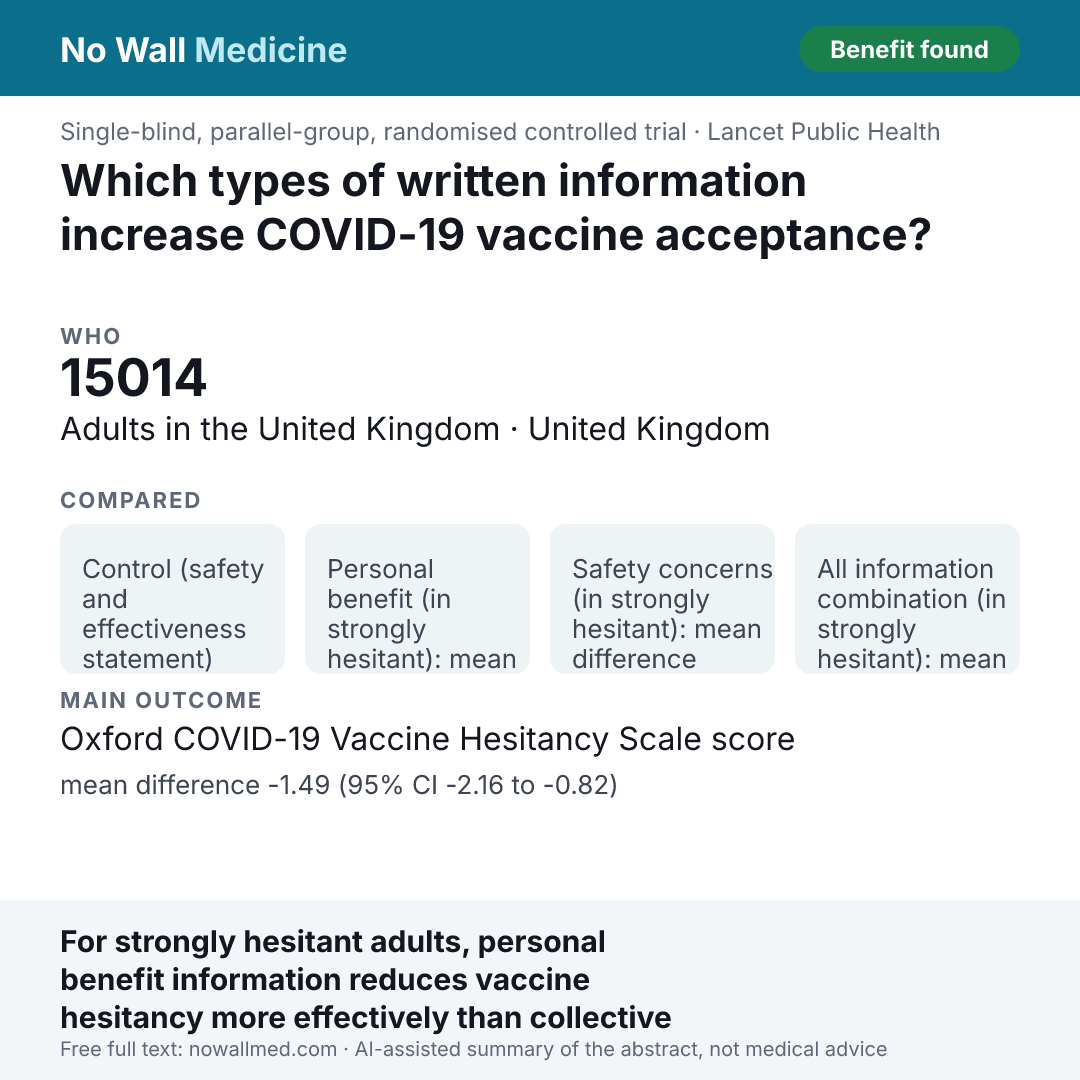
Which types of written information increase COVID-19 vaccine acceptance?
Who
15014
Adults in the United Kingdom · United Kingdom
Compared
Control (safety and effectiveness statement)
Personal benefit (in strongly hesitant): mean difference -1.49 (95% CI -2.16 to -0.82)
Safety concerns (in strongly hesitant): mean difference -0.91 (95% CI -1.58 to -0.23)
All information combination (in strongly hesitant): mean difference -0.86 (95% CI -1.53 to -0.18)
Main outcome
Oxford COVID-19 Vaccine Hesitancy Scale score
Result: mean difference -1.49 (95% CI -2.16 to -0.82)
Bottom line: For strongly hesitant adults, personal benefit information reduces vaccine hesitancy more effectively than collective benefit information.
Funded by: National Institute for Health Research
Lancet Public Health · 2021-05-13 · Save PNG
Key points
- Researchers conducted a randomized controlled trial with 15,014 adults in the UK to test how different types of written information affect vaccine acceptance.
- In the strongly hesitant group, personal benefit information, safety concern information, and a combination of all information reduced hesitancy compared to the control group.
- Information conditions did not change vaccine hesitancy levels for participants who were already willing or doubtful.
Discussion prompts
- Would these patients look like yours? Who was left out?
- Is the main outcome one that matters to patients?
- Is the difference large enough to change what you do?
Cite: Freeman D, Loe BS, Yu LM, et al. Effects of different types of written vaccination information on COVID-19 vaccine hesitancy in the UK (OCEANS-III): a single-blind, parallel-group, randomised controlled trial. Lancet Public Health. 2021;6(6):e416-e427. doi:10.1016/S2468-2667(21)00096-7
Free full text: PubMed Central · Summary and visual abstract: nowallmed.com/a/effects-of-different-types-of-written-vaccination-information-on-120dngx/ (AI-assisted from the abstract; check the paper before relying on it).