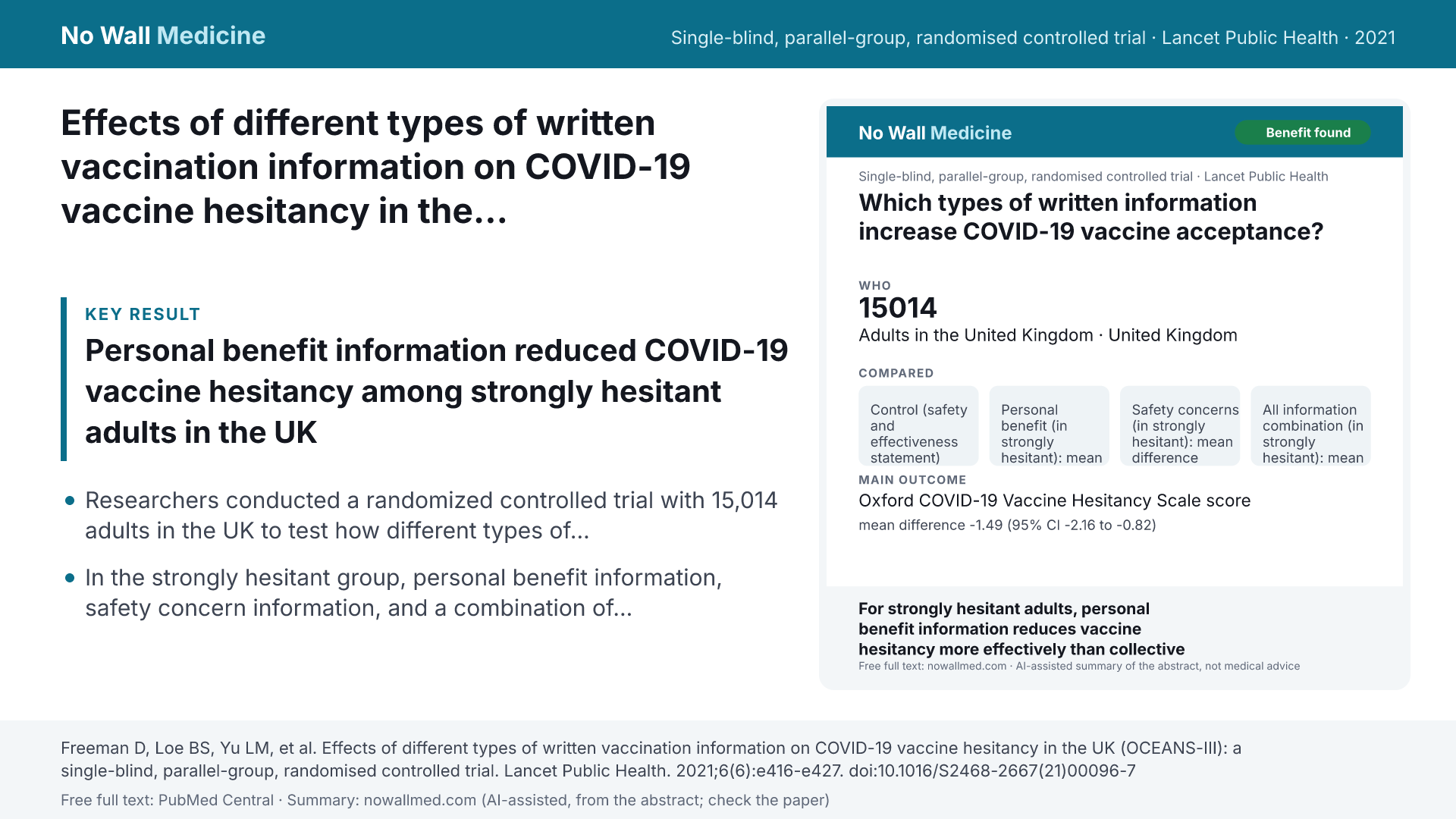
Personal benefit information reduced COVID-19 vaccine hesitancy among strongly hesitant adults in the UK
Effects of different types of written vaccination information on COVID-19 vaccine hesitancy in the UK (OCEANS-III): a single-blind, parallel-group, randomised controlled trial
Single-blind, parallel-group, randomised controlled trialBenefit found
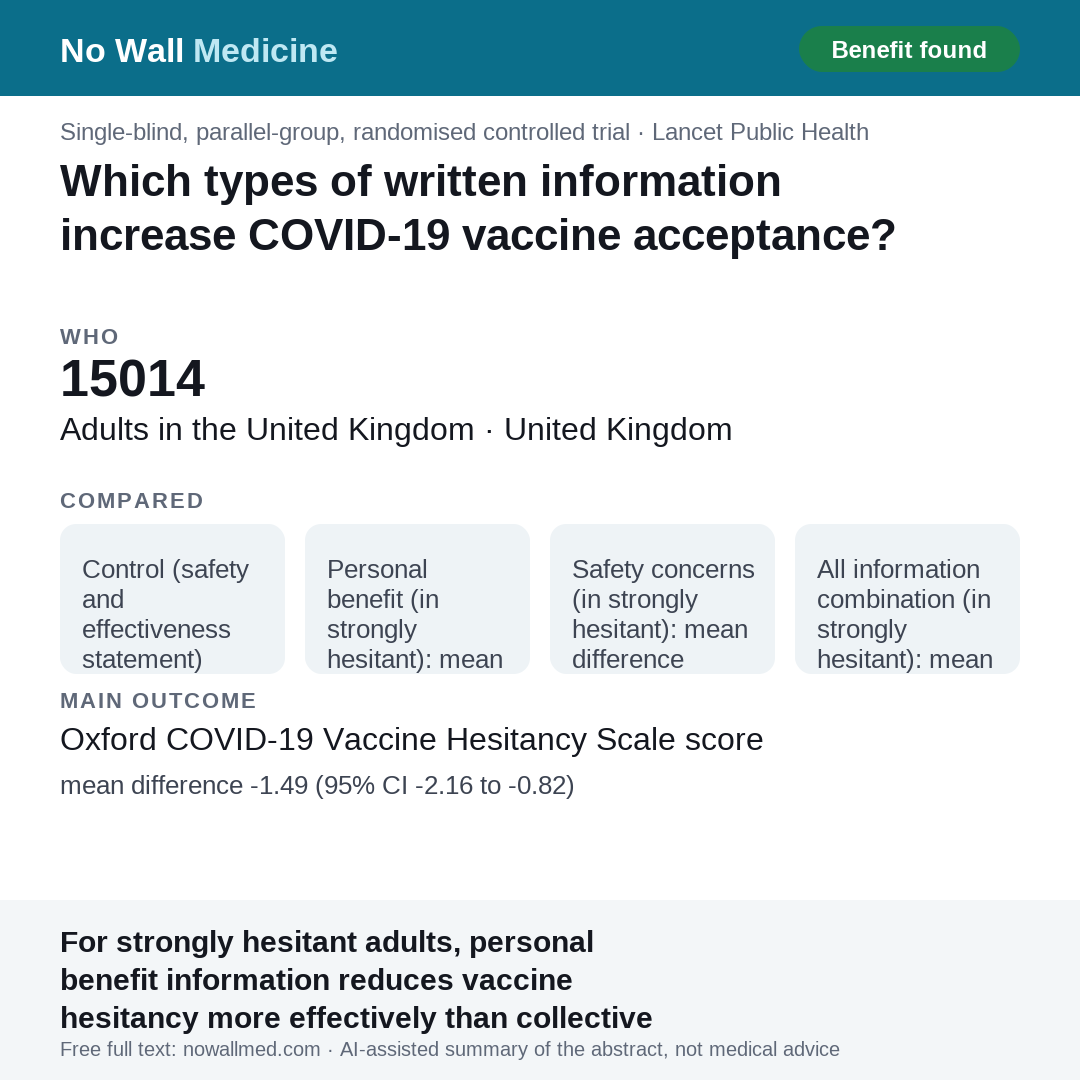
Which types of written information increase COVID-19 vaccine acceptance?
Who
15014
Adults in the United Kingdom · United Kingdom
Compared
Control (safety and effectiveness statement)
Personal benefit (in strongly hesitant): mean difference -1.49 (95% CI -2.16 to -0.82)
Safety concerns (in strongly hesitant): mean difference -0.91 (95% CI -1.58 to -0.23)
All information combination (in strongly hesitant): mean difference -0.86 (95% CI -1.53 to -0.18)
Main outcome
Oxford COVID-19 Vaccine Hesitancy Scale score
Result: mean difference -1.49 (95% CI -2.16 to -0.82)
Bottom line: For strongly hesitant adults, personal benefit information reduces vaccine hesitancy more effectively than collective benefit information.
Funded by: National Institute for Health Research
Lancet Public Health · 2021-05-13Download image
Clinical question: Which types of written information increase COVID-19 vaccine acceptance?
Key points
- Researchers conducted a randomized controlled trial with 15,014 adults in the UK to test how different types of written information affect vaccine acceptance.
- In the strongly hesitant group, personal benefit information, safety concern information, and a combination of all information reduced hesitancy compared to the control group.
- Information conditions did not change vaccine hesitancy levels for participants who were already willing or doubtful.
Headline and key points written with AI from the paper’s abstract, with every number checked against it. Read the paper before relying on them.
Was this summary helpful?
Abstract
Background
The effectiveness of the COVID-19 vaccination programme depends on mass participation: the greater the number of people vaccinated, the less risk to the population. Concise, persuasive messaging is crucial, particularly given substantial levels of vaccine hesitancy in the UK. Our aim was to test which types of written information about COVID-19 vaccination, in addition to a statement of efficacy and safety, might increase vaccine acceptance. Methods
For this single-blind, parallel-group, randomised controlled trial, we aimed to recruit 15 000 adults in the UK, who were quota sampled to be representative. Participants were randomly assigned equally across ten information conditions stratified by level of vaccine acceptance (willing, doubtful, or strongly hesitant). The control information condition comprised the safety and effectiveness statement taken from the UK National Health Service website; the remaining conditions addressed collective benefit, personal benefit, seriousness of the pandemic, and safety concerns. After online provision of vaccination information, participants completed the Oxford COVID-19 Vaccine Hesitancy Scale (outcome measure; score range 7-35) and the Oxford Vaccine Confidence and Complacency Scale (mediation measure). The primary outcome was willingness to be vaccinated. Participants were analysed in the groups they were allocated. p values were adjusted for multiple comparisons. The study was registered with ISRCTN, ISRCTN37254291. Findings
From Jan 19 to Feb 5, 2021, 15 014 adults were recruited. Vaccine hesitancy had reduced from 26·9% the previous year to 16·9%, so recruitment was extended to Feb 18 to recruit 3841 additional vaccine-hesitant adults. 12 463 (66·1%) participants were classified as willing, 2932 (15·6%) as doubtful, and 3460 (18·4%) as strongly hesitant (ie, report that they will avoid being vaccinated for as long as possible or will never get vaccinated). Information conditions did not alter COVID-19 vaccine hesitancy in those willing or doubtful (adjusted p values >0·70). In those strongly hesitant, COVID-19 vaccine hesitancy was reduced, in comparison to the control condition, by personal benefit information (mean difference -1·49, 95% CI -2·16 to -0·82; adjusted p=0·0015), directly addressing safety concerns about speed of development (-0·91, -1·58 to -0·23; adjusted p=0·0261), and a combination of all information (-0·86, -1·53 to -0·18; adjusted p=0·0313). In those strongly hesitant, provision of personal benefit information reduced hesitancy to a greater extent than provision of information on the collective benefit of not personally getting ill (-0·97, 95% CI -1·64 to -0·30; adjusted p=0·0165) or the collective benefit of not transmitting the virus (-1·01, -1·68 to -0·35; adjusted p=0·0150). Ethnicity and gender were found to moderate information condition outcomes. Interpretation
In the approximately 10% of the population who are strongly hesitant about COVID-19 vaccines, provision of information on personal benefit reduces hesitancy to a greater extent than information on collective benefits. Where perception of risk from vaccines is most salient, decision making becomes centred on the personal. As such, messaging that stresses the counterbalancing personal benefits is likely to prove most effective. The messaging from this study could be used in public health communications. Going forwards, the study highlights the need for future health campaigns to engage with the public on the terrain that is most salient to them. Funding
National Institute for Health Research (NIHR) Oxford Biomedical Research Centre and NIHR Oxford Health Biomedical Research Centre.
Abstract reproduced under the article’s CC BY licence.
Subject terms
Headline, design, result, key points, caveat and citation as plain text.
Cite this article
Freeman D, Loe BS, Yu LM, et al. Effects of different types of written vaccination information on COVID-19 vaccine hesitancy in the UK (OCEANS-III): a single-blind, parallel-group, randomised controlled trial. Lancet Public Health. 2021. doi:10.1016/S2468-2667(21)00096-7
Spotted a mistake? Suggest a correction