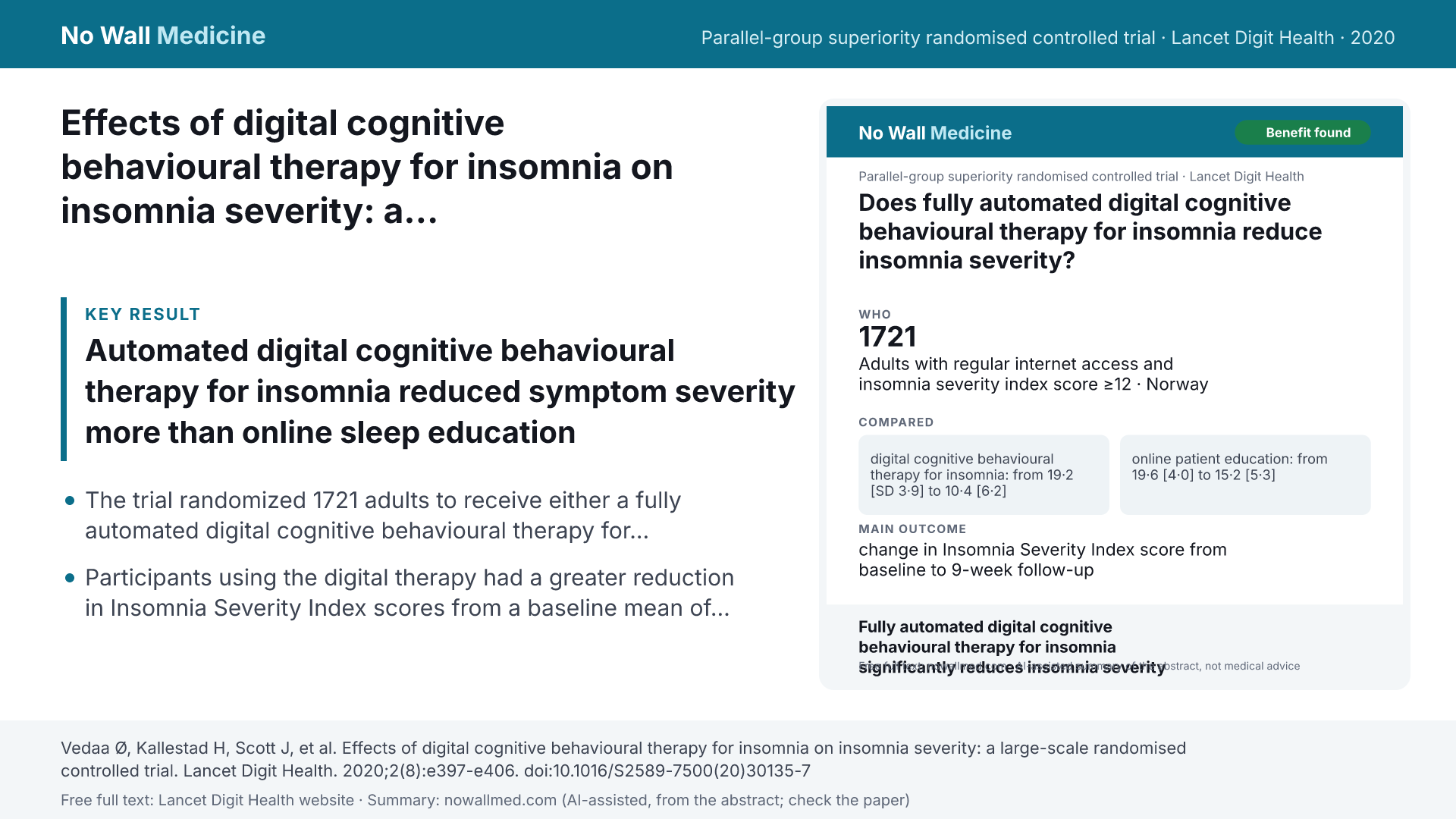
Automated digital cognitive behavioural therapy for insomnia reduced symptom severity more than online sleep education
Effects of digital cognitive behavioural therapy for insomnia on insomnia severity: a large-scale randomised controlled trial
Parallel-group superiority randomised controlled trialBenefit found
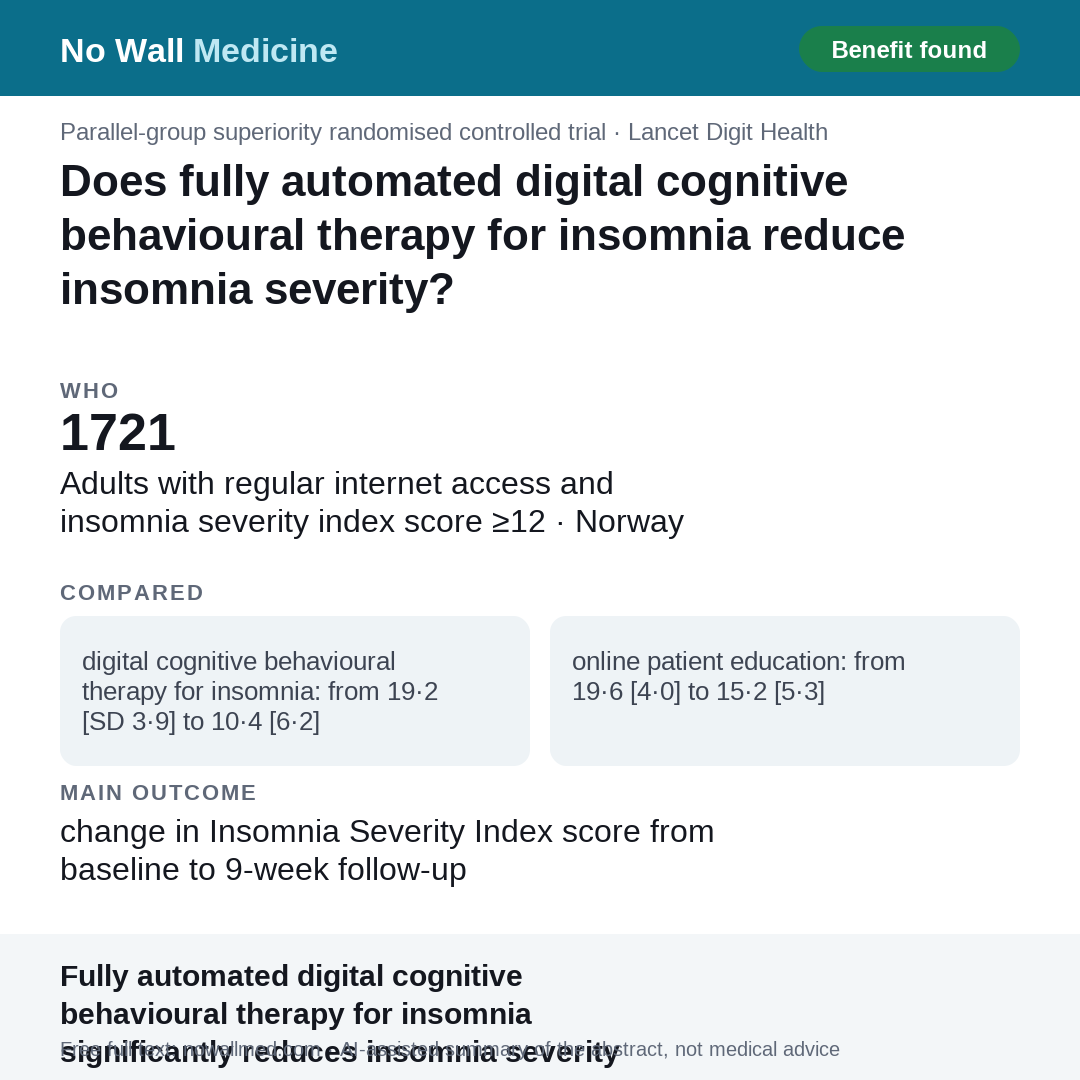
Does fully automated digital cognitive behavioural therapy for insomnia reduce insomnia severity?
Who
1721
Adults with regular internet access and insomnia severity index score ≥12 · Norway
Compared
digital cognitive behavioural therapy for insomnia: from 19·2 [SD 3·9] to 10·4 [6·2]
online patient education: from 19·6 [4·0] to 15·2 [5·3]
Main outcome
change in Insomnia Severity Index score from baseline to 9-week follow-up
Result: estimated mean difference -4·7 (95% CI -5·4 to -4·1)
Bottom line: Fully automated digital cognitive behavioural therapy for insomnia significantly reduces insomnia severity compared to online patient education.
Funded by: Norwegian Research Council; Liaison Committee for Education, Research and Innovation in Central Norway
Lancet Digit Health · 2020-12-17Download image
Clinical question: Does fully automated digital cognitive behavioural therapy for insomnia reduce insomnia severity?
Why it matters: It was unknown if a fully automated digital cognitive behavioural therapy program could effectively reduce insomnia severity when compared to online patient education.
Key points
- The trial randomized 1721 adults to receive either a fully automated digital cognitive behavioural therapy for insomnia program or online patient education about sleep.
- Participants using the digital therapy had a greater reduction in Insomnia Severity Index scores from a baseline mean of 19.2 to 10.4 at 9 weeks compared to 19.6 to 15.2 in the education group.
- The number needed to treat for insomnia remission, defined as an Insomnia Severity Index score below 8, was 3.2.
Headline and key points written with AI from the paper’s abstract, with every number checked against it. Read the paper before relying on them.
Was this summary helpful?
Abstract
Background
Although several large-scale randomised controlled trials have shown the efficacy of digital cognitive behavioural therapy for insomnia (dCBT-I), there is a need to validate widespread dissemination of dCBT-I using recommended key outcomes for insomnia. We investigated the effect of a fully automated dCBT-I programme on insomnia severity, sleep-wake patterns, sleep medication use, and daytime impairment. Methods
We did a parallel-group superiority randomised controlled trial comparing dCBT-I with online patient education about sleep. The interventions were available through a free-to-access website, publicised throughout Norway, which incorporated automated screening, informed consent, and randomisation procedures, as well as outcome assessments. Adults (age ≥18 years) who had regular internet access and scored 12 or higher on the Insomnia Severity Index (ISI) were eligible for inclusion, and were allocated (1:1) to receive dCBT-I (consisting of six core interactive sessions to be completed over 9 weeks) or patient education (control group). Participants were masked to group assignment and had no contact with researchers during the intervention period. The primary outcome was the change in ISI score from baseline to 9-week follow-up, assessed in the intention-to-treat population. This trial is registered with ClinicalTrials.gov (NCT02558647) and is ongoing, with 2-year follow-up assessments planned. Findings
Between Feb 26, 2016, and July 1, 2018, 5349 individuals commenced the online screening process, of which 1497 were ineligible or declined to participate, 2131 discontinued the screening process, and 1721 were randomly allocated (868 to receive dCBT-I and 853 to receive patient education). At 9-week follow-up, 584 (67%) participants in the dCBT-I group and 534 (63%) in the patient education group completed the ISI assessment. The latent growth model showed that participants in the dCBT-I group had a significantly greater reduction in ISI scores from baseline (mean score 19·2 [SD 3·9]) to 9-week follow-up (10·4 [6·2]) than those in the patient education group (from 19·6 [4·0] to 15·2 [5·3]; estimated mean difference -4·7 (95% CI -5·4 to -4·1; Cohen's d -1·21; p<0·001). Compared with patient education, the number needed to treat with dCBT-I was 2·7 (95% CI 2·4 to 3·2) for treatment response (ISI score reduction ≥8) and 3·2 (2·8 to 3·8) for insomnia remission (ISI score <8). No adverse events were reported to the trial team. Interpretation
dCBT-I is effective in reducing the severity of symptoms associated with the insomnia disorder. These findings support the widespread dissemination of dCBT-I. Future research is needed to identify the moderators of response and to improve targeting. Funding
Norwegian Research Council; Liaison Committee for Education, Research and Innovation in Central Norway.
Abstract reproduced under the article’s CC BY NC ND licence.
Subject terms
Cite this article
Vedaa Ø, Kallestad H, Scott J, et al. Effects of digital cognitive behavioural therapy for insomnia on insomnia severity: a large-scale randomised controlled trial. Lancet Digit Health. 2020. doi:10.1016/S2589-7500(20)30135-7
Spotted a mistake? Suggest a correction