Effects of digital cognitive behavioural therapy for insomnia on insomnia severity: a large-scale randomised controlled trial
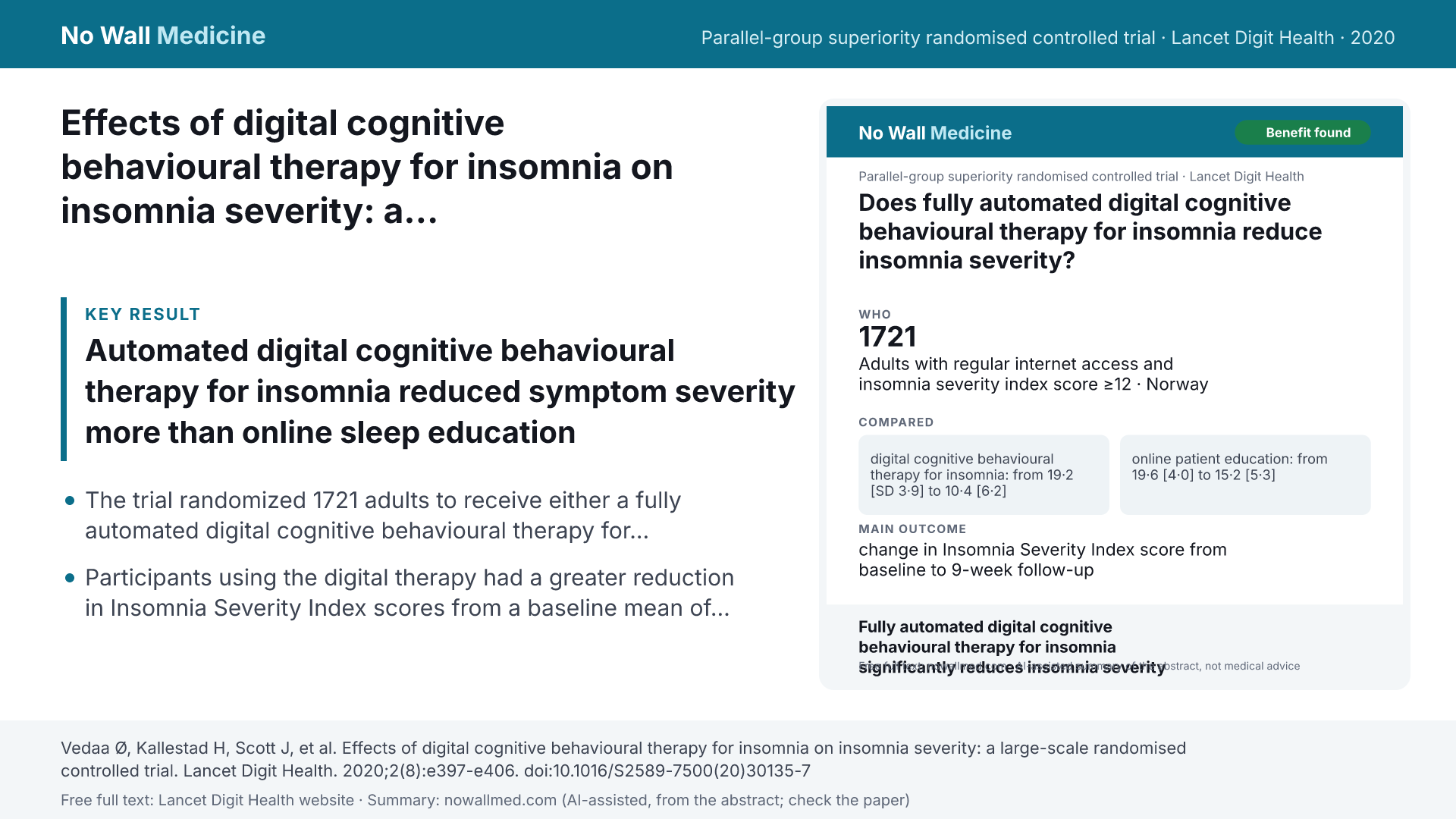
Key result: Automated digital cognitive behavioural therapy for insomnia reduced symptom severity more than online sleep education
Parallel-group superiority randomised controlled trialBenefit found
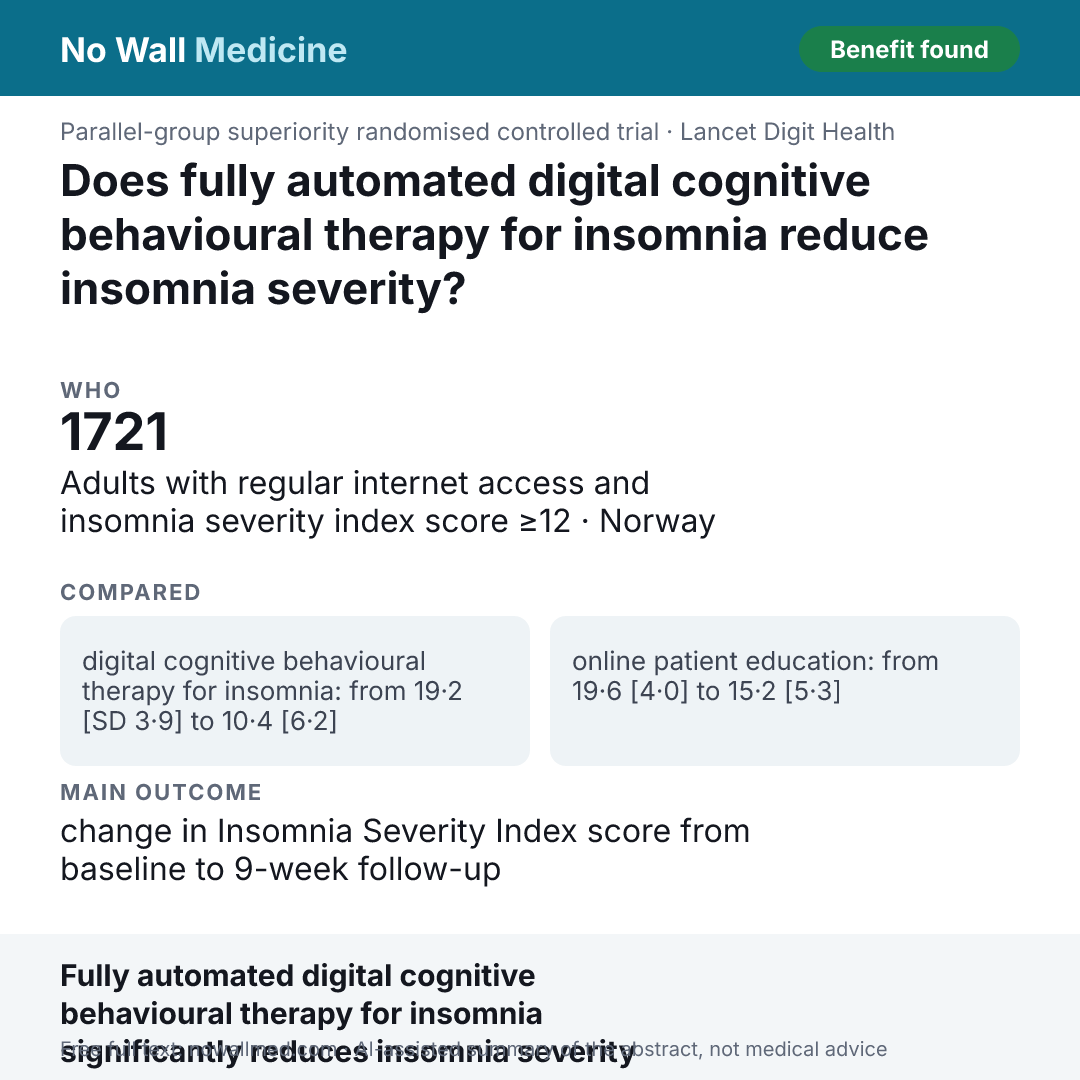
Does fully automated digital cognitive behavioural therapy for insomnia reduce insomnia severity?
Who
1721
Adults with regular internet access and insomnia severity index score ≥12 · Norway
Compared
digital cognitive behavioural therapy for insomnia: from 19·2 [SD 3·9] to 10·4 [6·2]
online patient education: from 19·6 [4·0] to 15·2 [5·3]
Main outcome
change in Insomnia Severity Index score from baseline to 9-week follow-up
Result: estimated mean difference -4·7 (95% CI -5·4 to -4·1)
Bottom line: Fully automated digital cognitive behavioural therapy for insomnia significantly reduces insomnia severity compared to online patient education.
Funded by: Norwegian Research Council; Liaison Committee for Education, Research and Innovation in Central Norway
Lancet Digit Health · 2020-12-17 · Save PNG
Key points
- The trial randomized 1721 adults to receive either a fully automated digital cognitive behavioural therapy for insomnia program or online patient education about sleep.
- Participants using the digital therapy had a greater reduction in Insomnia Severity Index scores from a baseline mean of 19.2 to 10.4 at 9 weeks compared to 19.6 to 15.2 in the education group.
- The number needed to treat for insomnia remission, defined as an Insomnia Severity Index score below 8, was 3.2.
Discussion prompts
- Would these patients look like yours? Who was left out?
- Is the main outcome one that matters to patients?
- Is the difference large enough to change what you do?
Cite: Vedaa Ø, Kallestad H, Scott J, et al. Effects of digital cognitive behavioural therapy for insomnia on insomnia severity: a large-scale randomised controlled trial. Lancet Digit Health. 2020;2(8):e397-e406. doi:10.1016/S2589-7500(20)30135-7
Free full text: Lancet Digit Health website · Summary and visual abstract: nowallmed.com/a/effects-of-digital-cognitive-behavioural-therapy-for-insomnia-on-hgsebg/ (AI-assisted from the abstract; check the paper before relying on it).