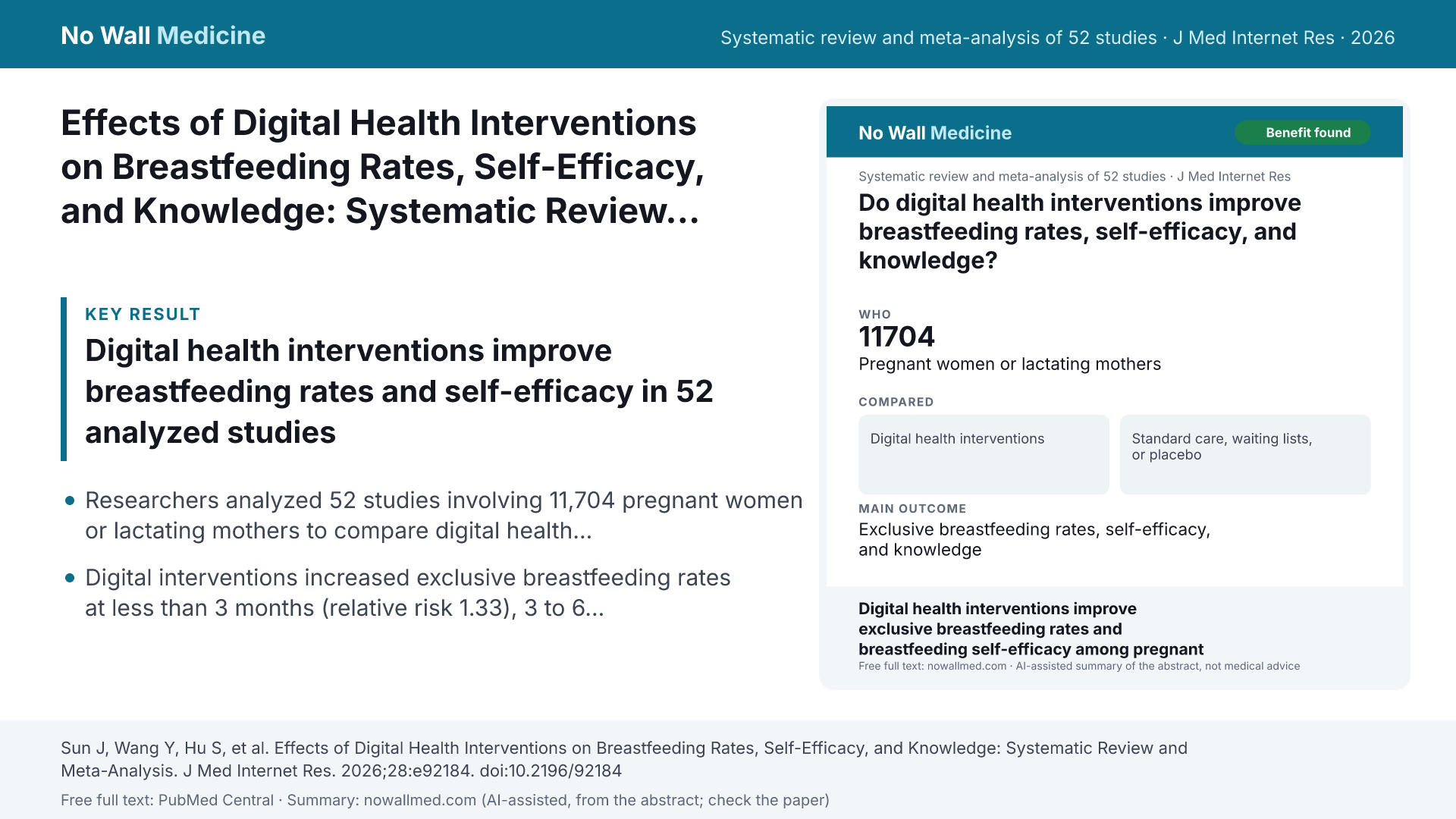
Digital health interventions improve breastfeeding rates and self-efficacy in 52 analyzed studies
Effects of Digital Health Interventions on Breastfeeding Rates, Self-Efficacy, and Knowledge: Systematic Review and Meta-Analysis
Systematic review and meta-analysis of 52 studiesBenefit found
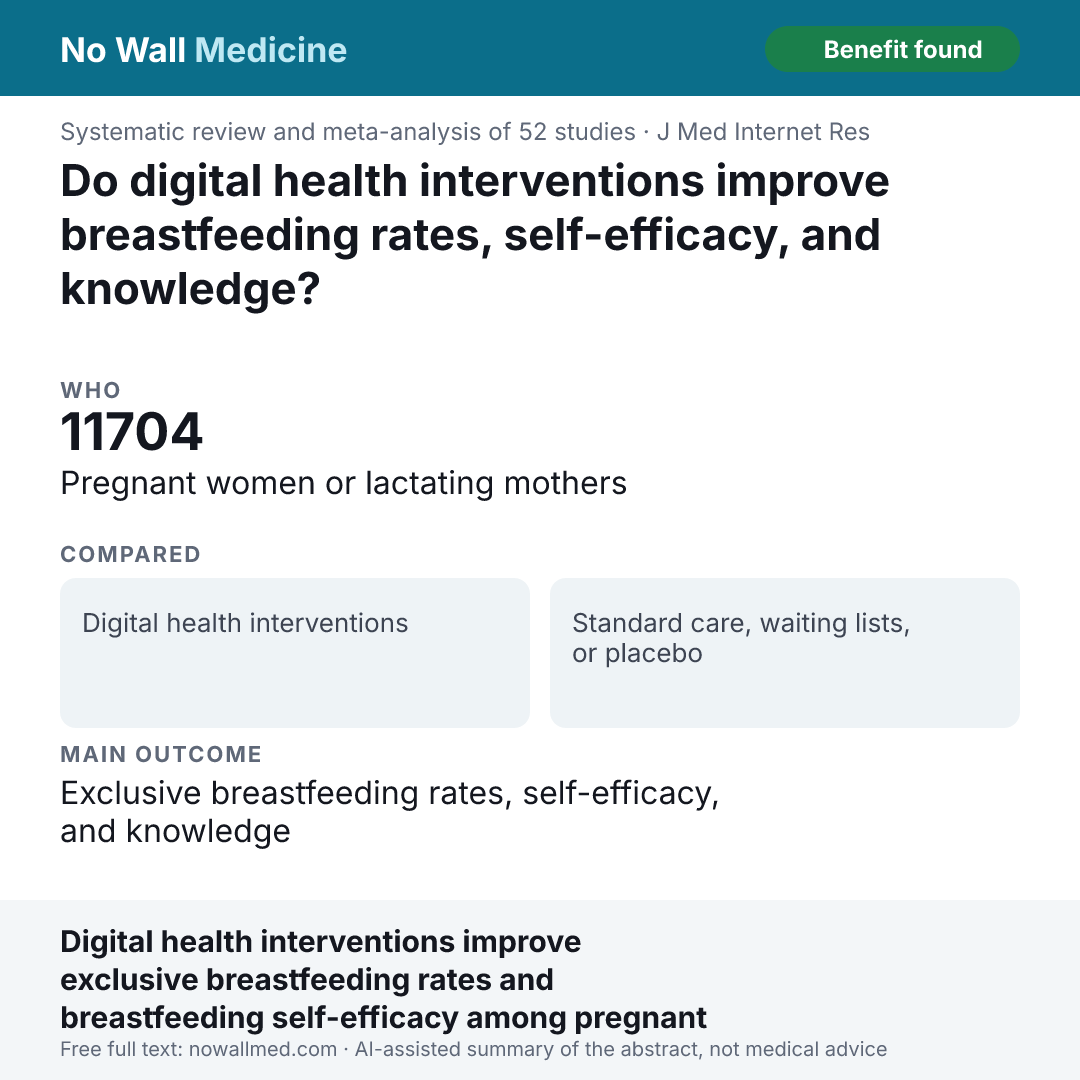
Do digital health interventions improve breastfeeding rates, self-efficacy, and knowledge?
Who
11704
Pregnant women or lactating mothers
Compared
Digital health interventions
Standard care, waiting lists, or placebo
Main outcome
Exclusive breastfeeding rates, self-efficacy, and knowledge
Result: relative risk 1.33 (95% CI 1.18-1.50) for exclusive breastfeeding at <3 months
Bottom line: Digital health interventions improve exclusive breastfeeding rates and breastfeeding self-efficacy among pregnant women and lactating mothers.
Limitation: Moderate risk of bias, substantial heterogeneity, wide 95% prediction interval, and low to moderate certainty of evidence.
J Med Internet Res · 2026-08-12 · PROSPERO CRD420251233352
Why it matters: Evidence regarding the impact of digital health interventions on breastfeeding outcomes has remained limited.
Headline and visual abstract written with AI from the paper’s abstract, with every number checked against it. Read the paper before relying on them.
Was this summary helpful?
Subject terms
Cite this article
Sun J, Wang Y, Hu S, et al. Effects of Digital Health Interventions on Breastfeeding Rates, Self-Efficacy, and Knowledge: Systematic Review and Meta-Analysis. J Med Internet Res. 2026;28:e92184. doi:10.2196/92184
Spotted a mistake? Suggest a correction