Digital interventions improved bladder symptoms and quality of life in patients with overactive bladder
Effects of Digital Interventions on Symptom Improvement and Quality of Life in Patients With Overactive Bladder: Systematic Review and Meta-Analysis
Systematic review and meta-analysis of seven randomized controlled trialsBenefit found
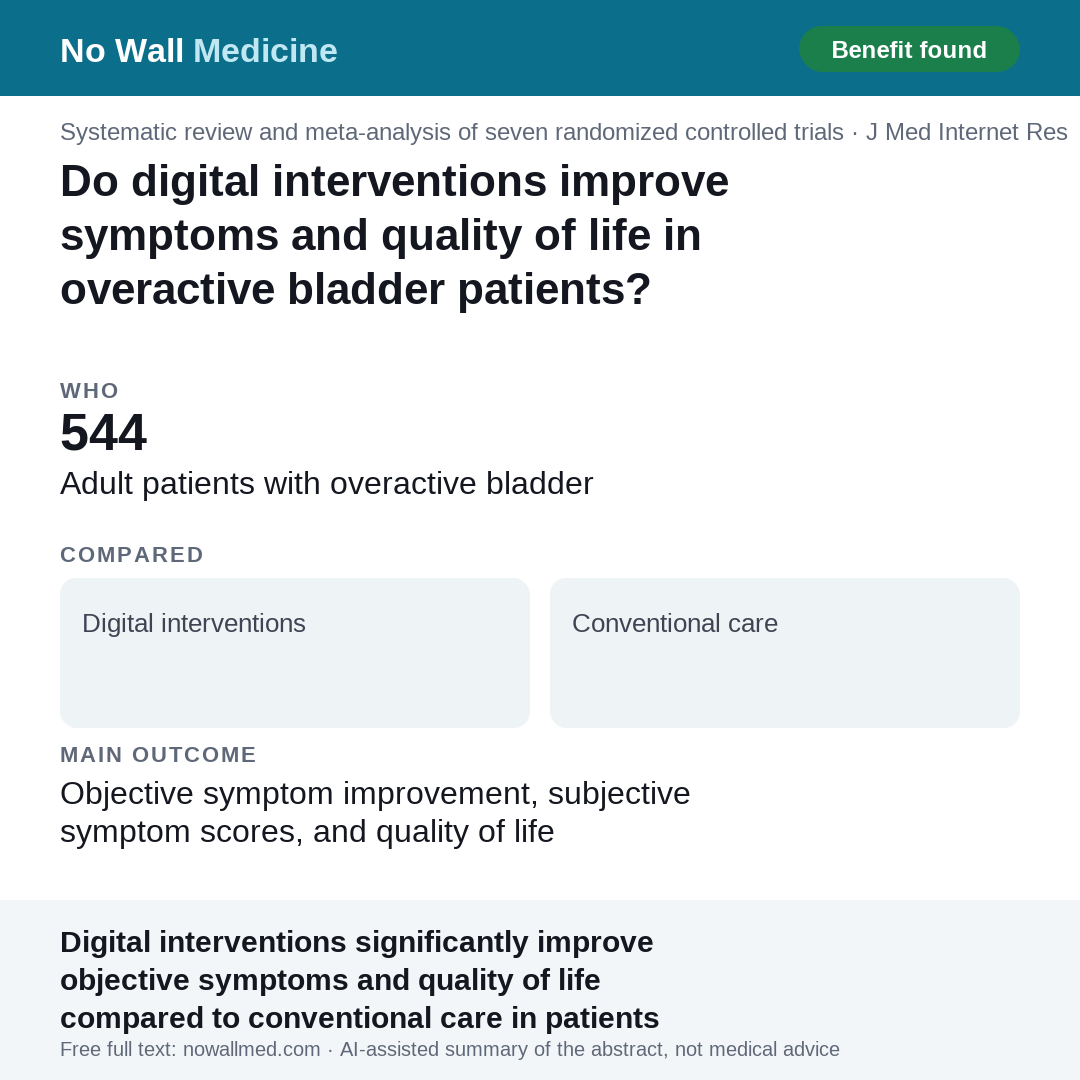
Do digital interventions improve symptoms and quality of life in overactive bladder patients?
Who
544
Adult patients with overactive bladder
Compared
Digital interventions
Conventional care
Main outcome
Objective symptom improvement, subjective symptom scores, and quality of life
Result: mean difference -1.72 (95% CI -2.61 to -0.83)
Bottom line: Digital interventions significantly improve objective symptoms and quality of life compared to conventional care in patients with overactive bladder.
Limitation: Small number of heterogeneous studies for certain subgroup analyses.
J Med Internet Res · 2026-08-10Download image
Clinical question: Do digital interventions improve symptoms and quality of life in overactive bladder patients?
Why it matters: Standard behavioral and drug therapies for overactive bladder often face challenges with long-term patient adherence in real-world settings.
Key points
- Researchers analyzed seven randomized controlled trials involving 544 participants to compare digital interventions with conventional care for overactive bladder.
- Digital tools significantly reduced 24-hour urinary frequency by a mean difference of -2.55 and urge incontinence episodes by a mean difference of -2.07.
- The interventions also significantly improved quality of life, though no significant difference was found in dropout rates between the two groups.
Limitation the authors note: The finding regarding digitally supervised support remains uncertain because it was based on two heterogeneous studies.
Headline and key points written with AI from the paper’s abstract, with every number checked against it. Read the paper before relying on them.
Topics
Cite this article
Wang N, Fan F, Ou Y, Huang S, Cao C, Huang H. Effects of Digital Interventions on Symptom Improvement and Quality of Life in Patients With Overactive Bladder: Systematic Review and Meta-Analysis. J Med Internet Res. 2026. doi:10.2196/88971
Spotted a mistake? Suggest a correction