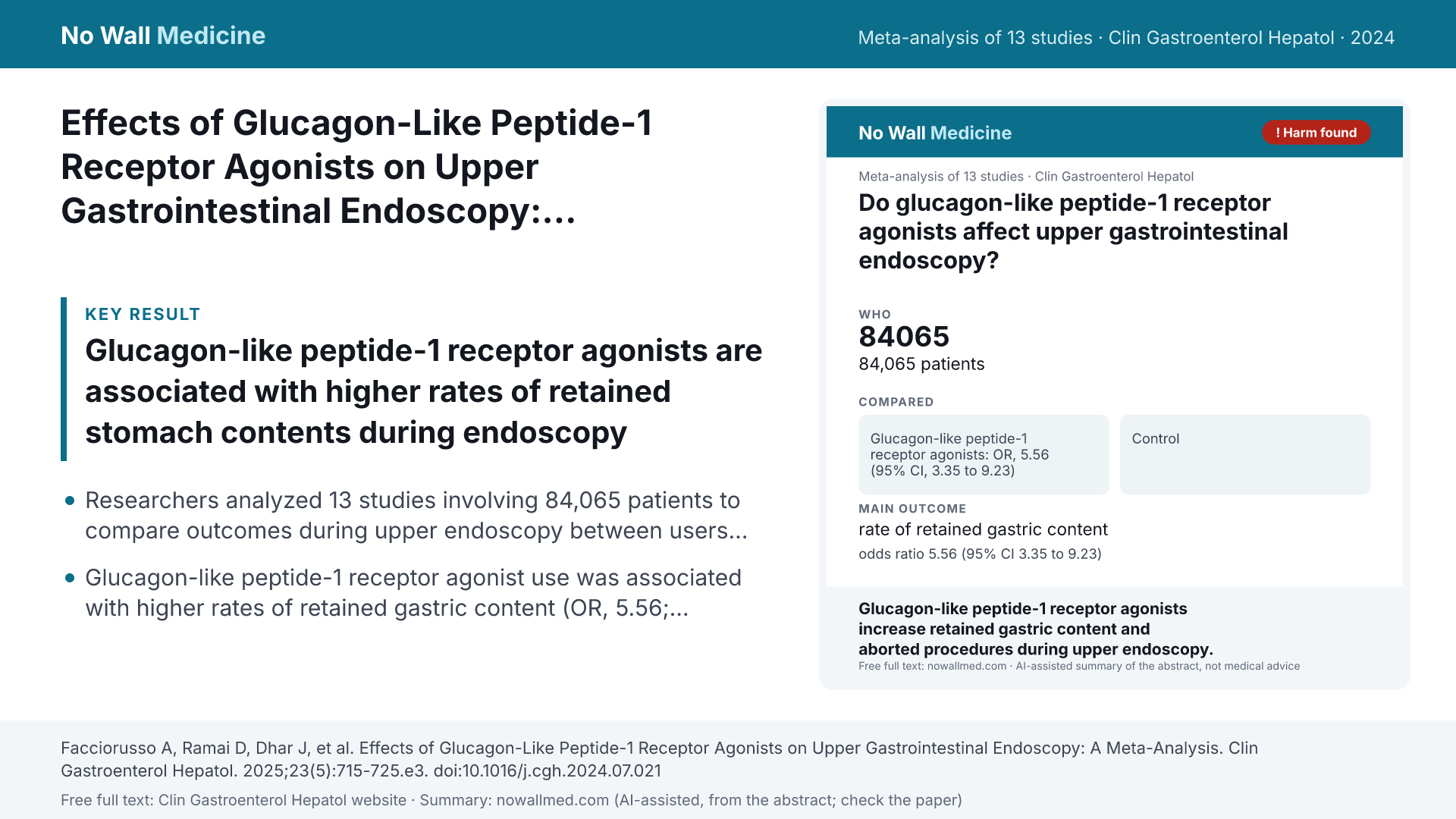
Glucagon-like peptide-1 receptor agonists are associated with higher rates of retained stomach contents during endoscopy
Effects of Glucagon-Like Peptide-1 Receptor Agonists on Upper Gastrointestinal Endoscopy: A Meta-Analysis
Meta-analysis of 13 studiesHarm found
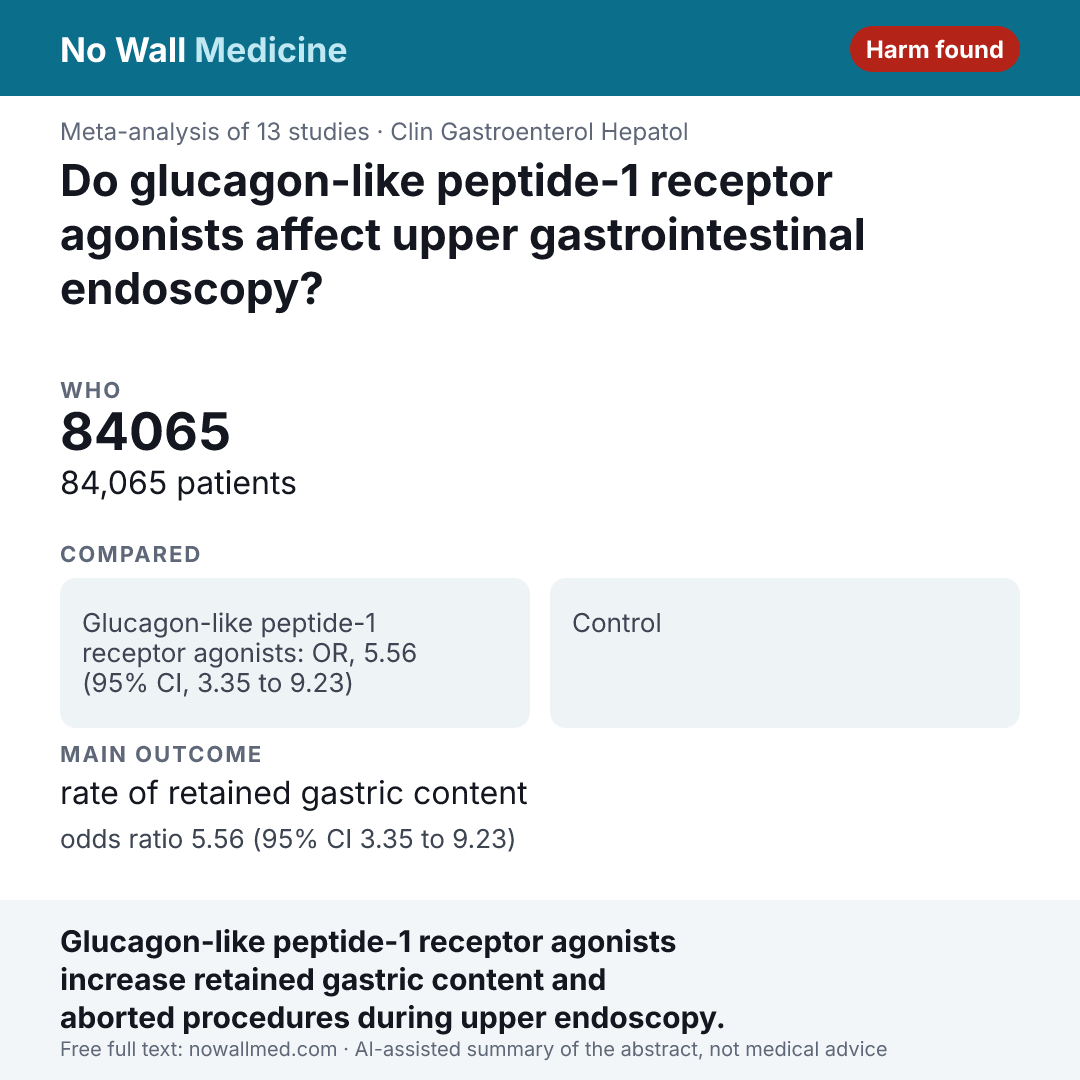
Do glucagon-like peptide-1 receptor agonists affect upper gastrointestinal endoscopy?
Who
84065
84,065 patients
Compared
Glucagon-like peptide-1 receptor agonists: OR, 5.56 (95% CI, 3.35 to 9.23)
Control
Main outcome
rate of retained gastric content
Result: odds ratio 5.56 (95% CI 3.35 to 9.23)
Bottom line: Glucagon-like peptide-1 receptor agonists increase retained gastric content and aborted procedures during upper endoscopy.
Clin Gastroenterol Hepatol · 2024-08-12 · Save PNG
Clinical question: Do glucagon-like peptide-1 receptor agonists affect upper gastrointestinal endoscopy?
Why it matters: The impact of glucagon-like peptide-1 receptor agonists on upper gastrointestinal endoscopy procedures is currently supported by limited evidence.
Key points
- Researchers analyzed 13 studies involving 84,065 patients to compare outcomes during upper endoscopy between users and non-users of glucagon-like peptide-1 receptor agonists.
- Glucagon-like peptide-1 receptor agonist use was associated with higher rates of retained gastric content (OR, 5.56; 95% CI, 3.35 to 9.23) and aborted procedures (OR, 5.13; 95% CI, 3.01 to 8.75).
- No significant differences were found between the groups regarding adverse event rates (OR, 4.04; 95% CI, 0.63 to 26.03) or aspiration rates (OR, 1.75; 95% CI, 0.64 to 4.77).
Headline and key points written with AI from the paper’s abstract, with every number checked against it. Read the paper before relying on them.
Was this summary helpful?
Subject terms
Headline, design, result, key points, caveat and citation as plain text.
Cite this article
Facciorusso A, Ramai D, Dhar J, et al. Effects of Glucagon-Like Peptide-1 Receptor Agonists on Upper Gastrointestinal Endoscopy: A Meta-Analysis. Clin Gastroenterol Hepatol. 2025;23(5):715-725.e3. doi:10.1016/j.cgh.2024.07.021
Spotted a mistake? Suggest a correction