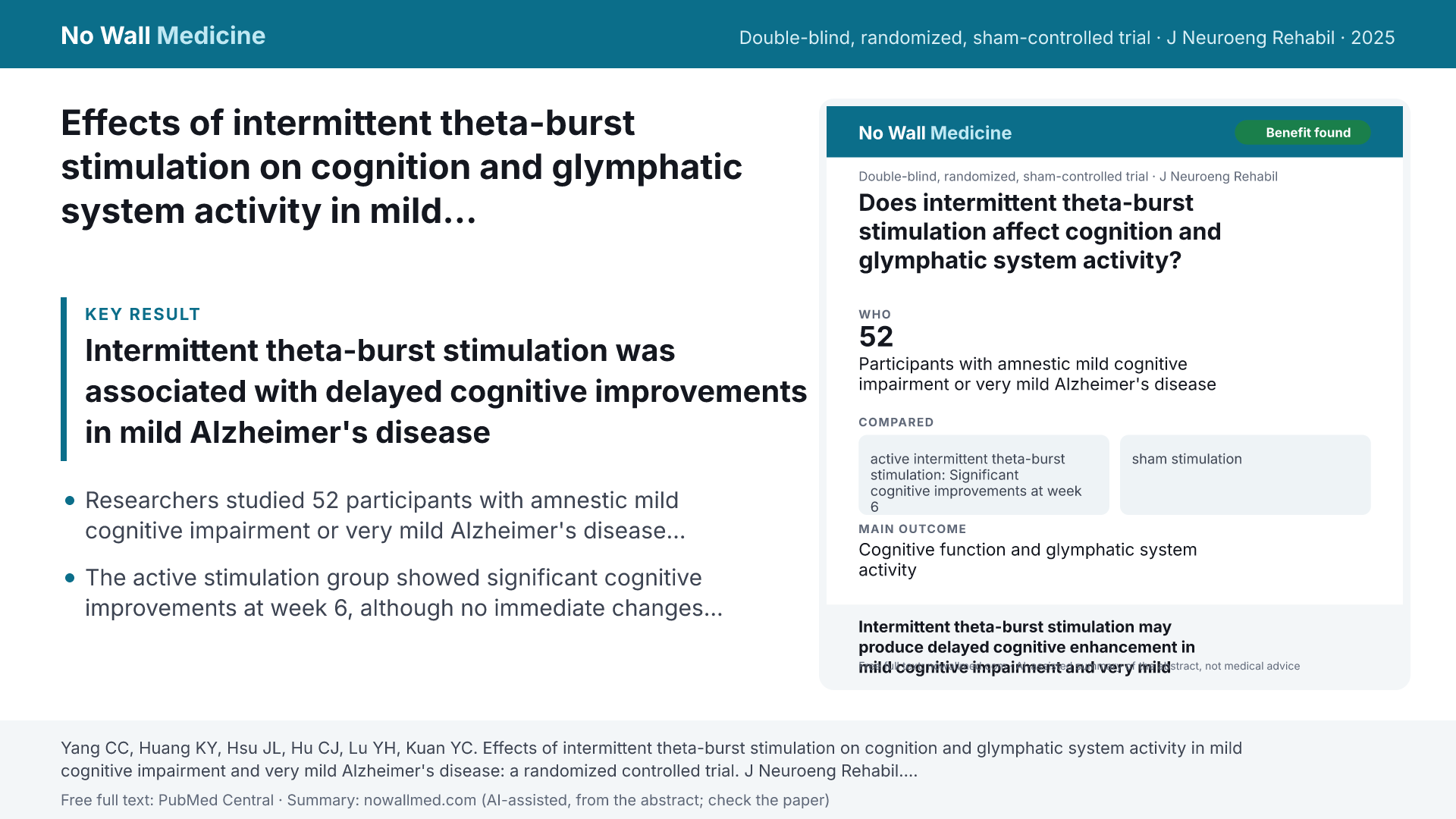
Intermittent theta-burst stimulation was associated with delayed cognitive improvements in mild Alzheimer's disease
Effects of intermittent theta-burst stimulation on cognition and glymphatic system activity in mild cognitive impairment and very mild Alzheimer's disease: a randomized controlled trial
Double-blind, randomized, sham-controlled trialBenefit found
Does intermittent theta-burst stimulation affect cognition and glymphatic system activity?
Who
52
Participants with amnestic mild cognitive impairment or very mild Alzheimer's disease
Compared
active intermittent theta-burst stimulation: Significant cognitive improvements at week 6
sham stimulation
Main outcome
Cognitive function and glymphatic system activity
Bottom line: Intermittent theta-burst stimulation may produce delayed cognitive enhancement in mild cognitive impairment and very mild Alzheimer's disease.
J Neuroeng Rehabil · 2025-09-26Download image
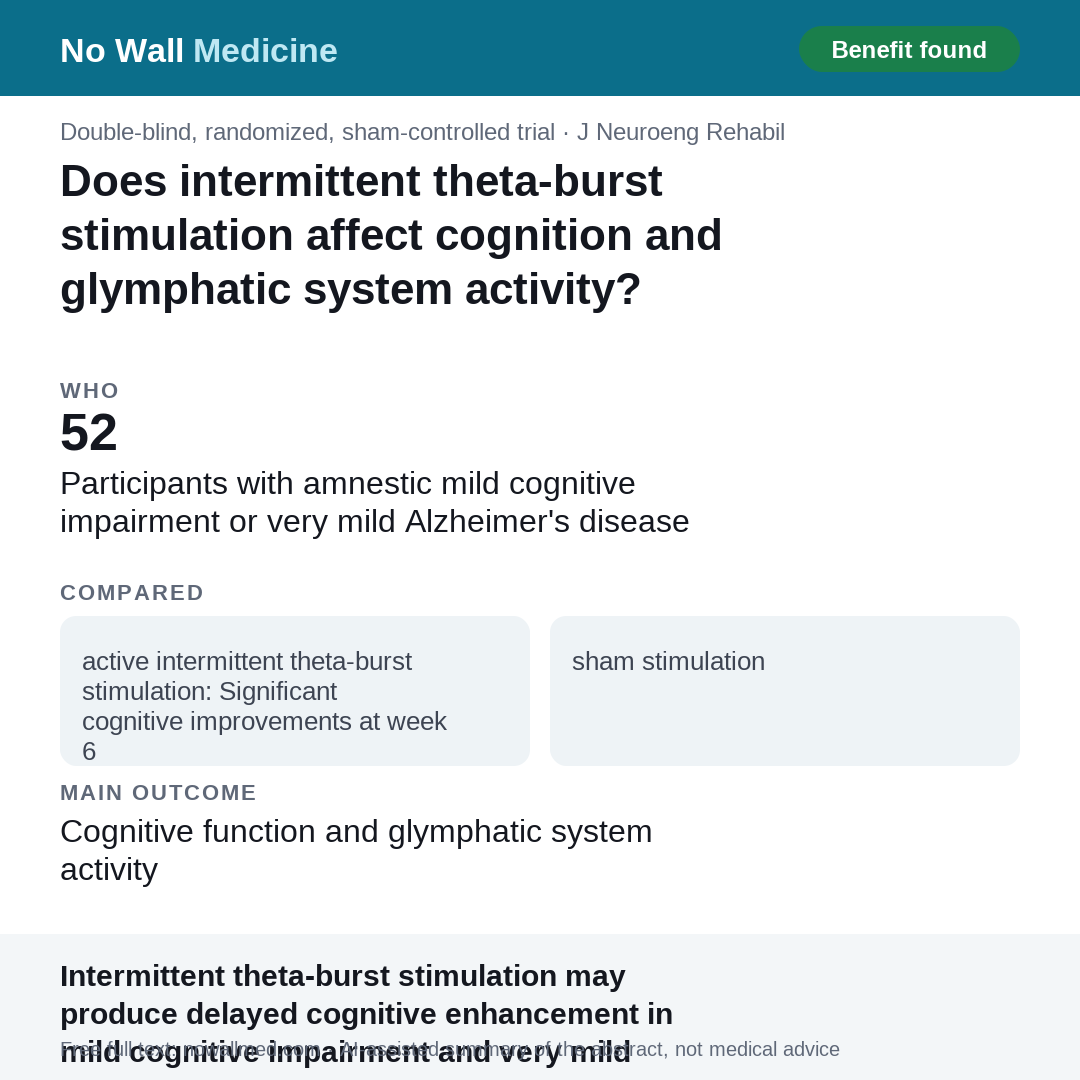
Clinical question: Does intermittent theta-burst stimulation affect cognition and glymphatic system activity?
Why it matters: It is uncertain how magnetic brain stimulation impacts human glymphatic system activity and whether it can improve cognitive function in patients with early Alzheimer's disease.
Key points
- Researchers studied 52 participants with amnestic mild cognitive impairment or very mild Alzheimer's disease using intermittent theta-burst stimulation, a type of magnetic brain stimulation.
- The active stimulation group showed significant cognitive improvements at week 6, although no immediate changes in cognition or glymphatic system activity were observed.
- The study measured glymphatic system activity, which is the brain's waste clearance system, using a technique called diffusion tensor image analysis along the perivascular space.
Headline and key points written with AI from the paper’s abstract, with every number checked against it. Read the paper before relying on them.
Was this summary helpful?
Subject terms
Cite this article
Yang CC, Huang KY, Hsu JL, Hu CJ, Lu YH, Kuan YC. Effects of intermittent theta-burst stimulation on cognition and glymphatic system activity in mild cognitive impairment and very mild Alzheimer's disease: a randomized controlled trial. J Neuroeng Rehabil. 2025. doi:10.1186/s12984-025-01738-1
Spotted a mistake? Suggest a correction