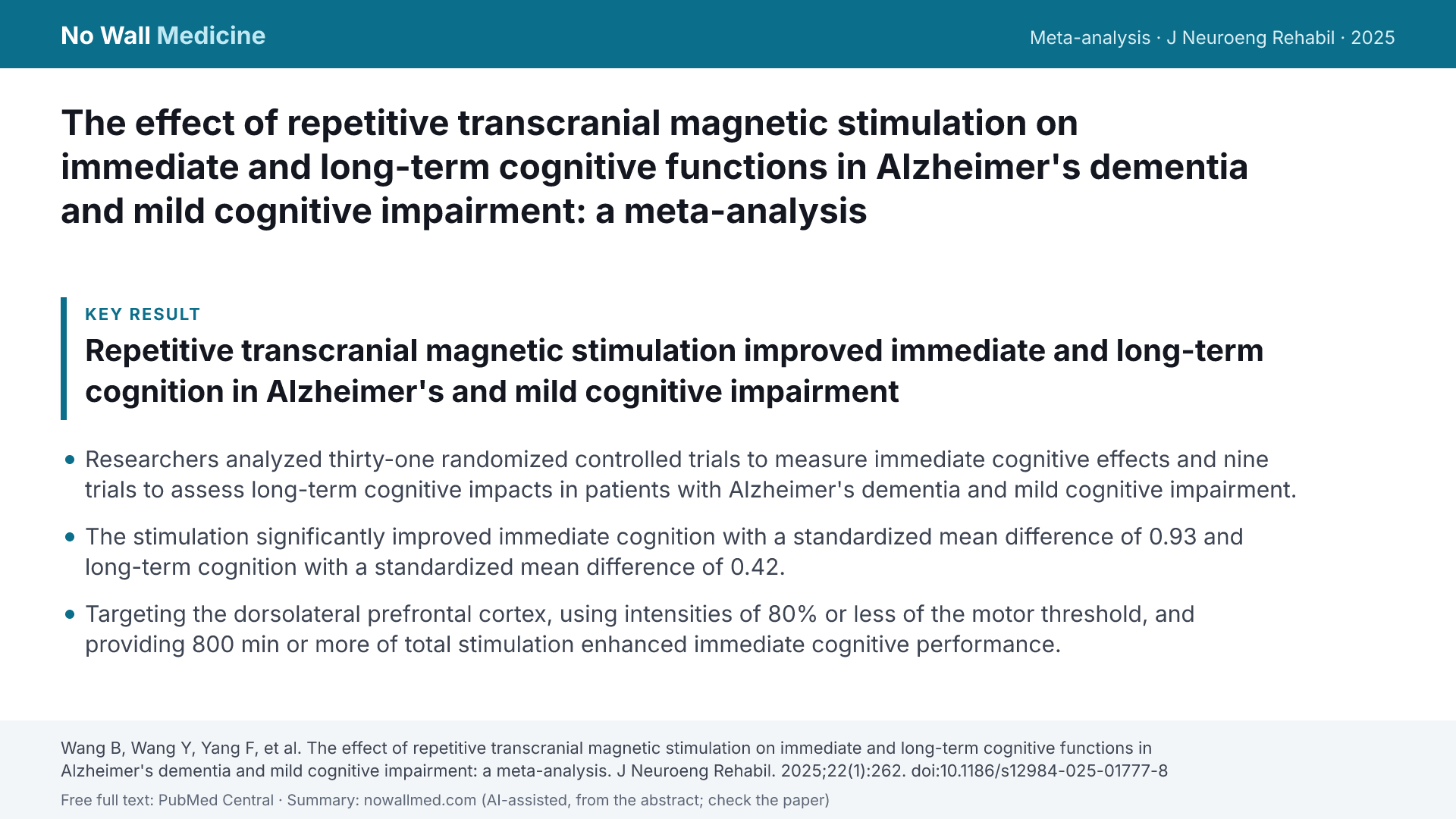
Repetitive transcranial magnetic stimulation improved immediate and long-term cognition in Alzheimer's and mild cognitive impairment
The effect of repetitive transcranial magnetic stimulation on immediate and long-term cognitive functions in Alzheimer's dementia and mild cognitive impairment: a meta-analysis
Why it matters: The impact of repetitive transcranial magnetic stimulation on immediate and long-term cognitive functions and the optimal stimulation parameters require further clarification.
Key points
- Researchers analyzed thirty-one randomized controlled trials to measure immediate cognitive effects and nine trials to assess long-term cognitive impacts in patients with Alzheimer's dementia and mild cognitive impairment.
- The stimulation significantly improved immediate cognition with a standardized mean difference of 0.93 and long-term cognition with a standardized mean difference of 0.42.
- Targeting the dorsolateral prefrontal cortex, using intensities of 80% or less of the motor threshold, and providing 800 min or more of total stimulation enhanced immediate cognitive performance.
Headline and key points written with AI from the paper’s abstract, with every number checked against it. Read the paper before relying on them.
Was this summary helpful?
Subject terms
Headline, design, result, key points, caveat and citation as plain text.
Cite this article
Wang B, Wang Y, Yang F, et al. The effect of repetitive transcranial magnetic stimulation on immediate and long-term cognitive functions in Alzheimer's dementia and mild cognitive impairment: a meta-analysis. J Neuroeng Rehabil. 2025. doi:10.1186/s12984-025-01777-8
Spotted a mistake? Suggest a correction