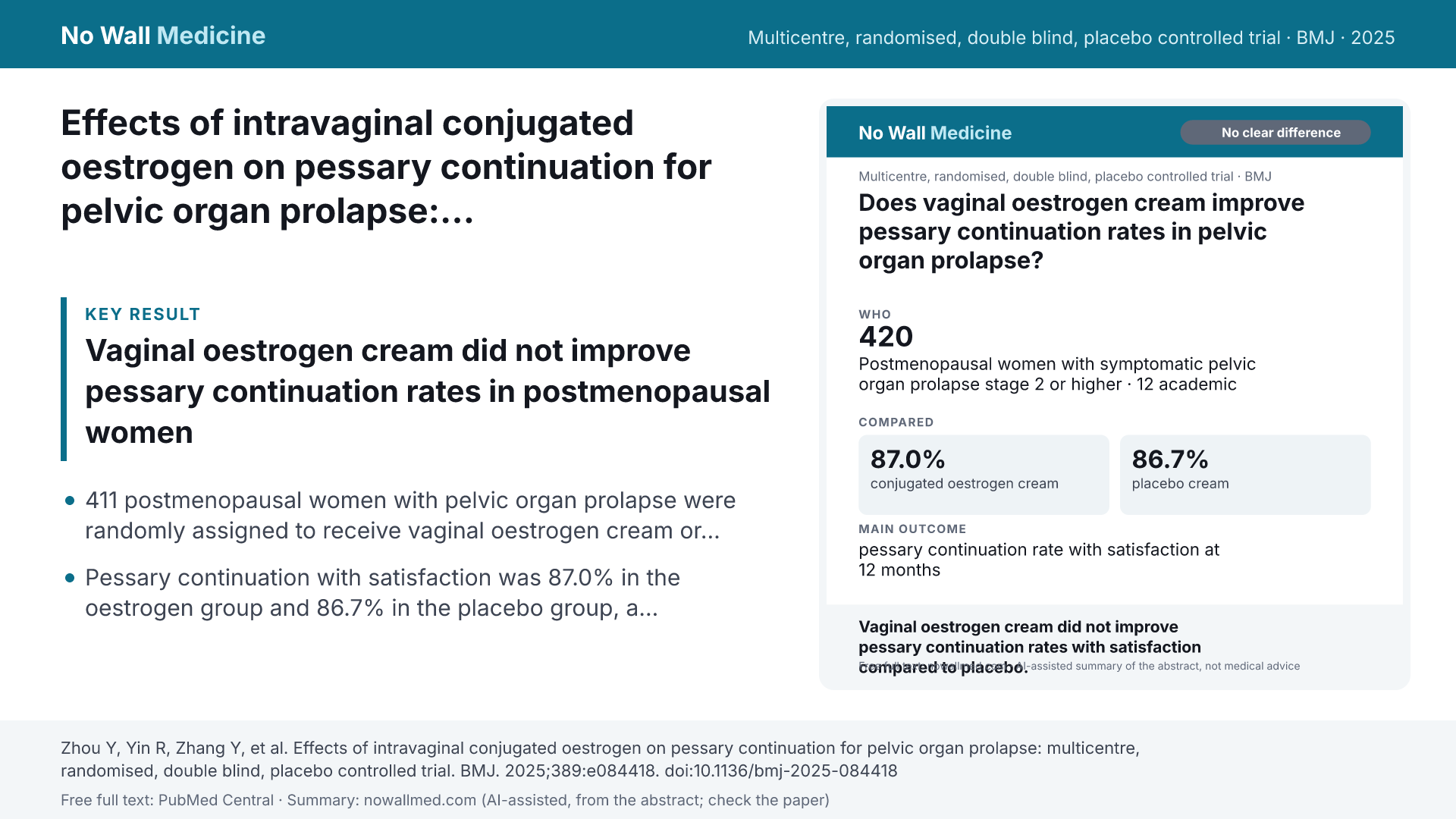
Vaginal oestrogen cream did not improve pessary continuation rates in postmenopausal women
Effects of intravaginal conjugated oestrogen on pessary continuation for pelvic organ prolapse: multicentre, randomised, double blind, placebo controlled trial
Multicentre, randomised, double blind, placebo controlled trialNo clear difference
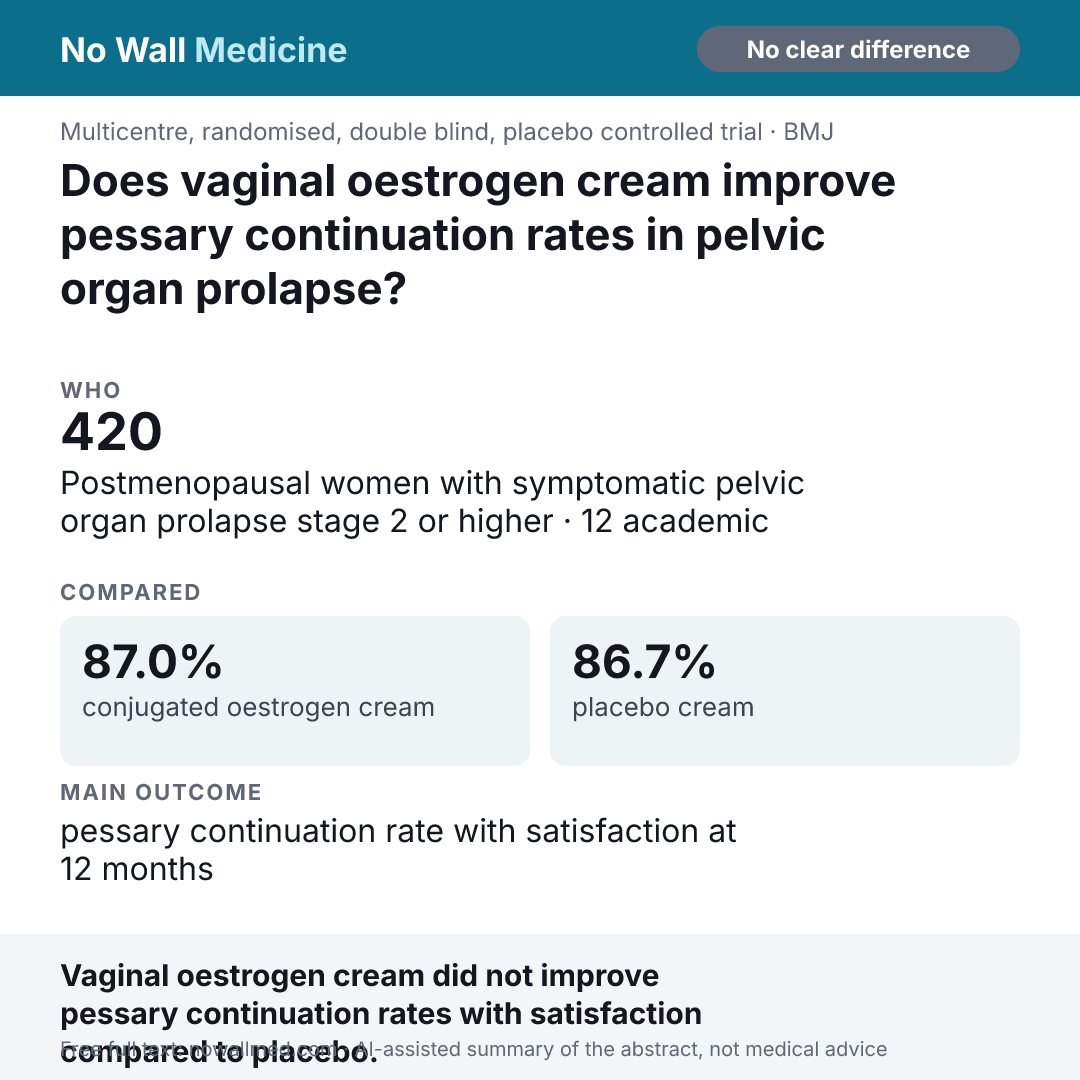
Does vaginal oestrogen cream improve pessary continuation rates in pelvic organ prolapse?
Who
420
Postmenopausal women with symptomatic pelvic organ prolapse stage 2 or higher · 12 academic medical centres in China
Compared
87.0%conjugated oestrogen cream
86.7%placebo cream
Main outcome
pessary continuation rate with satisfaction at 12 months
Result: risk difference 0.3%, 95% confidence interval -6.2% to 6.9%
Bottom line: Vaginal oestrogen cream did not improve pessary continuation rates with satisfaction compared to placebo.
BMJ · 2025-06-27 · Save PNG
Clinical question: Does vaginal oestrogen cream improve pessary continuation rates in pelvic organ prolapse?
Key points
- 411 postmenopausal women with pelvic organ prolapse were randomly assigned to receive vaginal oestrogen cream or placebo cream for 12 months.
- Pessary continuation with satisfaction was 87.0% in the oestrogen group and 86.7% in the placebo group, a difference that was not statistically significant.
- Excessive discharge, vaginal erosion, and vaginal bleeding were significantly less common in the oestrogen group compared with the placebo group.
Headline and key points written with AI from the paper’s abstract, with every number checked against it. Read the paper before relying on them.
Was this summary helpful?
Abstract
Objective
To examine the effect of vaginal oestrogen cream on pessary continuation rates in pelvic organ prolapse. Design
Multicentre, randomised, double blind, placebo controlled trial. Setting
12 academic medical centres in China (May 2020-June 2023). Participants
Postmenopausal women with symptomatic pelvic organ prolapse ≥stage 2 and successfully fitted with ring pessaries were randomly assigned in a 1:1 ratio to receive oestrogen cream or placebo cream. Interventions
One gram of conjugated oestrogen cream (0.625 mg/g) or placebo cream was inserted vaginally every night for the first two weeks after successful pessary fitting followed by twice weekly for 12 months. Main outcome measures
The primary outcome was the pessary continuation rate with satisfaction, which was defined as the proportion of participants who continued using the pessary and reported a response of very much better or much better on the Patient Global Impression of Improvement questionnaire at 12 months. Secondary outcomes included self-reported pelvic floor symptoms and adverse events. All analyses were based on a modified intention-to-treat approach, including participants who had at least one visit. Results
Of 420 postmenopausal women randomised, 411 had at least one visit and were included in the modified intention-to-treat analysis (208 in the vaginal oestrogen group and 203 in the placebo group). The mean age of participants was 66 years. Pessary continuation rate with satisfaction did not differ significantly between the oestrogen group and the placebo group (181/208 (87.0%) v 176/203 (86.7%); risk difference 0.3%, 95% confidence interval -6.2% to 6.9%; P=0.92). Excessive discharge (34/208 (16.3%) v 52/203 (25.6%); -9.3%, -17.1% to -1.4%), vaginal erosion or ulcer (4/208 (1.9%) v 14/203 (6.9%); -5.0%, -8.9% to -1.0%), and vaginal bleeding (3/208 (1.4%) v 13/203 (6.4%); -5.0%, -8.7% to -1.2%) were less common in the vaginal oestrogen group. Conclusions
Oestrogen cream did not improve the continuation rate of ring pessary use with satisfaction. Use of oestrogen cream might be associated with a lower risk of common adverse events. The clinical decision to use vaginal oestrogen should take into account its benefits and risks and the patient's personal preferences. Trial registration
ClinicalTrials.gov NCT04393194.
Abstract reproduced under the article’s CC BY NC licence.
Subject terms
Headline, design, result, key points, caveat and citation as plain text.
Cite this article
Zhou Y, Yin R, Zhang Y, et al. Effects of intravaginal conjugated oestrogen on pessary continuation for pelvic organ prolapse: multicentre, randomised, double blind, placebo controlled trial. BMJ. 2025;389:e084418. doi:10.1136/bmj-2025-084418
Spotted a mistake? Suggest a correction