Ischaemic postconditioning showed no overall cardioprotective effects in patients undergoing aortic valve replacement
Effects of ischaemic postconditioning in aortic valve replacement: a multicenter randomized controlled trial
Multicentre, prospective, randomized trialNo clear difference
Does ischaemic postconditioning improve postcardioplegic cardiac function in elective aortic valve replacement?
Who
209
Adult patients undergoing elective aortic valve replacement · Multicentre
Compared
Standard operation
Postconditioning
Main outcome
Cardiac index
Result: mean between-group difference, 95% confidence interval (CI), 0.11 (-0.1 to 0.3)
Bottom line: Ischaemic postconditioning had no overall cardioprotective effects in patients undergoing aortic valve replacement.
Eur J Cardiothorac Surg · 2021-12-02Download image
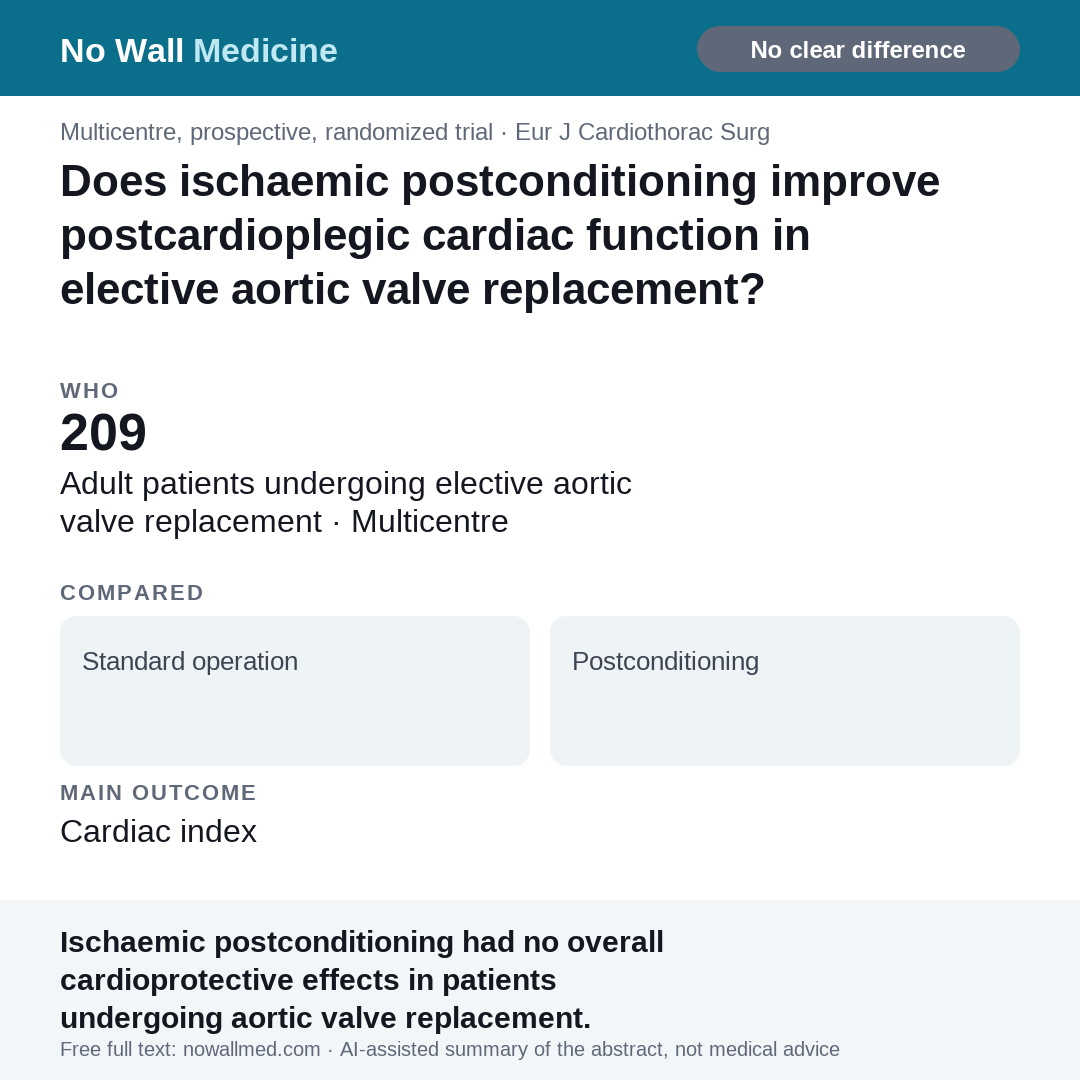
Clinical question: Does ischaemic postconditioning improve postcardioplegic cardiac function in elective aortic valve replacement?
Why it matters: The effect of ischaemic postconditioning, which involves brief cycles of blood flow after heart surgery, on heart function after aortic valve replacement is not known.
Key points
- Researchers studied 209 adult patients undergoing elective aortic valve replacement, comparing standard operations to three cycles of flow and non-flow of blood.
- The treatment showed no significant difference in cardiac index, which is a measure of blood flow, and no effect on troponin T or creatine kinase MB.
- Postconditioning was associated with a 45% reduction in the relative risk for combined postoperative atrial fibrillation and intraoperative ventricular fibrillation.
Headline and key points written with AI from the paper’s abstract, with every number checked against it. Read the paper before relying on them.
Was this summary helpful?
Subject terms
Cite this article
Kaljusto ML, Bautin A, Jakobsen Ø, Wilimski R, Brunborg C, Wennemo M. Effects of ischaemic postconditioning in aortic valve replacement: a multicenter randomized controlled trial. Eur J Cardiothorac Surg. 2021. doi:10.1093/ejcts/ezab500
Spotted a mistake? Suggest a correction
Top studies every Monday
The week’s key trials and guidelines in your specialties, plus any topics you follow. By email, free.
Get the weekly digest