Effects of Limiting Recreational Screen Media Use on Physical Activity and Sleep in Families With Children: A Cluster Randomized Clinical Trial
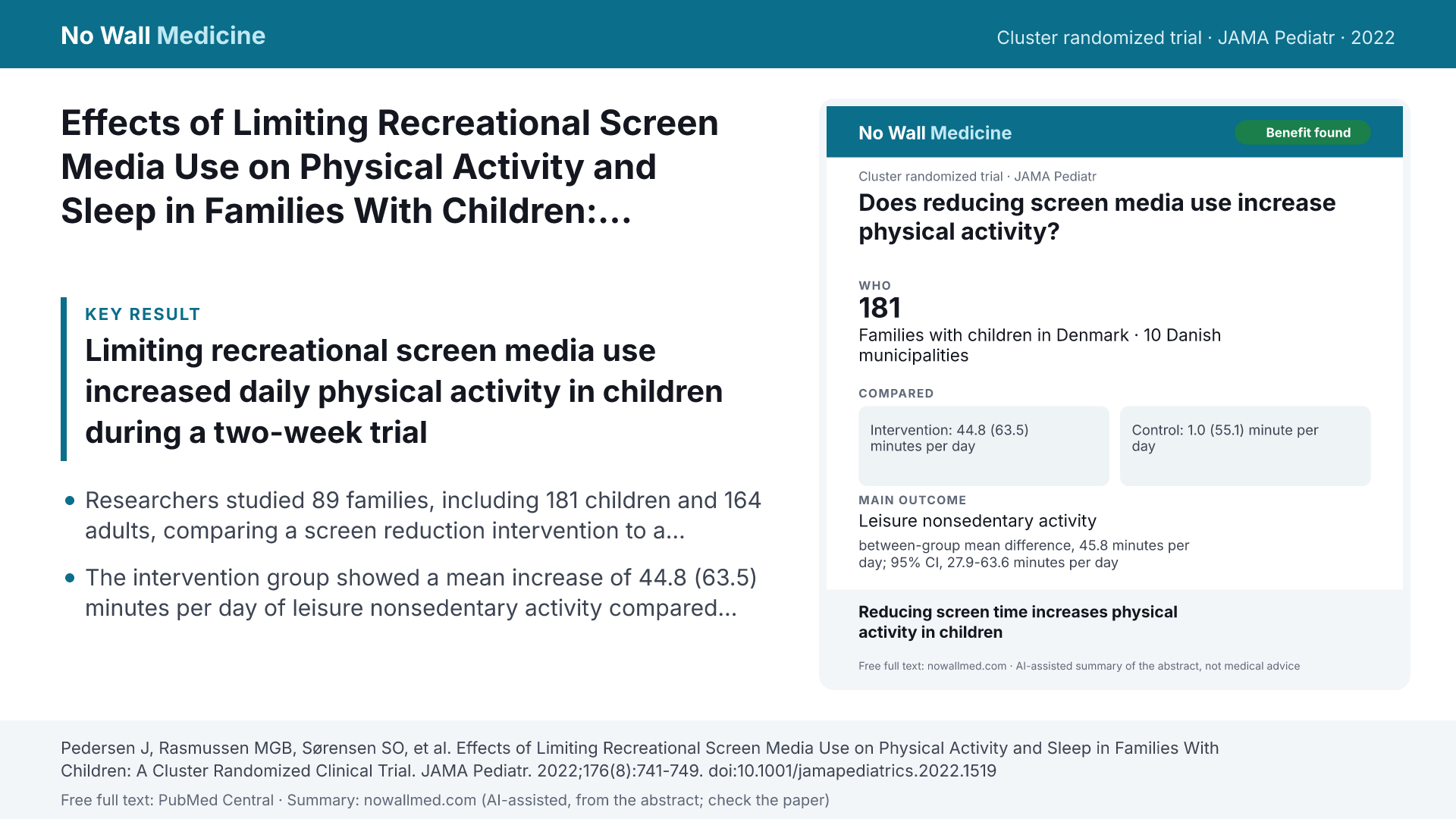
Key result: Limiting recreational screen media use increased daily physical activity in children during a two-week trial
Cluster randomized trialBenefit found
Does reducing screen media use increase physical activity?
Who
181
Families with children in Denmark · 10 Danish municipalities
Compared
Intervention: 44.8 (63.5) minutes per day
Control: 1.0 (55.1) minute per day
Main outcome
Leisure nonsedentary activity
Result: between-group mean difference, 45.8 minutes per day; 95% CI, 27.9-63.6 minutes per day
Bottom line: Reducing screen time increases physical activity in children
JAMA Pediatr · 2022-05-24
Key points
- Researchers studied 89 families, including 181 children and 164 adults, comparing a screen reduction intervention to a control group.
- The intervention group showed a mean increase of 44.8 (63.5) minutes per day of leisure nonsedentary activity compared to 1.0 (55.1) minute in the control group.
- No significant differences were found between the groups for sleep outcomes measured by electroencephalography, which tracks brain activity during sleep.
Discussion prompts
- Would these patients look like yours? Who was left out?
- Is the main outcome one that matters to patients?
- Is the difference large enough to change what you do?
Cite: Pedersen J, Rasmussen MGB, Sørensen SO, et al. Effects of Limiting Recreational Screen Media Use on Physical Activity and Sleep in Families With Children: A Cluster Randomized Clinical Trial. JAMA Pediatr. 2022;176(8):741-749. doi:10.1001/jamapediatrics.2022.1519
Free full text: PubMed Central · Summary and visual abstract: nowallmed.com/a/effects-of-limiting-recreational-screen-media-use-on-physical-g3whdy/ (AI-assisted from the abstract; check the paper before relying on it).