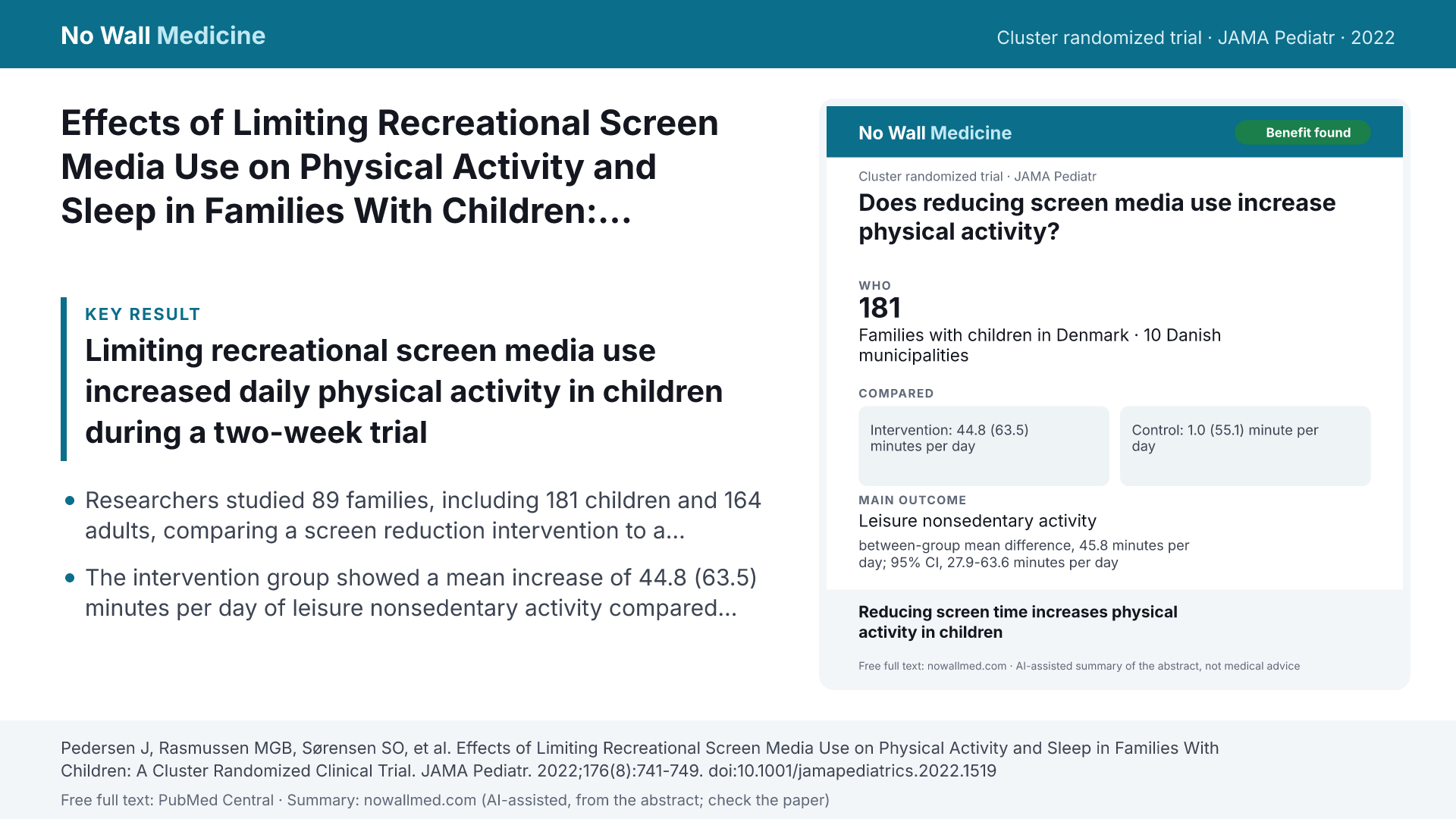
Limiting recreational screen media use increased daily physical activity in children during a two-week trial
Effects of Limiting Recreational Screen Media Use on Physical Activity and Sleep in Families With Children: A Cluster Randomized Clinical Trial
Cluster randomized trialBenefit found
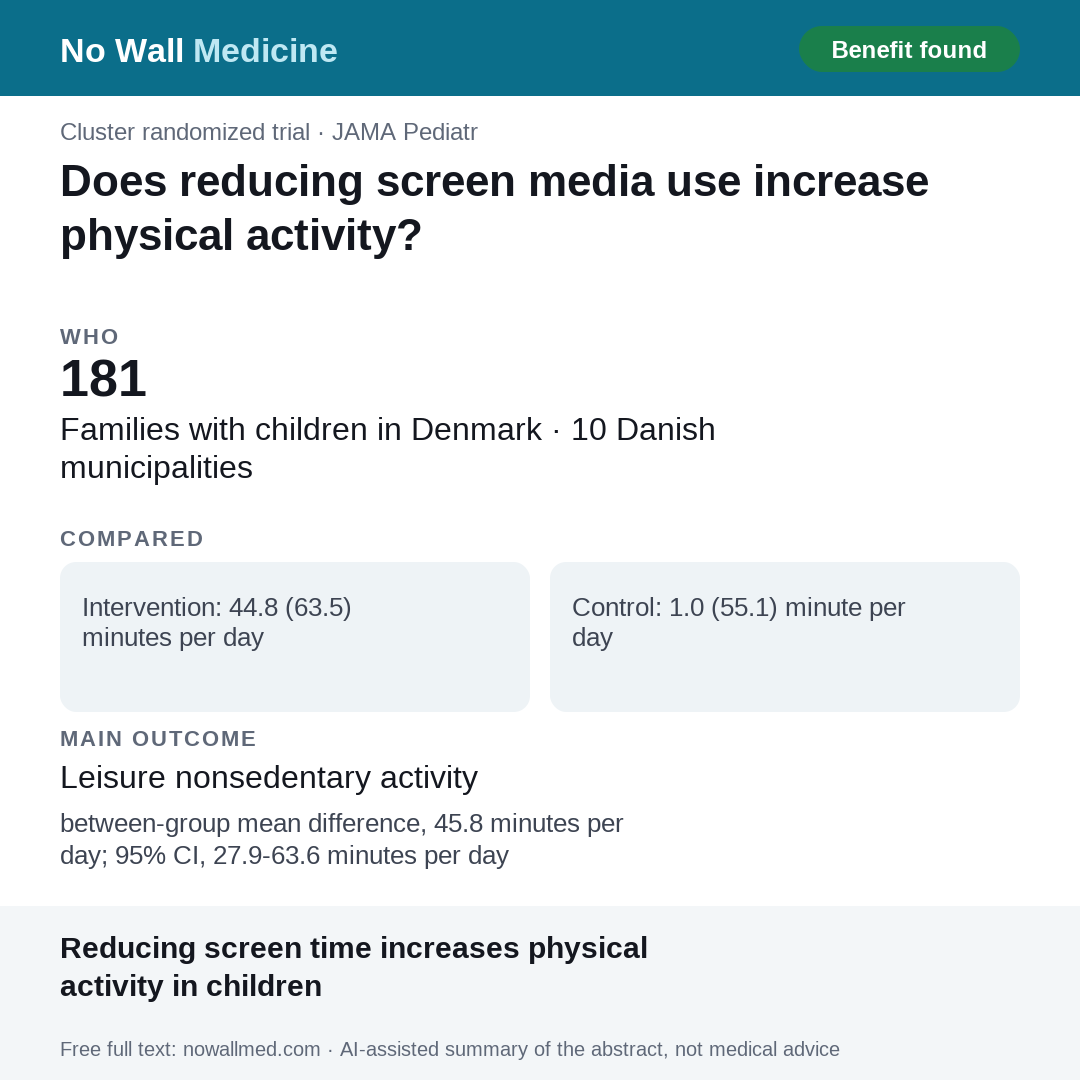
Does reducing screen media use increase physical activity?
Who
181
Families with children in Denmark · 10 Danish municipalities
Compared
Intervention: 44.8 (63.5) minutes per day
Control: 1.0 (55.1) minute per day
Main outcome
Leisure nonsedentary activity
Result: between-group mean difference, 45.8 minutes per day; 95% CI, 27.9-63.6 minutes per day
Bottom line: Reducing screen time increases physical activity in children
JAMA Pediatr · 2022-05-24Download image
Same trial (NCT04098913)
Papers we list that report this registered trial, oldest first. Read a secondary analysis alongside the main results.
- Main results Benefit found
This paper JAMA Pediatr 2022-05 - Secondary analysis Benefit found
Reducing leisure-time screen media use for two weeks was associated with better mental health JAMA Netw Open 2024-07
Clinical question: Does reducing screen media use increase physical activity?
Key points
- Researchers studied 89 families, including 181 children and 164 adults, comparing a screen reduction intervention to a control group.
- The intervention group showed a mean increase of 44.8 (63.5) minutes per day of leisure nonsedentary activity compared to 1.0 (55.1) minute in the control group.
- No significant differences were found between the groups for sleep outcomes measured by electroencephalography, which tracks brain activity during sleep.
Headline and key points written with AI from the paper’s abstract, with every number checked against it. Read the paper before relying on them.
Was this summary helpful?
Subject terms
Headline, design, result, key points, caveat and citation as plain text.
Cite this article
Pedersen J, Rasmussen MGB, Sørensen SO, et al. Effects of Limiting Recreational Screen Media Use on Physical Activity and Sleep in Families With Children: A Cluster Randomized Clinical Trial. JAMA Pediatr. 2022;176(8):741-749. doi:10.1001/jamapediatrics.2022.1519
Spotted a mistake? Suggest a correction