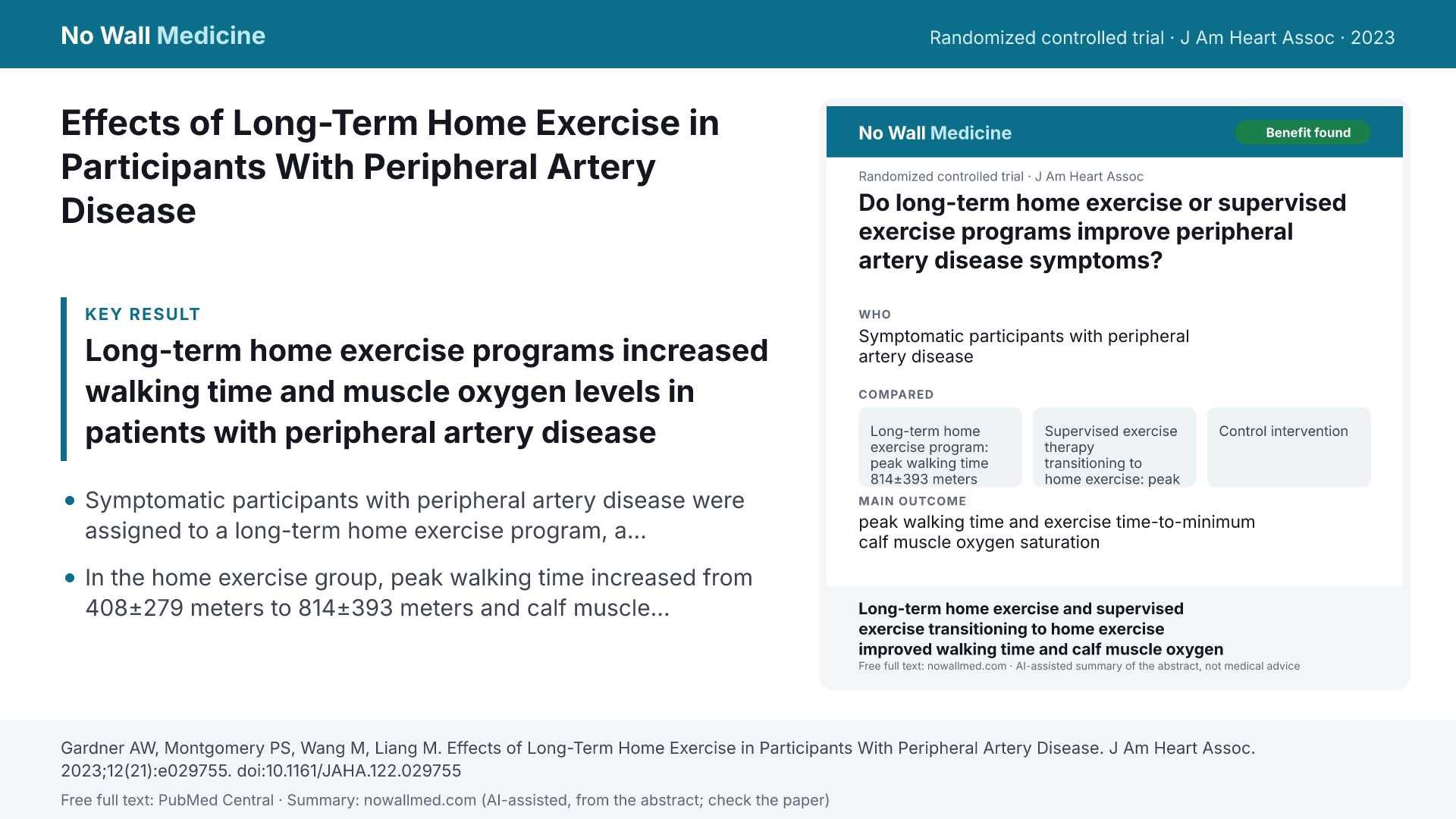
Long-term home exercise programs increased walking time and muscle oxygen levels in patients with peripheral artery disease
Effects of Long-Term Home Exercise in Participants With Peripheral Artery Disease
Randomized controlled trialBenefit found
Do long-term home exercise or supervised exercise programs improve peripheral artery disease symptoms?
Who
Symptomatic participants with peripheral artery disease
Compared
Long-term home exercise program: peak walking time 814±393 meters
Supervised exercise therapy transitioning to home exercise: peak walking time 818±313 meters
Control intervention
Main outcome
peak walking time and exercise time-to-minimum calf muscle oxygen saturation
Bottom line: Long-term home exercise and supervised exercise transitioning to home exercise improved walking time and calf muscle oxygen saturation.
J Am Heart Assoc · 2023-11-06Download image
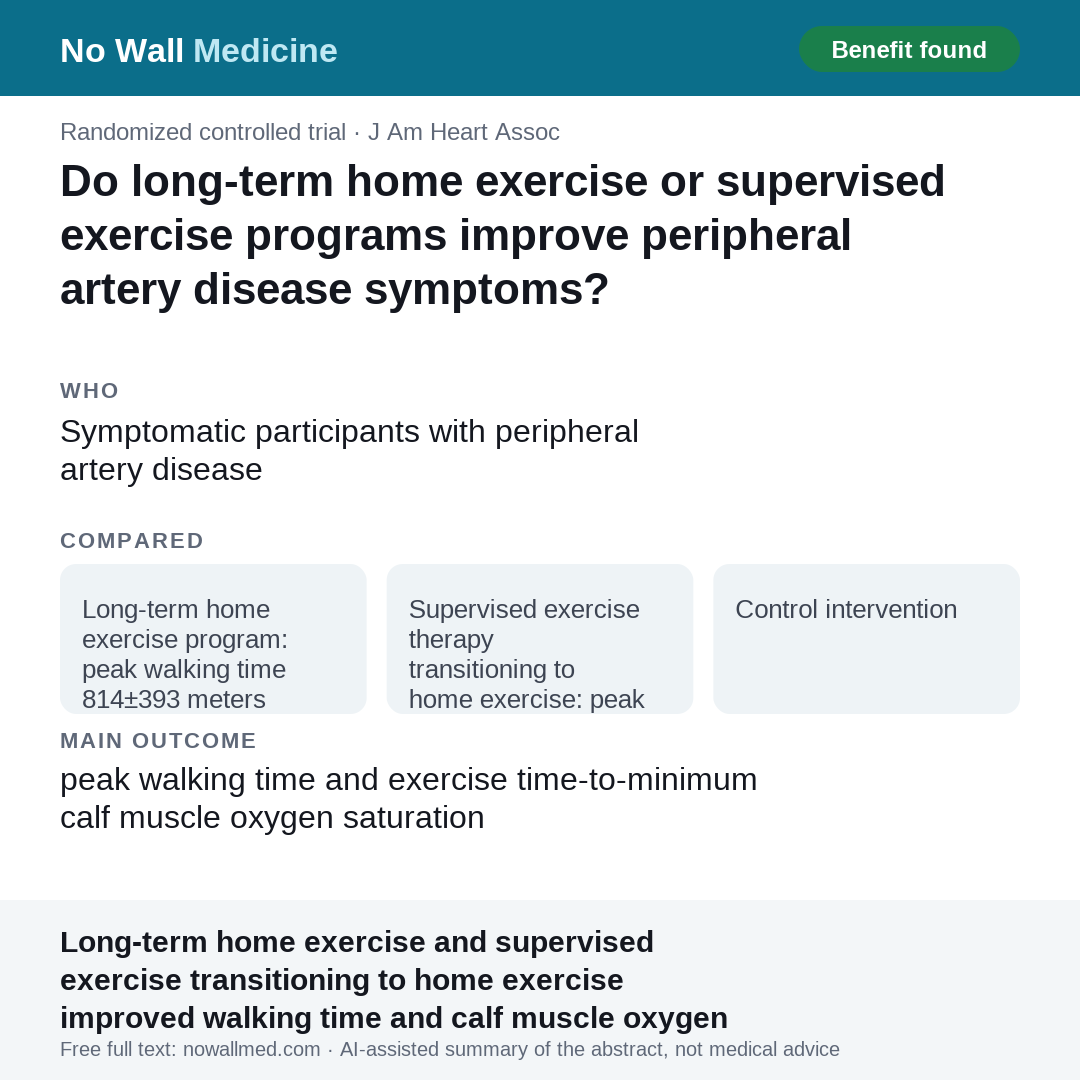
Clinical question: Do long-term home exercise or supervised exercise programs improve peripheral artery disease symptoms?
Why it matters: It was unknown how long-term home exercise programs compare to supervised therapy and walking advice for improving walking distance and muscle oxygen levels in peripheral artery disease.
Key points
- Symptomatic participants with peripheral artery disease were assigned to a long-term home exercise program, a supervised program transitioning to home exercise, or a control group.
- In the home exercise group, peak walking time increased from 408±279 meters to 814±393 meters and calf muscle oxygen saturation time increased from 238±241 seconds to 497±485 seconds.
- In the supervised-to-home group, peak walking time increased from 457±288 meters to 818±313 meters and calf muscle oxygen saturation time increased from 296±289 seconds to 620±450 seconds.
Headline and key points written with AI from the paper’s abstract, with every number checked against it. Read the paper before relying on them.
Was this summary helpful?
Subject terms
Cite this article
Gardner AW, Montgomery PS, Wang M, Liang M. Effects of Long-Term Home Exercise in Participants With Peripheral Artery Disease. J Am Heart Assoc. 2023. doi:10.1161/JAHA.122.029755
Spotted a mistake? Suggest a correction