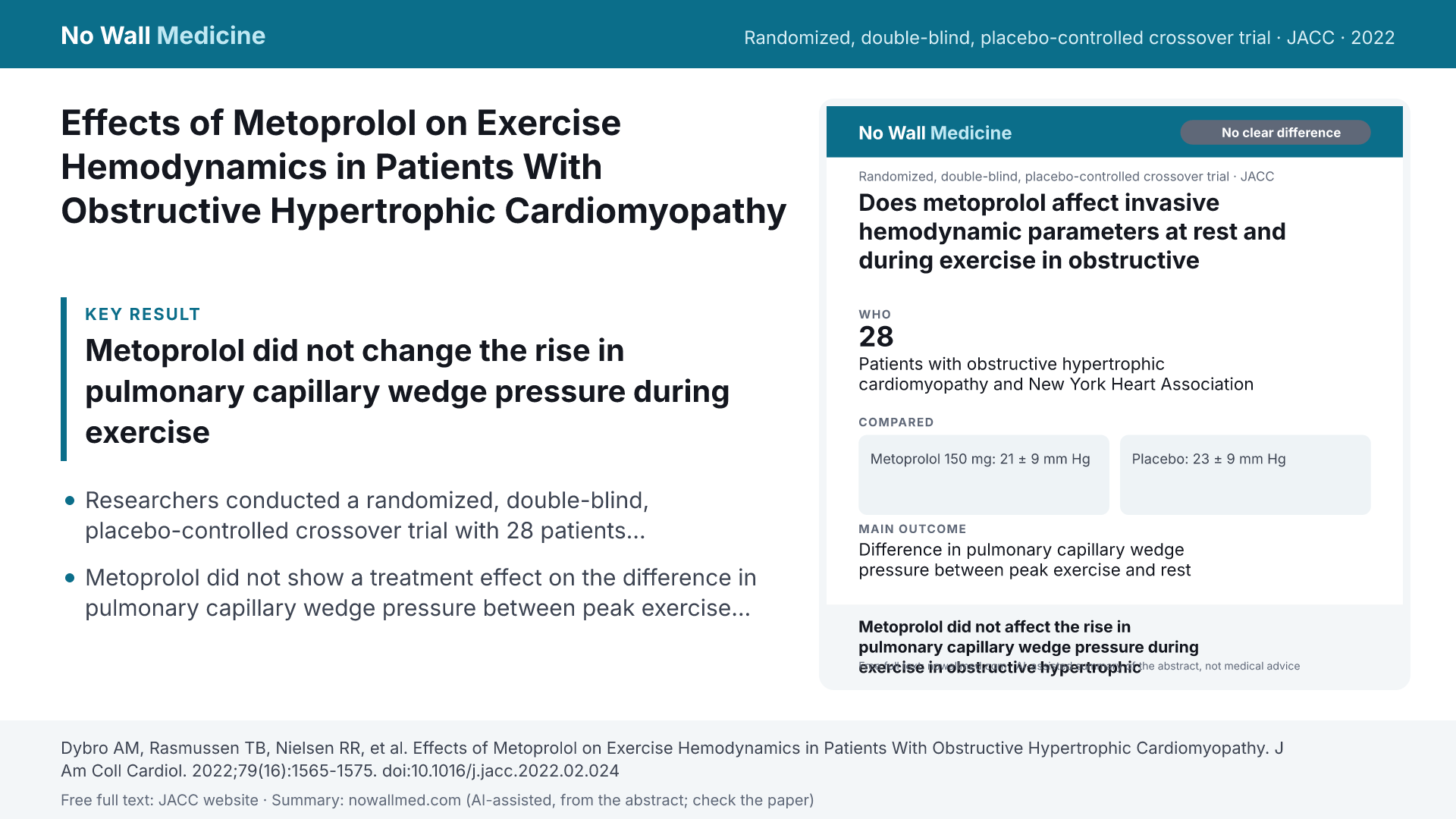
Metoprolol did not change the rise in pulmonary capillary wedge pressure during exercise
Effects of Metoprolol on Exercise Hemodynamics in Patients With Obstructive Hypertrophic Cardiomyopathy
Randomized, double-blind, placebo-controlled crossover trialNo clear difference
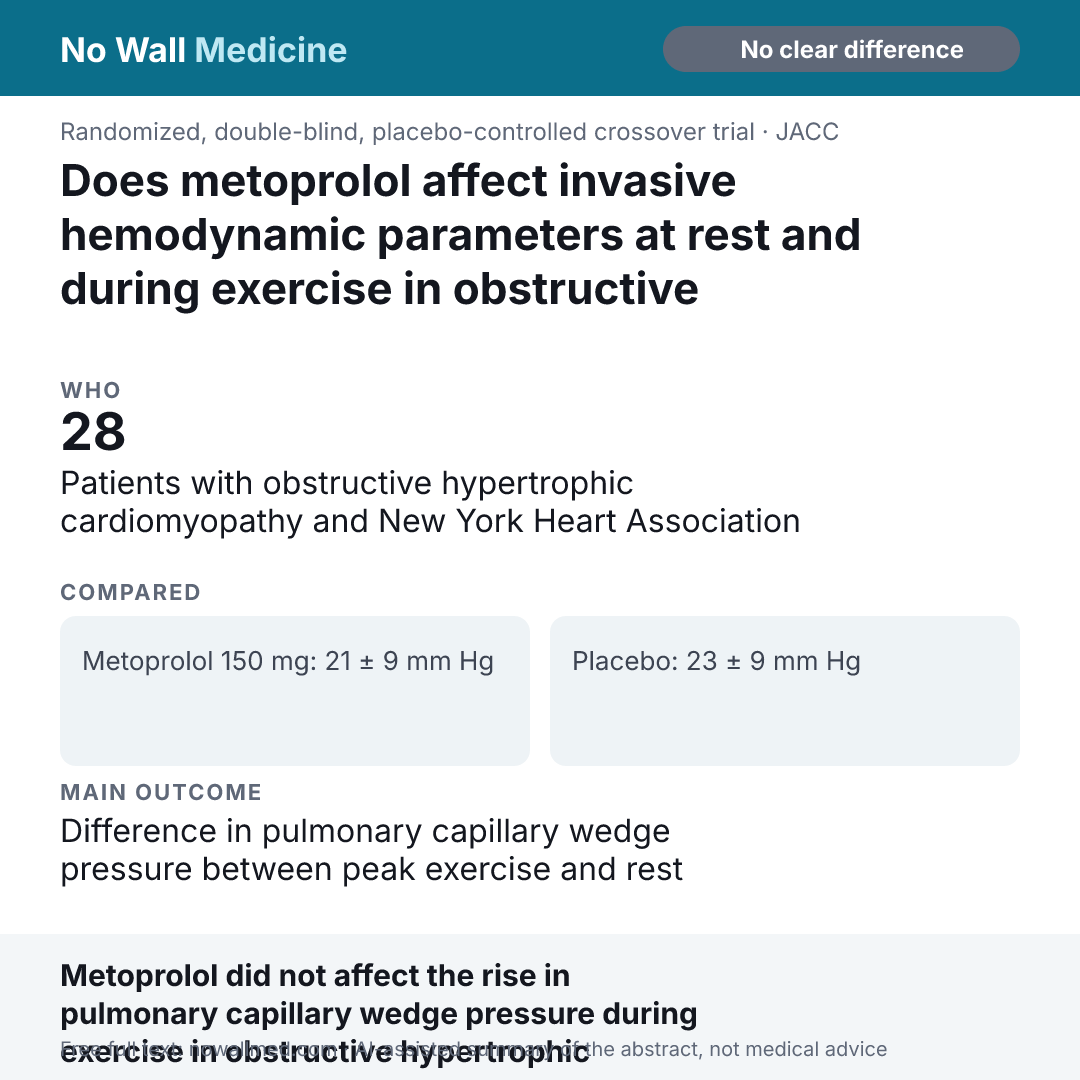
Does metoprolol affect invasive hemodynamic parameters at rest and during exercise in obstructive hypertrophic cardiomyopathy?
Who
28
Patients with obstructive hypertrophic cardiomyopathy and New York Heart Association functional class ≥II
Compared
Metoprolol 150 mg: 21 ± 9 mm Hg
Placebo: 23 ± 9 mm Hg
Main outcome
Difference in pulmonary capillary wedge pressure between peak exercise and rest
Bottom line: Metoprolol did not affect the rise in pulmonary capillary wedge pressure during exercise in obstructive hypertrophic cardiomyopathy.
JACC · 2022-04-22 · Save PNG
Same trial (NCT03532802)
Papers we list that report this registered trial, oldest first. Read a secondary analysis alongside the main results.
- Main results Key finding
Metoprolol reduced heart outflow obstruction and symptoms in patients with obstructive hypertrophic cardiomyopathy JACC 2021-12 - Related analysis No clear difference
This paper JACC 2022-04
Clinical question: Does metoprolol affect invasive hemodynamic parameters at rest and during exercise in obstructive hypertrophic cardiomyopathy?
Why it matters: The relationship between medical treatment and exercise hemodynamics, such as pressure in the lungs, is incompletely understood in patients with obstructive hypertrophic cardiomyopathy.
Key points
- Researchers conducted a randomized, double-blind, placebo-controlled crossover trial with 28 patients with obstructive hypertrophic cardiomyopathy.
- Metoprolol did not show a treatment effect on the difference in pulmonary capillary wedge pressure between peak exercise and rest compared to placebo (21 ± 9 mm Hg vs 23 ± 9 mm Hg; P = 0.12).
- At peak exercise, metoprolol was associated with a lower heart rate, a lower left ventricular outflow tract gradient, less mitral regurgitation, and an increased stroke volume of +9 mL.
Headline and key points written with AI from the paper’s abstract, with every number checked against it. Read the paper before relying on them.
Was this summary helpful?
Subject terms
Headline, design, result, key points, caveat and citation as plain text.
Cite this article
Dybro AM, Rasmussen TB, Nielsen RR, et al. Effects of Metoprolol on Exercise Hemodynamics in Patients With Obstructive Hypertrophic Cardiomyopathy. J Am Coll Cardiol. 2022;79(16):1565-1575. doi:10.1016/j.jacc.2022.02.024
Spotted a mistake? Suggest a correction