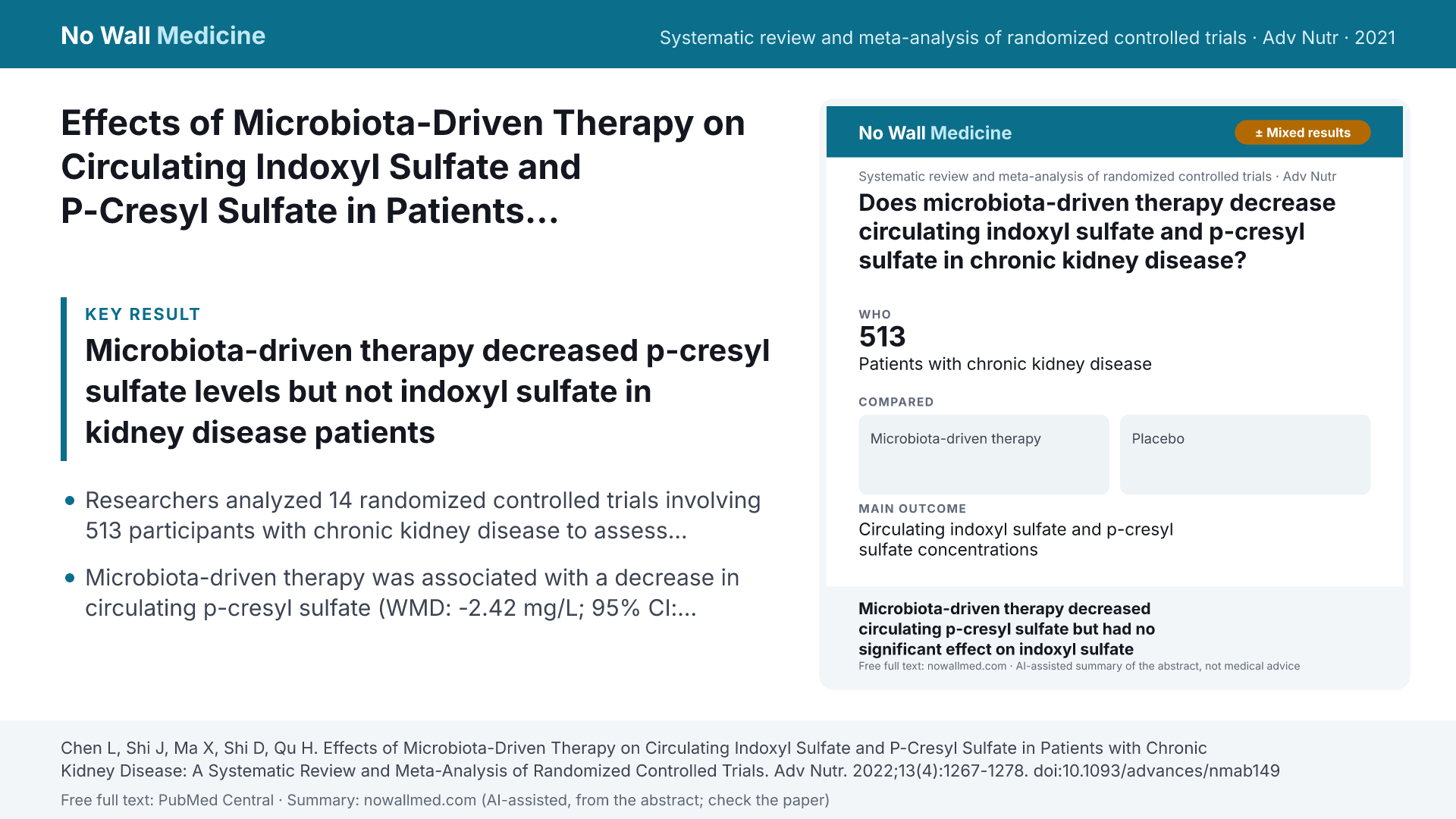
Microbiota-driven therapy decreased p-cresyl sulfate levels but not indoxyl sulfate in kidney disease patients
Effects of Microbiota-Driven Therapy on Circulating Indoxyl Sulfate and P-Cresyl Sulfate in Patients with Chronic Kidney Disease: A Systematic Review and Meta-Analysis of Randomized Controlled Trials
Systematic review and meta-analysis of randomized controlled trialsMixed results
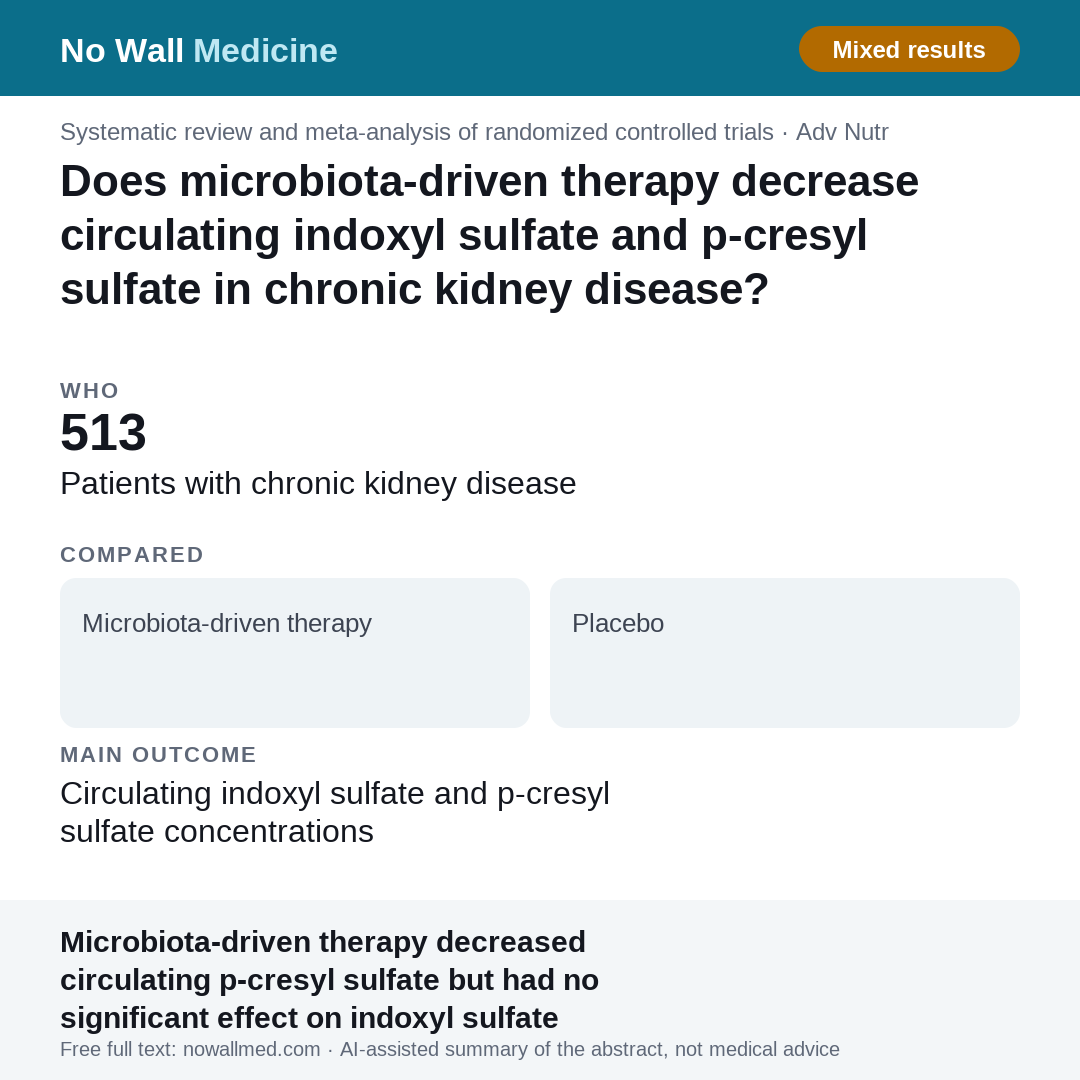
Does microbiota-driven therapy decrease circulating indoxyl sulfate and p-cresyl sulfate in chronic kidney disease?
Who
513
Patients with chronic kidney disease
Compared
Microbiota-driven therapy
Placebo
Main outcome
Circulating indoxyl sulfate and p-cresyl sulfate concentrations
Result: indoxyl sulfate WMD: -1.64 mg/L (95% CI: -3.46, 0.18 mg/L); p-cresyl sulfate WMD: -2.42 mg/L (95% CI: -3.81, -1.04 mg/L)
Bottom line: Microbiota-driven therapy decreased circulating p-cresyl sulfate but had no significant effect on indoxyl sulfate concentrations.
Limitation: Additional large, well-designed randomized controlled trials with improved methodology and reporting are necessary.
Adv Nutr · 2021-12-15Download image
Clinical question: Does microbiota-driven therapy decrease circulating indoxyl sulfate and p-cresyl sulfate in chronic kidney disease?
Why it matters: The effects of using probiotics, prebiotics, or synbiotics to change levels of protein-bound uremic toxins in chronic kidney disease patients are controversial.
Key points
- Researchers analyzed 14 randomized controlled trials involving 513 participants with chronic kidney disease to assess the effects of probiotics, prebiotics, or synbiotics.
- Microbiota-driven therapy was associated with a decrease in circulating p-cresyl sulfate (WMD: -2.42 mg/L; 95% CI: -3.81, -1.04 mg/L; P = 0.001) but had no significant effect on indoxyl sulfate (WMD: -1.64 mg/L; 95% CI: -3.46, 0.18 mg/L; P = 0.077).
- Subgroup analysis showed that prebiotics and synbiotics were associated with lower p-cresyl sulfate levels, while probiotics were not.
Limitation the authors note: Additional large, well-designed randomized controlled trials with improved methodology and reporting are necessary to assess long-term effects.
Headline and key points written with AI from the paper’s abstract, with every number checked against it. Read the paper before relying on them.
Was this summary helpful?
Subject terms
Cite this article
Chen L, Shi J, Ma X, Shi D, Qu H. Effects of Microbiota-Driven Therapy on Circulating Indoxyl Sulfate and P-Cresyl Sulfate in Patients with Chronic Kidney Disease: A Systematic Review and Meta-Analysis of Randomized Controlled Trials. Adv Nutr. 2021. doi:10.1093/advances/nmab149
Spotted a mistake? Suggest a correction