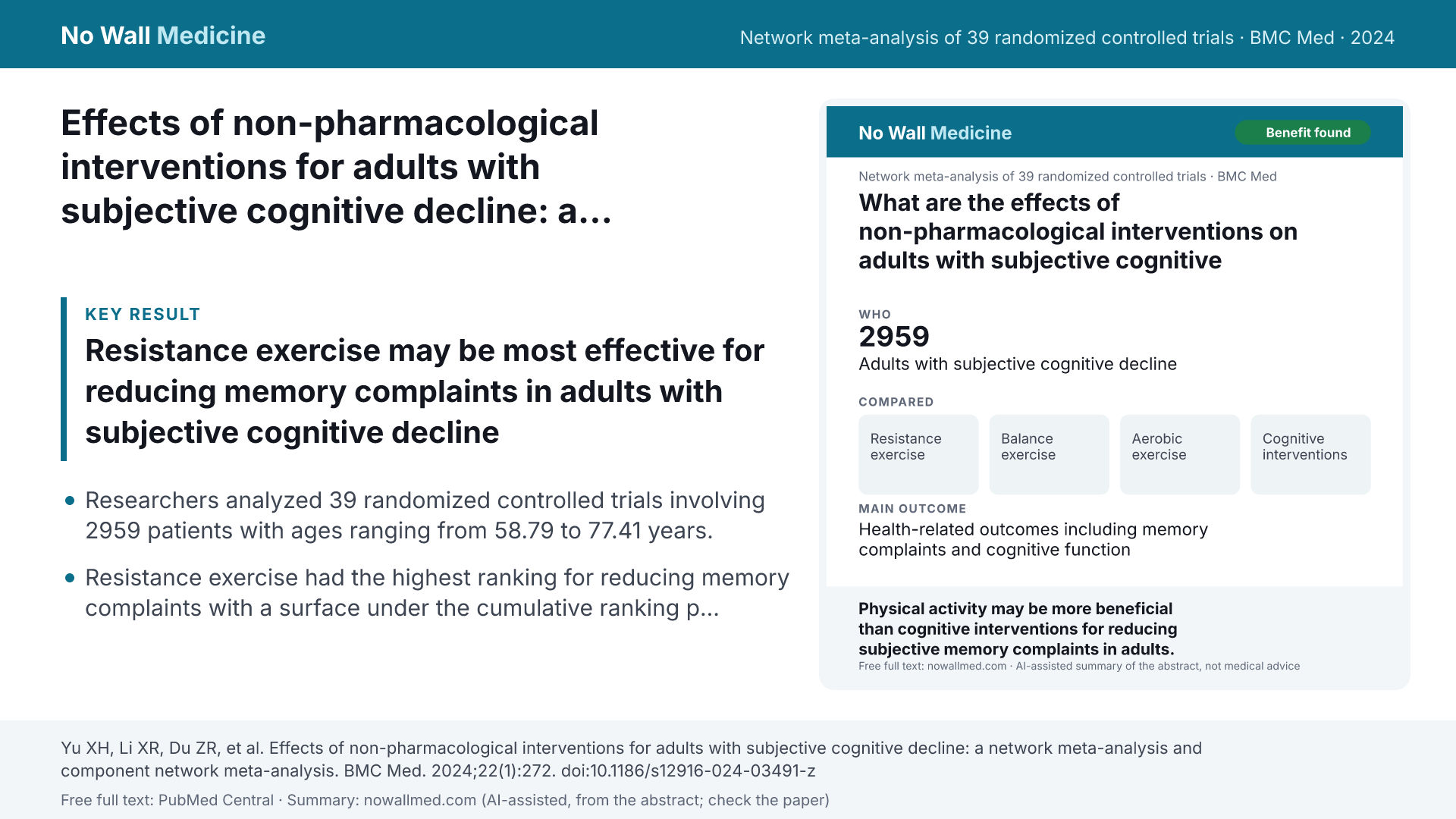
Resistance exercise may be most effective for reducing memory complaints in adults with subjective cognitive decline
Effects of non-pharmacological interventions for adults with subjective cognitive decline: a network meta-analysis and component network meta-analysis
Network meta-analysis of 39 randomized controlled trialsBenefit found
What are the effects of non-pharmacological interventions on adults with subjective cognitive decline?
Who
2959
Adults with subjective cognitive decline
Compared
Resistance exercise
Balance exercise
Aerobic exercise
Cognitive interventions
Main outcome
Health-related outcomes including memory complaints and cognitive function
Bottom line: Physical activity may be more beneficial than cognitive interventions for reducing subjective memory complaints in adults.
Limitation: Randomized clinical trials with high-quality and large-scale are warranted to validate the findings.
BMC Med · 2024-06-27 · Save PNG
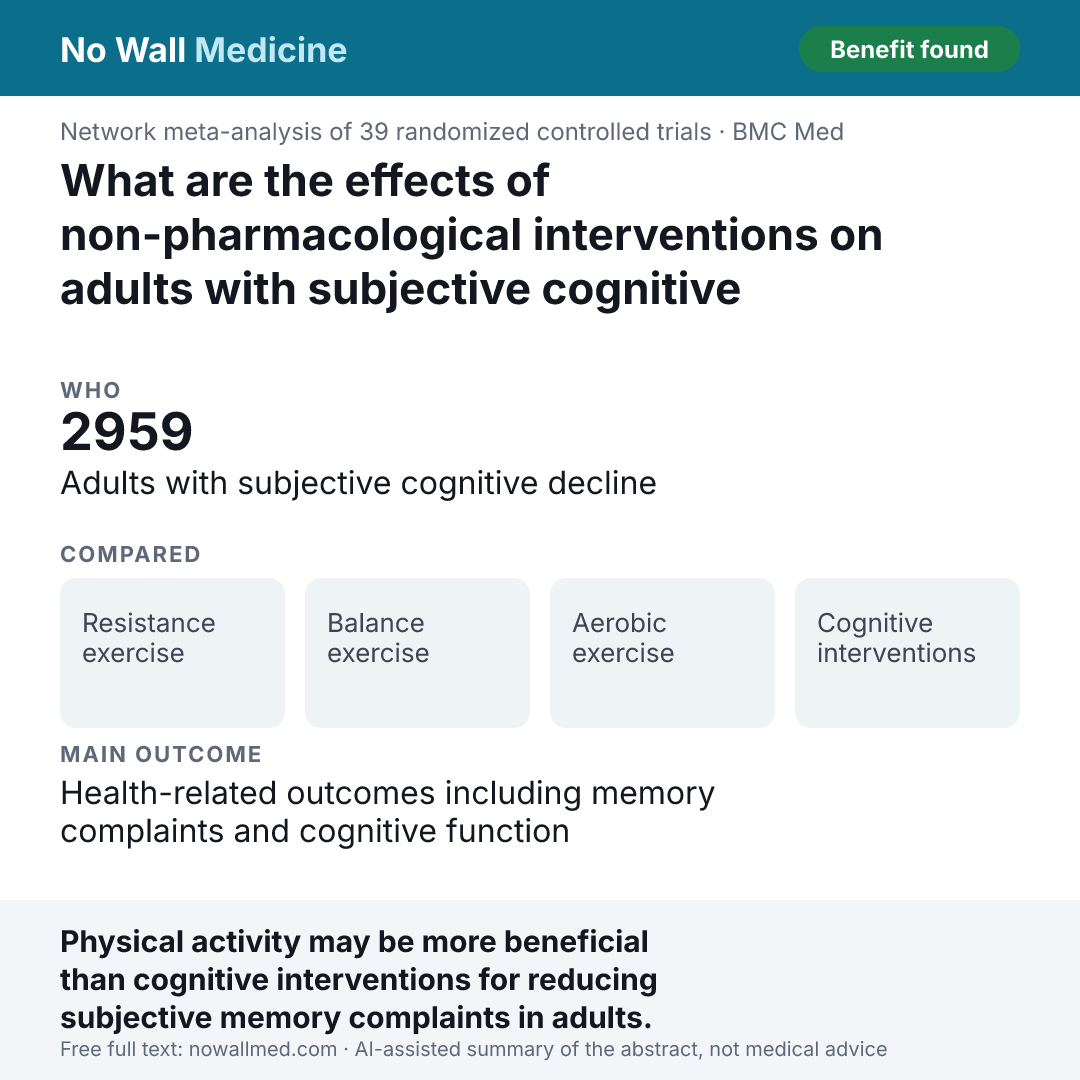
Clinical question: What are the effects of non-pharmacological interventions on adults with subjective cognitive decline?
Key points
- Researchers analyzed 39 randomized controlled trials involving 2959 patients with ages ranging from 58.79 to 77.41 years.
- Resistance exercise had the highest ranking for reducing memory complaints with a surface under the cumulative ranking p score of 0.888.
- Specific components like music therapy and cognitive training were associated with improvements in global cognitive function and language scores.
Limitation the authors note: The authors state that high-quality and large-scale randomized clinical trials are needed to validate these findings.
Headline and key points written with AI from the paper’s abstract, with every number checked against it. Read the paper before relying on them.
Was this summary helpful?
Subject terms
Headline, design, result, key points, caveat and citation as plain text.
Cite this article
Yu XH, Li XR, Du ZR, et al. Effects of non-pharmacological interventions for adults with subjective cognitive decline: a network meta-analysis and component network meta-analysis. BMC Med. 2024;22(1):272. doi:10.1186/s12916-024-03491-z
Spotted a mistake? Suggest a correction