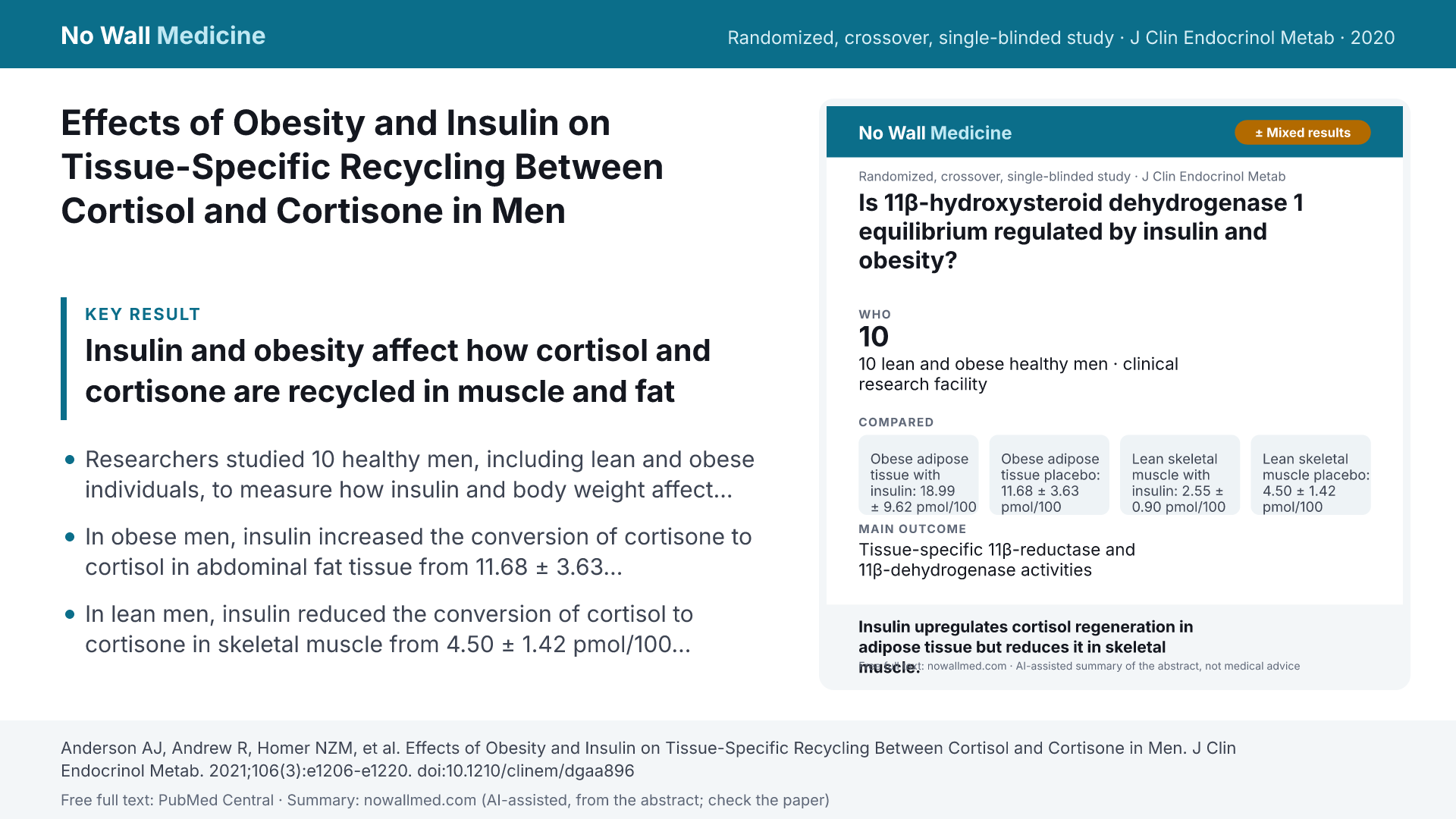
Effects of Obesity and Insulin on Tissue-Specific Recycling Between Cortisol and Cortisone in Men
Key result: Insulin and obesity affect how cortisol and cortisone are recycled in muscle and fat
Randomized, crossover, single-blinded studyMixed results
Is 11β-hydroxysteroid dehydrogenase 1 equilibrium regulated by insulin and obesity?
Who
10
10 lean and obese healthy men · clinical research facility
Compared
Obese adipose tissue with insulin: 18.99 ± 9.62 pmol/100 g/minute
Obese adipose tissue placebo: 11.68 ± 3.63 pmol/100 g/minute
Lean skeletal muscle with insulin: 2.55 ± 0.90 pmol/100 g/minute
Lean skeletal muscle placebo: 4.50 ± 1.42 pmol/100 g/minute
Main outcome
Tissue-specific 11β-reductase and 11β-dehydrogenase activities
Bottom line: Insulin upregulates cortisol regeneration in adipose tissue but reduces it in skeletal muscle.
J Clin Endocrinol Metab · 2020-12-04
Key points
- Researchers studied 10 healthy men, including lean and obese individuals, to measure how insulin and body weight affect the enzyme 11β-hydroxysteroid dehydrogenase 1.
- In obese men, insulin increased the conversion of cortisone to cortisol in abdominal fat tissue from 11.68 ± 3.63 pmol/100 g/minute to 18.99 ± 9.62 pmol/100 g/minute.
- In lean men, insulin reduced the conversion of cortisol to cortisone in skeletal muscle from 4.50 ± 1.42 pmol/100 g/minute to 2.55 ± 0.90 pmol/100 g/minute.
Discussion prompts
- Would these patients look like yours? Who was left out?
- Is the main outcome one that matters to patients?
- Is the difference large enough to change what you do?
Cite: Anderson AJ, Andrew R, Homer NZM, et al. Effects of Obesity and Insulin on Tissue-Specific Recycling Between Cortisol and Cortisone in Men. J Clin Endocrinol Metab. 2021;106(3):e1206-e1220. doi:10.1210/clinem/dgaa896
Free full text: PubMed Central · Summary and visual abstract: nowallmed.com/a/effects-of-obesity-and-insulin-on-tissue-specific-recycling-between-4htoty/ (AI-assisted from the abstract; check the paper before relying on it).