Intermittently scanned continuous glucose monitoring helped patients with type 2 diabetes lower HbA1c levels
Effects of Patient-Driven Lifestyle Modification Using Intermittently Scanned Continuous Glucose Monitoring in Patients With Type 2 Diabetes: Results From the Randomized Open-label PDF Study
12-week, open-label, randomized controlled trialBenefit found
Does patient-driven lifestyle modification using intermittently scanned continuous glucose monitoring improve HbA1c in type 2 diabetes?
Who
126
patients with type 2 diabetes
Compared
intervention group
control group
Main outcome
change in HbA1c level from baseline
Result: risk-adjusted difference -0.50%, 95% CI -0.74 to -0.26
Bottom line: Patient-driven lifestyle modification using intermittently scanned continuous glucose monitoring effectively lowered HbA1c levels in patients with type 2 diabetes.
Diabetes Care · 2022-08-20Download image
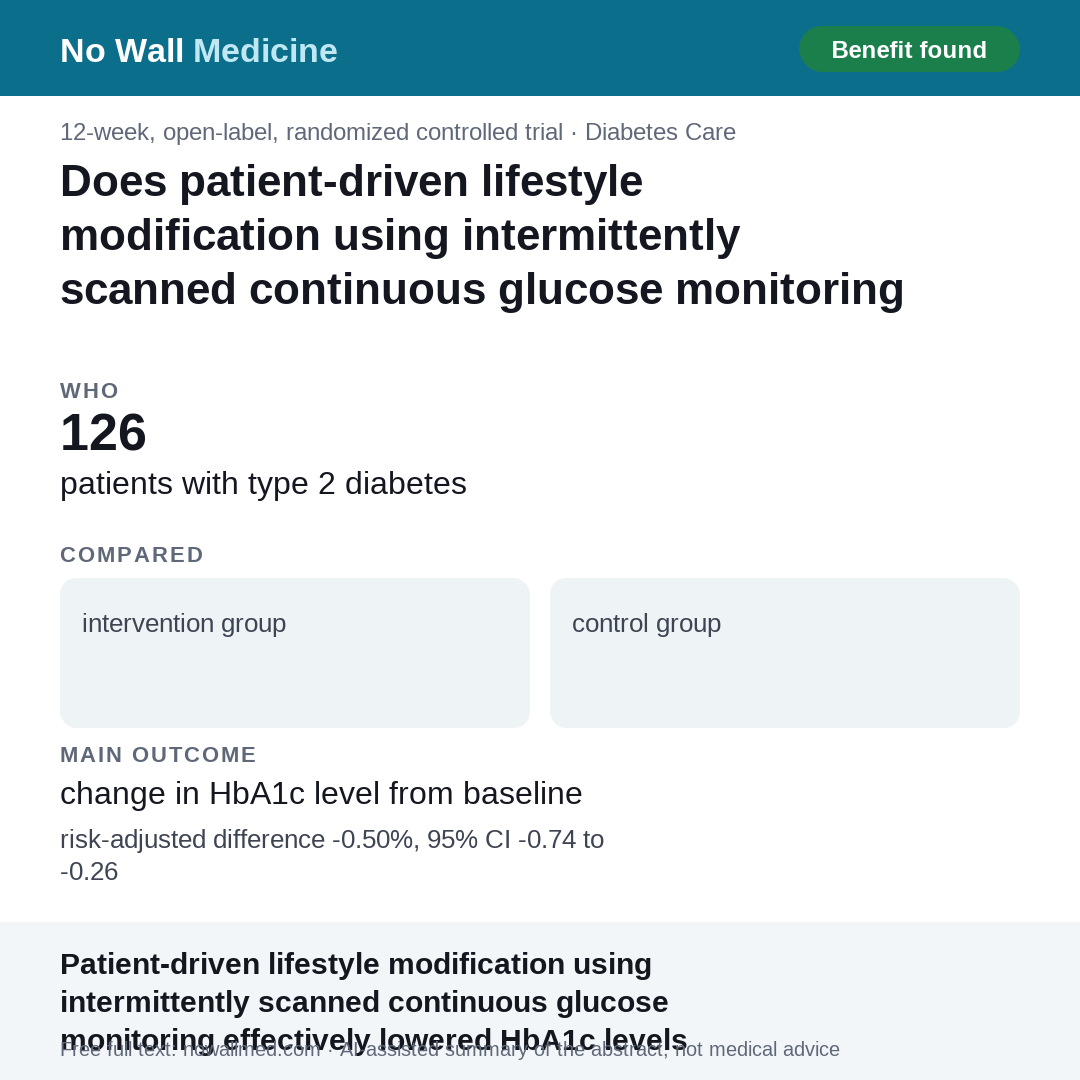
Clinical question: Does patient-driven lifestyle modification using intermittently scanned continuous glucose monitoring improve HbA1c in type 2 diabetes?
Why it matters: It was unknown if patient-driven lifestyle changes guided by intermittently scanned continuous glucose monitoring and a specific eating behavior algorithm could improve glucose control in type 2 diabetes.
Key points
- Researchers conducted a 12-week randomized trial with 126 participants with type 2 diabetes comparing structured education with intermittently scanned continuous glucose monitoring to standard care.
- The intervention group showed a greater improvement in HbA1c than the control group with a risk-adjusted difference of -0.50% (95% CI -0.74 to -0.26, P < 0.001).
- The intervention group also had a greater reduction in fasting blood glucose by -16.5 mg/dL and body weight by -1.5 kg compared to the control group.
Headline and key points written with AI from the paper’s abstract, with every number checked against it. Read the paper before relying on them.
Topics
Cite this article
Choe HJ, Rhee EJ, Won JC, Park KS, Lee WY, Cho YM. Effects of Patient-Driven Lifestyle Modification Using Intermittently Scanned Continuous Glucose Monitoring in Patients With Type 2 Diabetes: Results From the Randomized Open-label PDF Study. Diabetes Care. 2022. doi:10.2337/dc22-0764
Spotted a mistake? Suggest a correction
Top studies every Monday
The week’s key trials and guidelines in your specialties, plus any topics you follow. By email, free.
Get the weekly digest