Intermittently scanned continuous glucose monitoring showed more time in range than fingerstick testing
Multicenter Randomized Trial of Intermittently Scanned Continuous Glucose Monitoring Versus Self-Monitoring of Blood Glucose in Individuals With Type 2 Diabetes and Recent-Onset Acute Myocardial Infarction: Results of the LIBERATES Trial
Multicenter two-arm randomized trialMixed results
Does intermittently scanned continuous glucose monitoring improve outcomes in type 2 diabetes after myocardial infarction?
Who
141
Individuals with type 2 diabetes and recent myocardial infarction · Multicenter
Compared
intermittently scanned continuous glucose monitoring: increased TIR by 17 min/day (95% credible interval -105 to +153 min/day)
self-monitoring of blood glucose
Main outcome
time in range (glucose 3.9-10 mmol/L/day)
Result: 17 min/day (95% credible interval -105 to +153 min/day)
Bottom line: Intermittently scanned continuous glucose monitoring marginally increases time in range and significantly reduces hypoglycemic exposure compared to self-monitoring.
Diabetes Care · 2022-12-15Download image
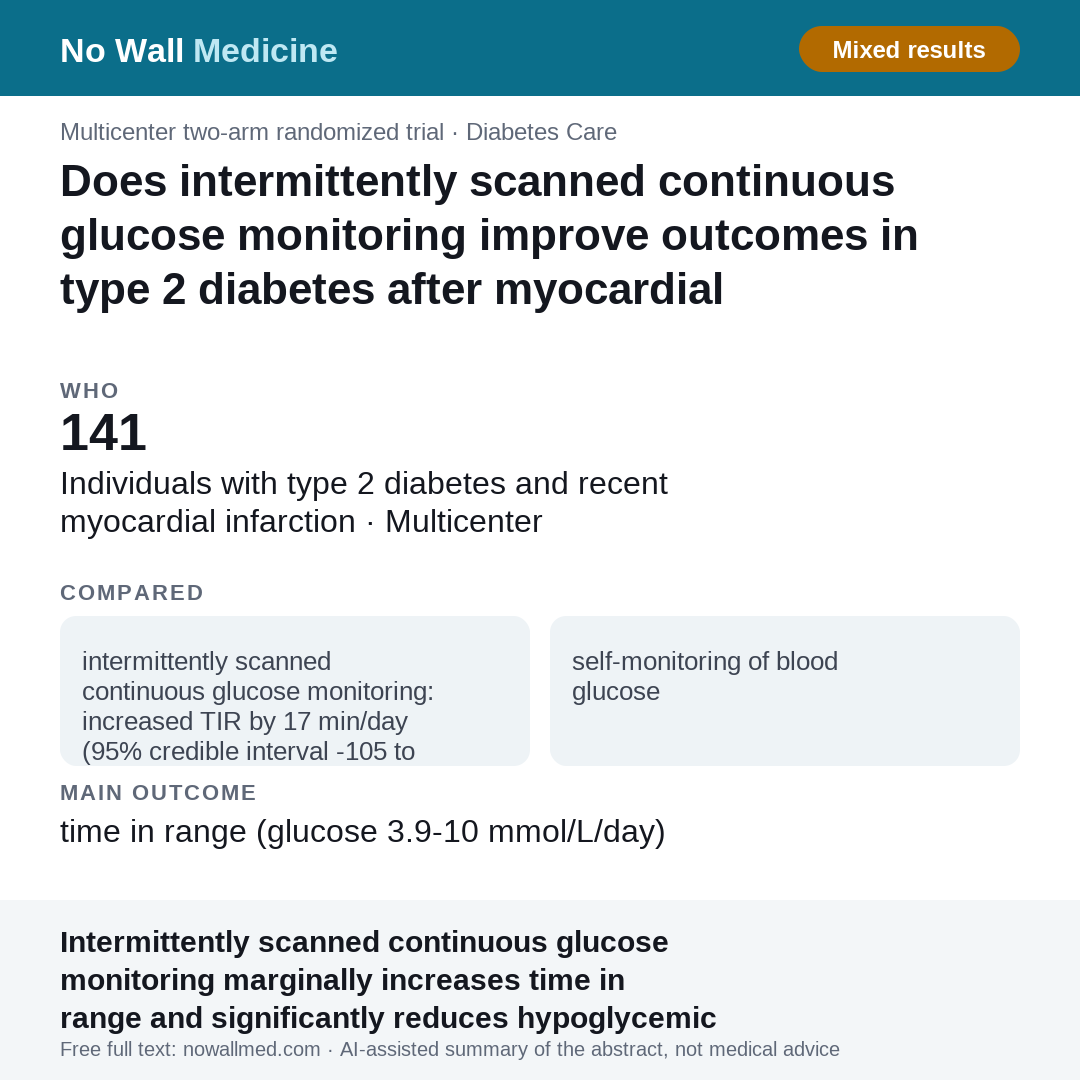
Clinical question: Does intermittently scanned continuous glucose monitoring improve outcomes in type 2 diabetes after myocardial infarction?
Why it matters: It is unknown how different glucose-monitoring strategies affect glycemic control and patient outcomes in people with type 2 diabetes following a recent heart attack.
Key points
- Researchers studied 141 people with type 2 diabetes and recent heart attack who were treated with insulin or sulphonylurea.
- Intermittently scanned continuous glucose monitoring was associated with an increase in time in range of 17 min/day compared to self-monitoring of blood glucose.
- Users of intermittently scanned continuous glucose monitoring showed lower hypoglycemic exposure of -80 min/day at days 76-90.
Headline and key points written with AI from the paper’s abstract, with every number checked against it. Read the paper before relying on them.
Topics
Cite this article
Ajjan RA, Heller SR, Everett CC, Vargas-Palacios A, Higham R, Sharples L. Multicenter Randomized Trial of Intermittently Scanned Continuous Glucose Monitoring Versus Self-Monitoring of Blood Glucose in Individuals With Type 2 Diabetes and Recent-Onset Acute Myocardial Infarction: Results of the LIBERATES Trial. Diabetes Care. 2022. doi:10.2337/dc22-1219
Spotted a mistake? Suggest a correction
Top studies every Monday
The week’s key trials and guidelines in your specialties, plus any topics you follow. By email, free.
Get the weekly digest