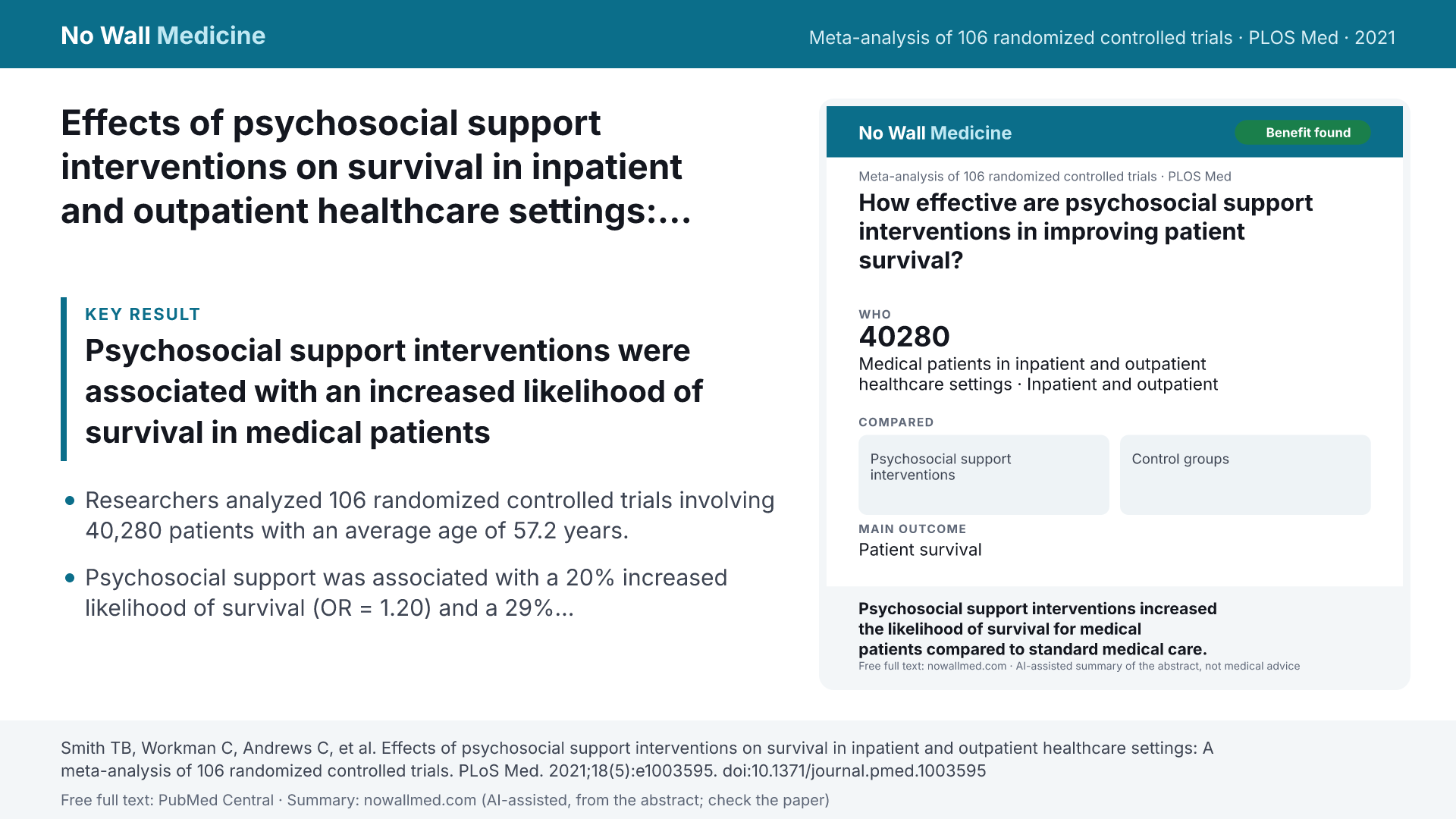
Psychosocial support interventions were associated with an increased likelihood of survival in medical patients
Effects of psychosocial support interventions on survival in inpatient and outpatient healthcare settings: A meta-analysis of 106 randomized controlled trials
Meta-analysis of 106 randomized controlled trialsBenefit found
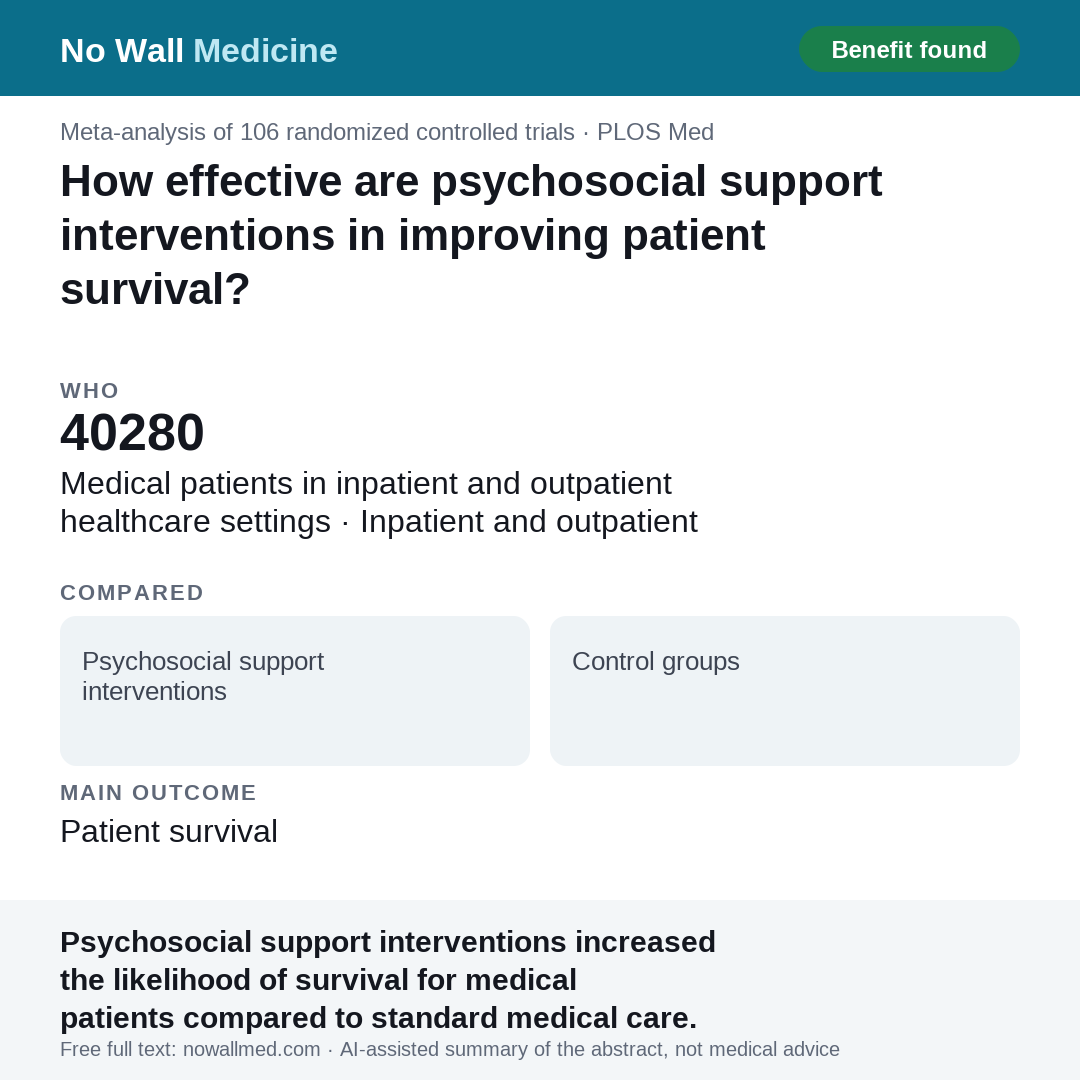
How effective are psychosocial support interventions in improving patient survival?
Who
40280
Medical patients in inpatient and outpatient healthcare settings · Inpatient and outpatient healthcare settings
Compared
Psychosocial support interventions
Control groups
Main outcome
Patient survival
Result: odds ratio 1.20 (95% CI 1.09 to 1.31)
Bottom line: Psychosocial support interventions increased the likelihood of survival for medical patients compared to standard medical care.
Limitation: Interventions very rarely blinded personnel and participants to study arm.
PLOS Med · 2021-05-18Download image
Clinical question: How effective are psychosocial support interventions in improving patient survival?
Why it matters: Prior reviews of psychosocial support interventions in medical settings have reported mixed outcomes regarding their effectiveness in improving patient survival.
Key points
- Researchers analyzed 106 randomized controlled trials involving 40,280 patients with an average age of 57.2 years.
- Psychosocial support was associated with a 20% increased likelihood of survival (OR = 1.20) and a 29% increased probability of survival over time (HR = 1.29).
- Interventions explicitly promoting health behaviors yielded improved survival, while those focusing primarily on social or emotional outcomes did not.
Limitation the authors note: Interventions very rarely blinded personnel and participants to study arm, such that expectations for improvement were not controlled.
Headline and key points written with AI from the paper’s abstract, with every number checked against it. Read the paper before relying on them.
Was this summary helpful?
Subject terms
Cite this article
Smith TB, Workman C, Andrews C, et al. Effects of psychosocial support interventions on survival in inpatient and outpatient healthcare settings: A meta-analysis of 106 randomized controlled trials. PLOS Med. 2021. doi:10.1371/journal.pmed.1003595
Spotted a mistake? Suggest a correction