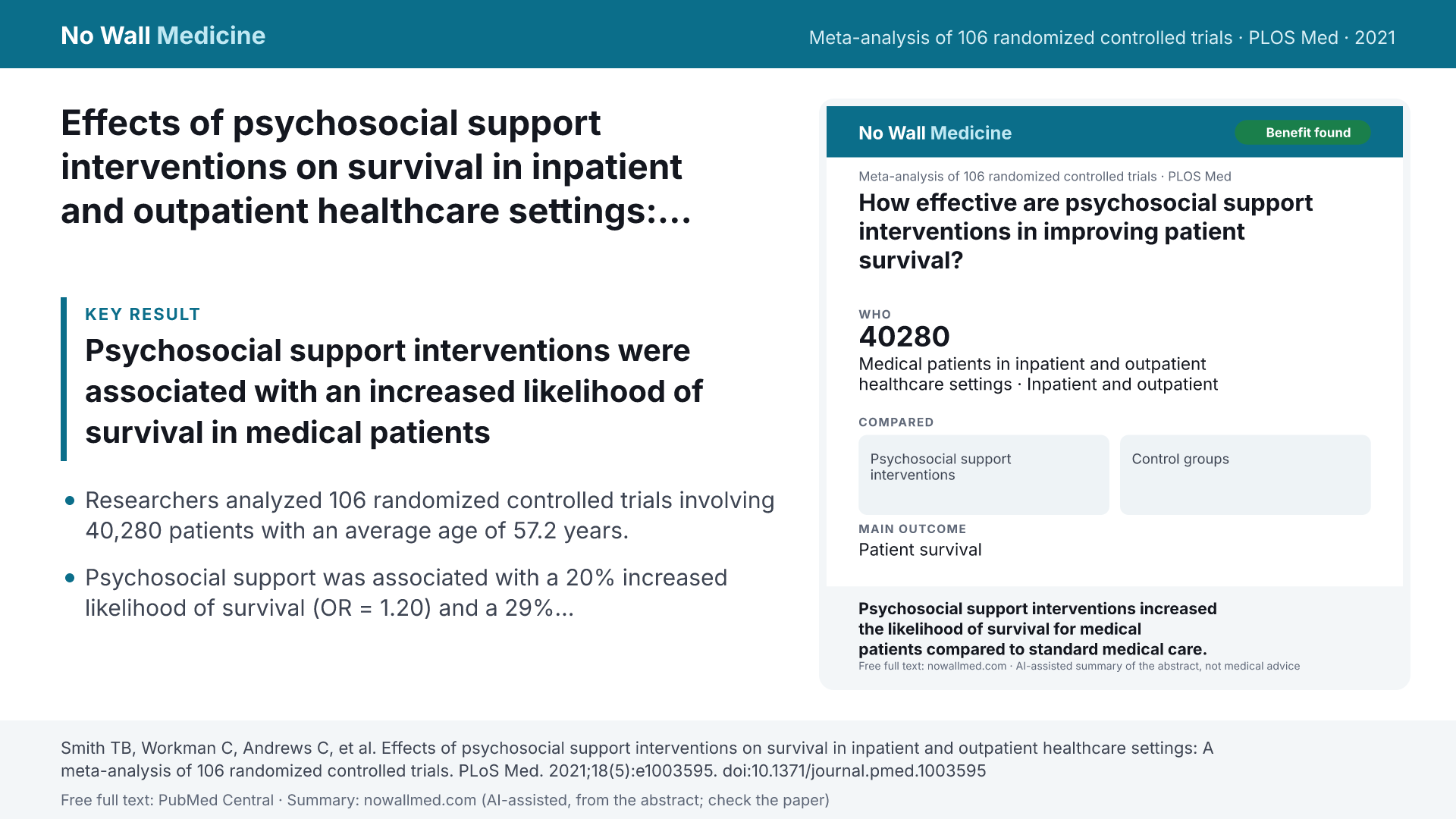
Effects of psychosocial support interventions on survival in inpatient and outpatient healthcare settings: A meta-analysis of 106 randomized controlled trials
Key result: Psychosocial support interventions were associated with an increased likelihood of survival in medical patients
Key points
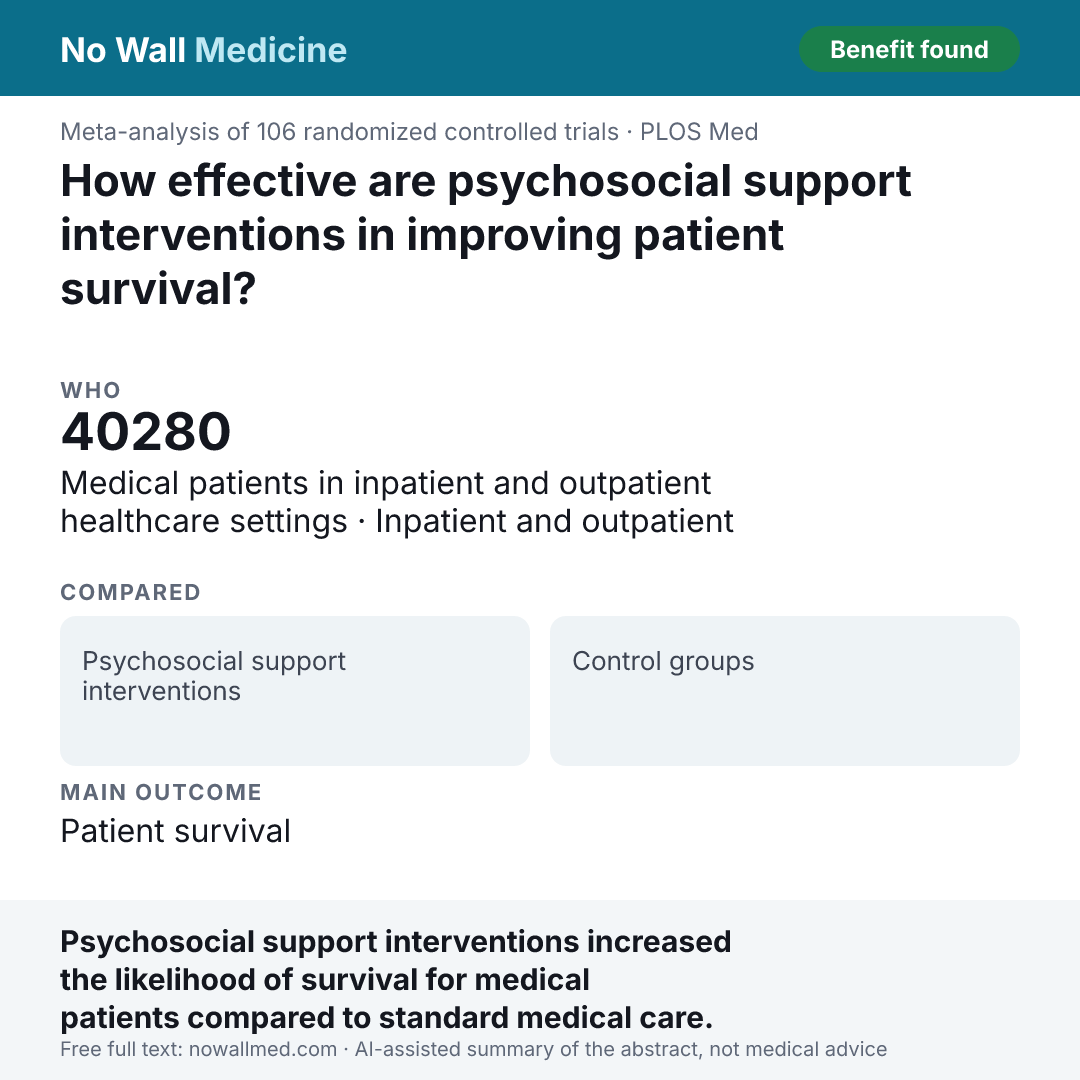
- Researchers analyzed 106 randomized controlled trials involving 40,280 patients with an average age of 57.2 years.
- Psychosocial support was associated with a 20% increased likelihood of survival (OR = 1.20) and a 29% increased probability of survival over time (HR = 1.29).
- Interventions explicitly promoting health behaviors yielded improved survival, while those focusing primarily on social or emotional outcomes did not.
Why it matters: Prior reviews of psychosocial support interventions in medical settings have reported mixed outcomes regarding their effectiveness in improving patient survival.
Limitation the authors note: Interventions very rarely blinded personnel and participants to study arm, such that expectations for improvement were not controlled.
Discussion prompts
- Would these patients look like yours? Who was left out?
- Is the main outcome one that matters to patients?
- Is the difference large enough to change what you do?
Cite: Smith TB, Workman C, Andrews C, et al. Effects of psychosocial support interventions on survival in inpatient and outpatient healthcare settings: A meta-analysis of 106 randomized controlled trials. PLoS Med. 2021;18(5):e1003595. doi:10.1371/journal.pmed.1003595
Free full text: PubMed Central · Summary and visual abstract: nowallmed.com/a/effects-of-psychosocial-support-interventions-on-survival-in-zitmfp/ (AI-assisted from the abstract; check the paper before relying on it).