Effects of rapid fluid infusion on hemoglobin concentration: a systematic review and meta-analysis
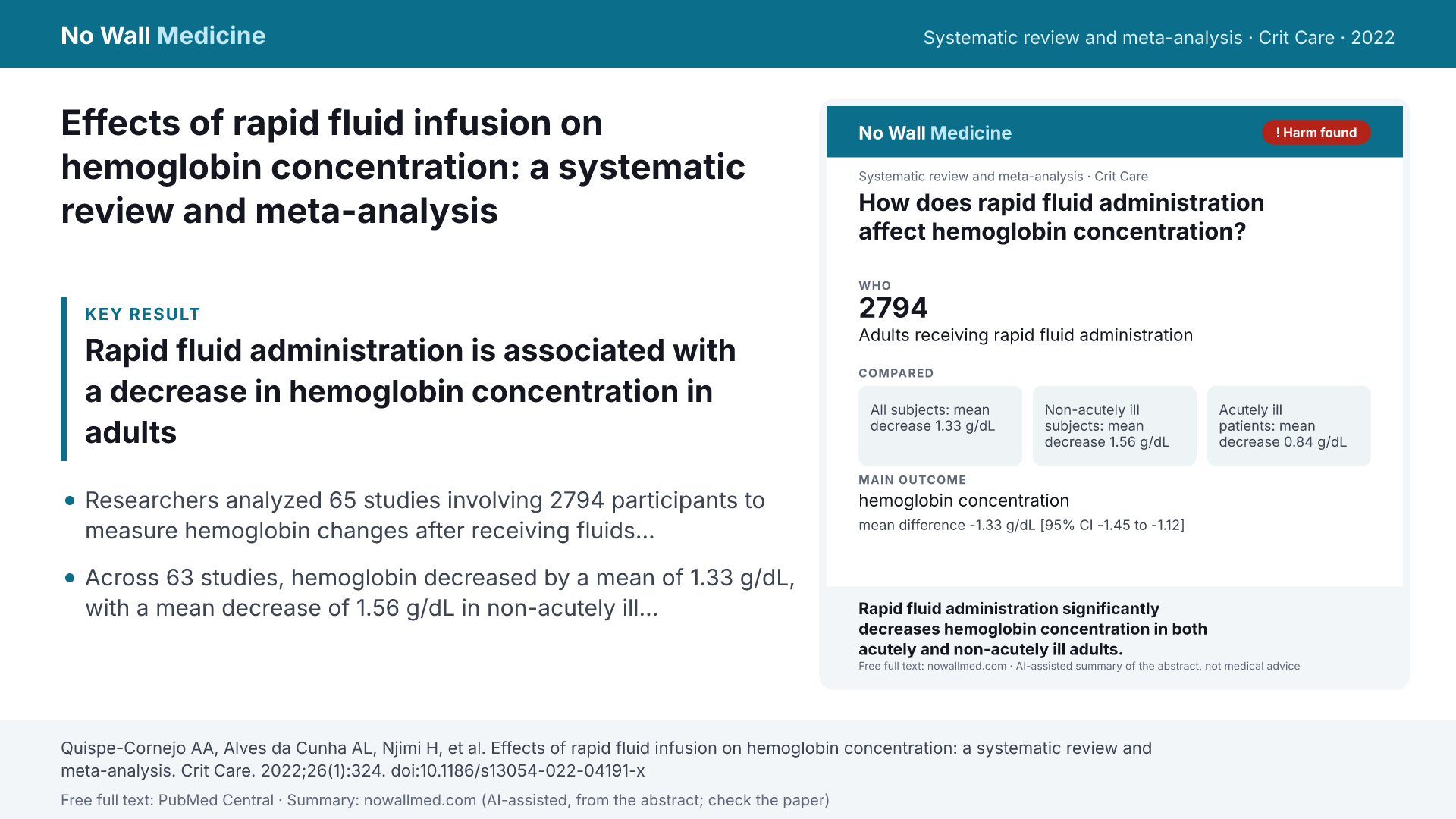
Key result: Rapid fluid administration is associated with a decrease in hemoglobin concentration in adults
Systematic review and meta-analysisHarm found
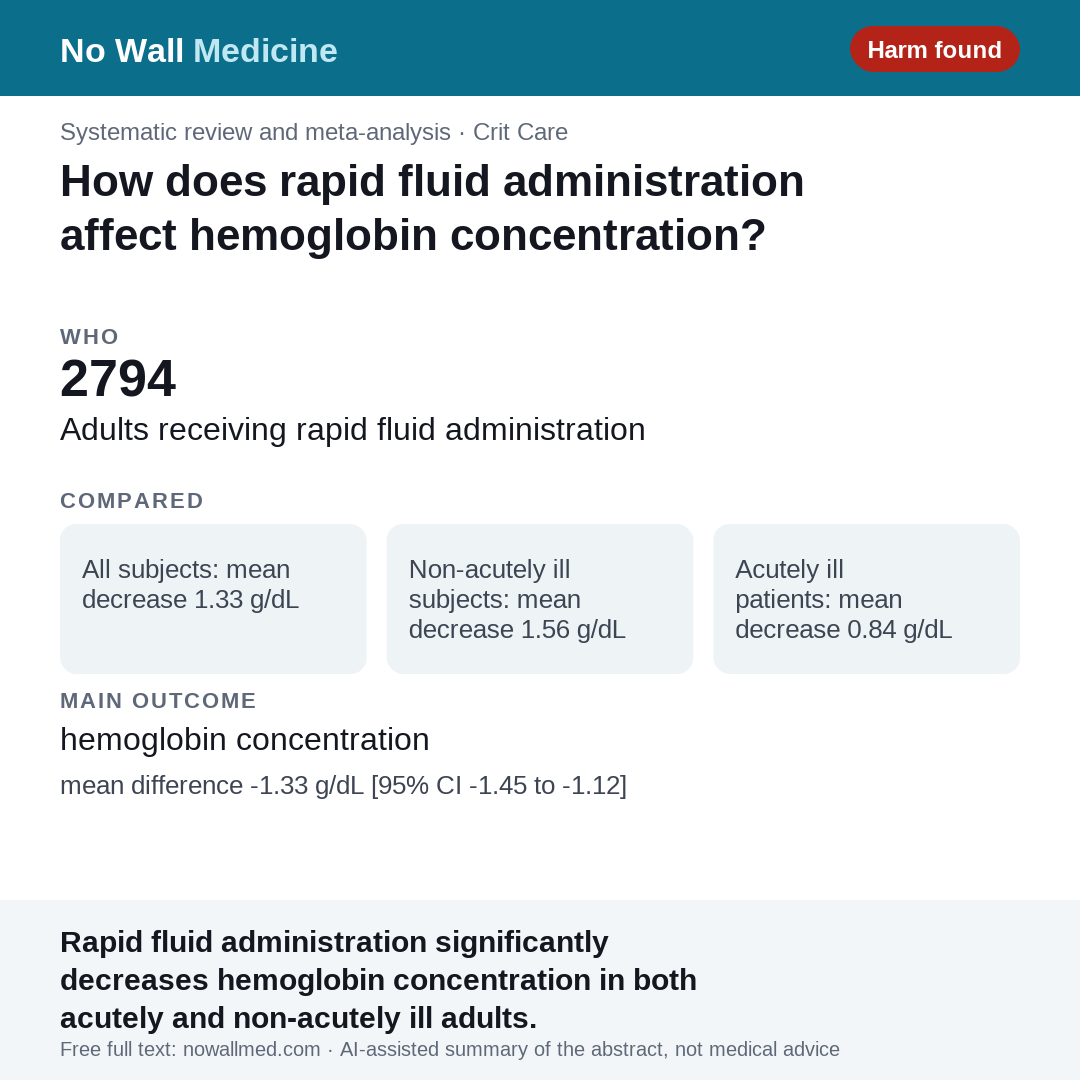
How does rapid fluid administration affect hemoglobin concentration?
Who
2794
Adults receiving rapid fluid administration
Compared
All subjects: mean decrease 1.33 g/dL
Non-acutely ill subjects: mean decrease 1.56 g/dL
Acutely ill patients: mean decrease 0.84 g/dL
Main outcome
hemoglobin concentration
Result: mean difference -1.33 g/dL [95% CI -1.45 to -1.12]
Bottom line: Rapid fluid administration significantly decreases hemoglobin concentration in both acutely and non-acutely ill adults.
Crit Care · 2022-10-23Download image
Key points
- Researchers analyzed 65 studies involving 2794 participants to measure hemoglobin changes after receiving fluids quickly, which is defined as being given over less than 120 minutes.
- Across 63 studies, hemoglobin decreased by a mean of 1.33 g/dL, with a mean decrease of 1.56 g/dL in non-acutely ill subjects and 0.84 g/dL in acutely ill patients.
- In patients who did not respond to fluids, oxygen delivery, the amount of oxygen sent to tissues, decreased significantly alongside the decrease in hemoglobin.
Discussion prompts
- Would these patients look like yours? Who was left out?
- Is the main outcome one that matters to patients?
- Is the difference large enough to change what you do?
Cite: Quispe-Cornejo AA, Alves da Cunha AL, Njimi H, et al. Effects of rapid fluid infusion on hemoglobin concentration: a systematic review and meta-analysis. Crit Care. 2022. doi:10.1186/s13054-022-04191-x
Free full text: PubMed Central · Summary and visual abstract: nowallmed.com/a/effects-of-rapid-fluid-infusion-on-hemoglobin-concentration-a-ifxwnt/ (AI-assisted from the abstract; check the paper before relying on it).