Supervised exercise therapy improved blood pressure and heart rate during exercise for people with peripheral artery disease
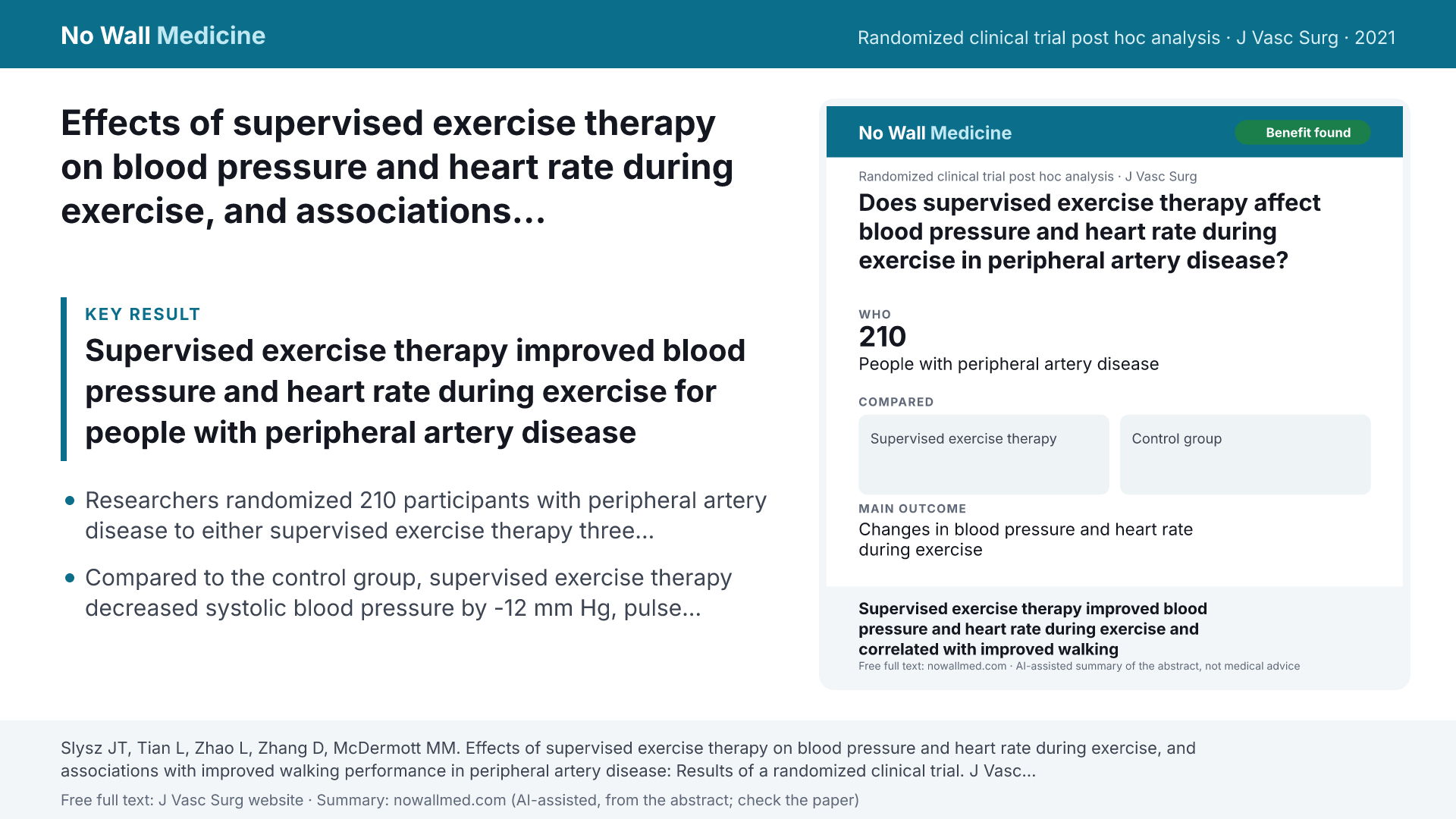
Effects of supervised exercise therapy on blood pressure and heart rate during exercise, and associations with improved walking performance in peripheral artery disease: Results of a randomized clinical trial
Randomized clinical trial post hoc analysisBenefit found
Does supervised exercise therapy affect blood pressure and heart rate during exercise in peripheral artery disease?
Who
210
People with peripheral artery disease
Compared
Supervised exercise therapy
Control group
Main outcome
Changes in blood pressure and heart rate during exercise
Bottom line: Supervised exercise therapy improved blood pressure and heart rate during exercise and correlated with improved walking performance.
J Vasc Surg · 2021-06-03 · Save PNG
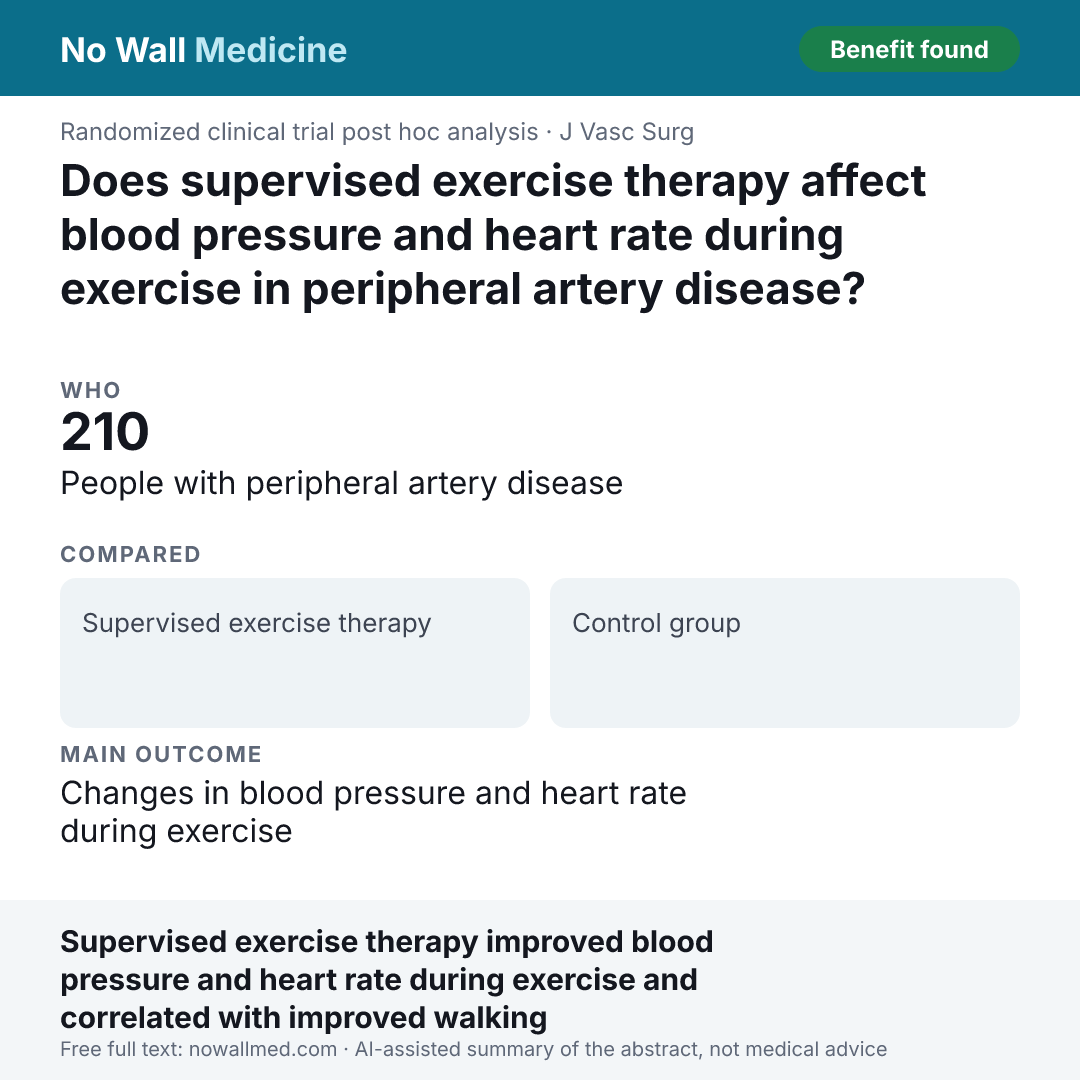
Clinical question: Does supervised exercise therapy affect blood pressure and heart rate during exercise in peripheral artery disease?
Key points
- Researchers randomized 210 participants with peripheral artery disease to either supervised exercise therapy three times weekly or weekly health lectures for 6 months.
- Compared to the control group, supervised exercise therapy decreased systolic blood pressure by -12 mm Hg, pulse pressure by -9 mm Hg, and heart rate by -7 beats per minute during exercise.
- Greater decreases in systolic blood pressure, pulse pressure, and heart rate during exercise were associated with greater improvements in walking distance and walking impairment scores.
Headline and key points written with AI from the paper’s abstract, with every number checked against it. Read the paper before relying on them.
Was this summary helpful?
Subject terms
Headline, design, result, key points, caveat and citation as plain text.
Cite this article
Slysz JT, Tian L, Zhao L, Zhang D, McDermott MM. Effects of supervised exercise therapy on blood pressure and heart rate during exercise, and associations with improved walking performance in peripheral artery disease: Results of a randomized clinical trial. J Vasc Surg. 2021;74(5):1589-1600.e4. doi:10.1016/j.jvs.2021.05.033
Spotted a mistake? Suggest a correction