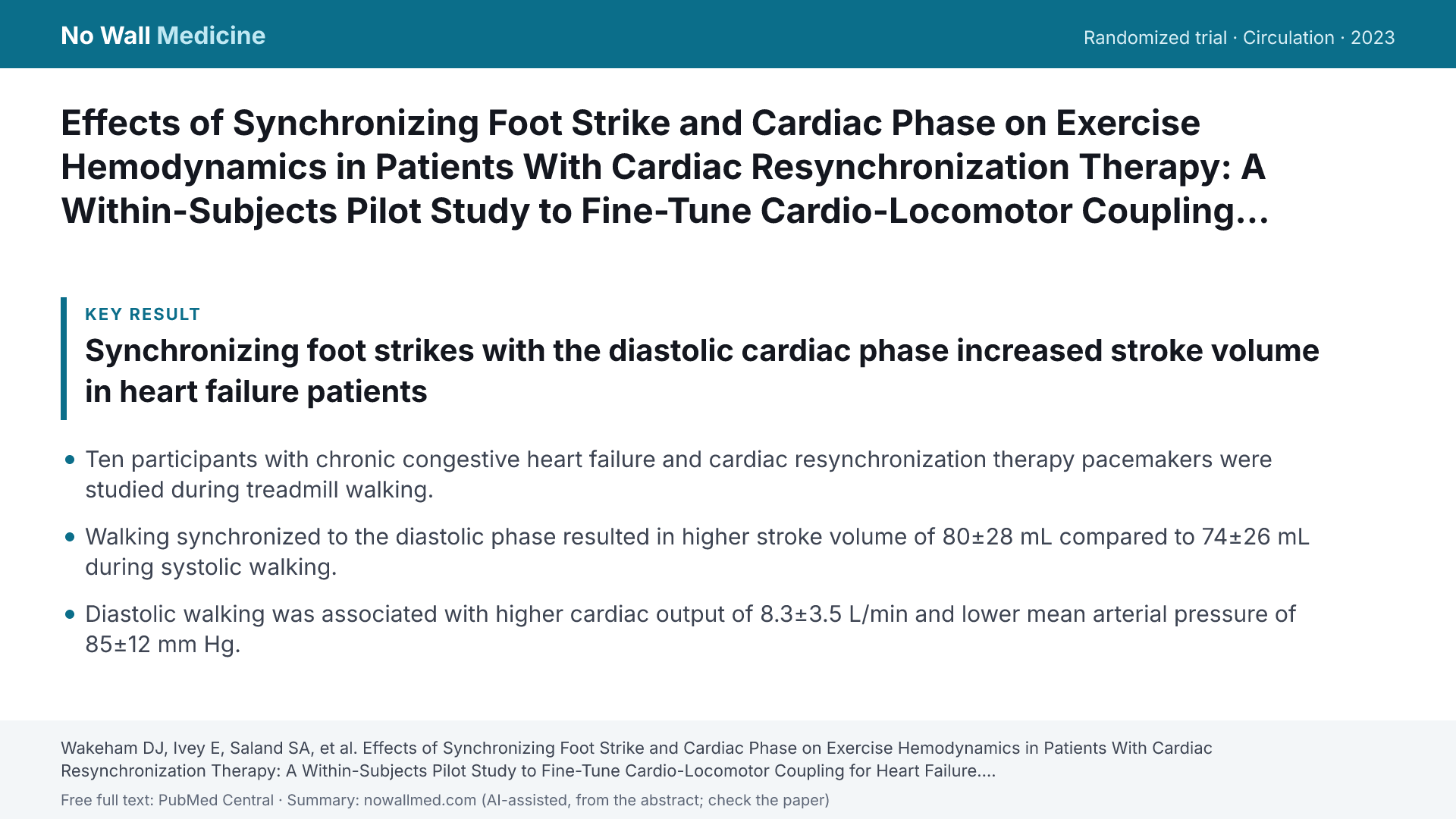
Effects of Synchronizing Foot Strike and Cardiac Phase on Exercise Hemodynamics in Patients With Cardiac Resynchronization Therapy: A Within-Subjects Pilot Study to Fine-Tune Cardio-Locomotor Coupling for Heart Failure
Key result: Synchronizing foot strikes with the diastolic cardiac phase increased stroke volume in heart failure patients
Key points
- Ten participants with chronic congestive heart failure and cardiac resynchronization therapy pacemakers were studied during treadmill walking.
- Walking synchronized to the diastolic phase resulted in higher stroke volume of 80±28 mL compared to 74±26 mL during systolic walking.
- Diastolic walking was associated with higher cardiac output of 8.3±3.5 L/min and lower mean arterial pressure of 85±12 mm Hg.
Discussion prompts
- Would these patients look like yours? Who was left out?
- Is the main outcome one that matters to patients?
- Is the difference large enough to change what you do?
Cite: Wakeham DJ, Ivey E, Saland SA, et al. Effects of Synchronizing Foot Strike and Cardiac Phase on Exercise Hemodynamics in Patients With Cardiac Resynchronization Therapy: A Within-Subjects Pilot Study to Fine-Tune Cardio-Locomotor Coupling for Heart Failure. Circulation. 2023;148(25):2008-2016. doi:10.1161/CIRCULATIONAHA.123.066170
Free full text: PubMed Central · Summary and visual abstract: nowallmed.com/a/effects-of-synchronizing-foot-strike-and-cardiac-phase-on-exercise-1oa7995/ (AI-assisted from the abstract; check the paper before relying on it).