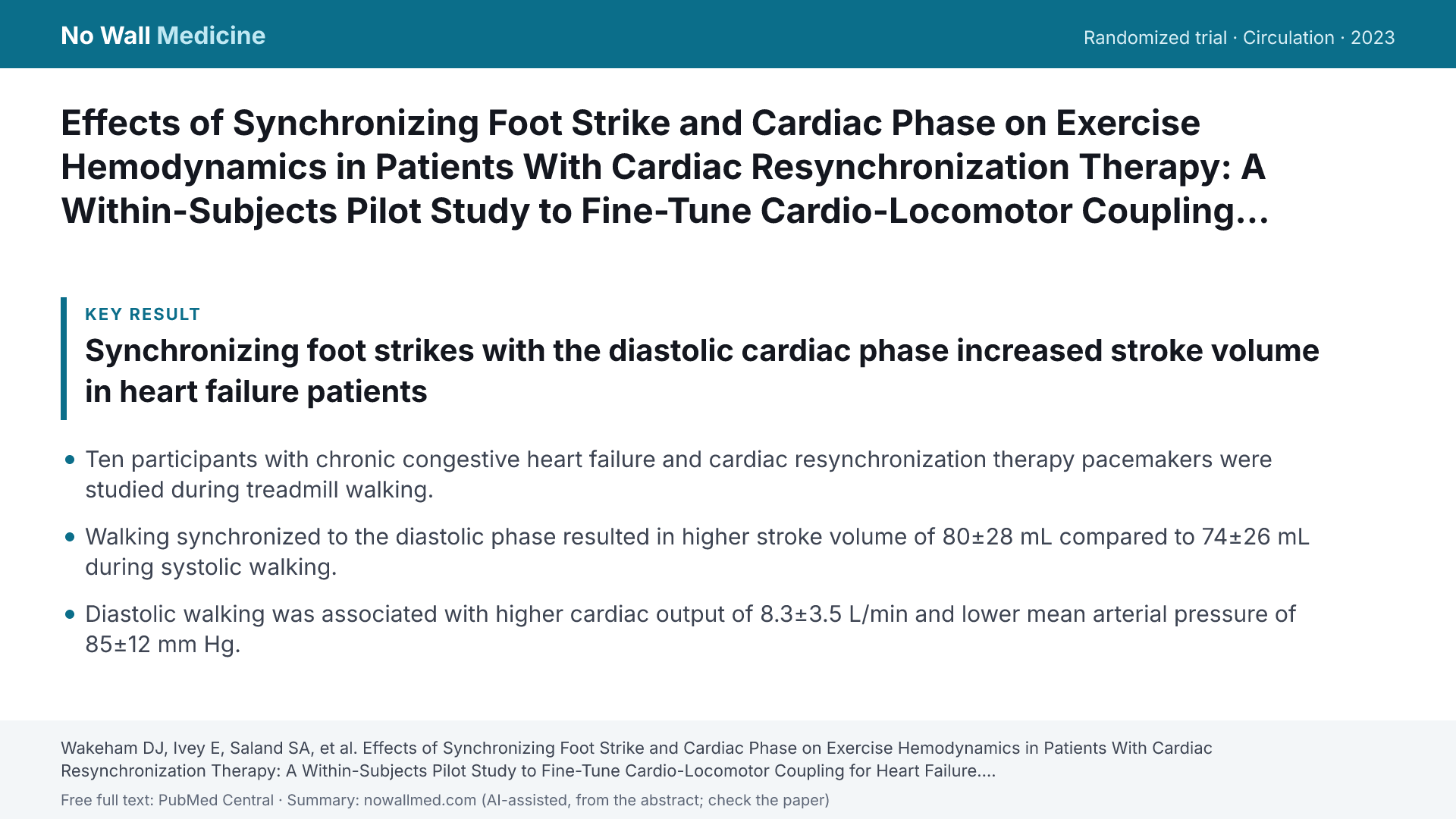
Synchronizing foot strikes with the diastolic cardiac phase increased stroke volume in heart failure patients
Effects of Synchronizing Foot Strike and Cardiac Phase on Exercise Hemodynamics in Patients With Cardiac Resynchronization Therapy: A Within-Subjects Pilot Study to Fine-Tune Cardio-Locomotor Coupling for Heart Failure
Why it matters: It is unknown if optimizing cardio-locomotor coupling, or the timing between steps and the heart cycle, can improve exercise hemodynamics in patients with heart failure.
Key points
- Ten participants with chronic congestive heart failure and cardiac resynchronization therapy pacemakers were studied during treadmill walking.
- Walking synchronized to the diastolic phase resulted in higher stroke volume of 80±28 mL compared to 74±26 mL during systolic walking.
- Diastolic walking was associated with higher cardiac output of 8.3±3.5 L/min and lower mean arterial pressure of 85±12 mm Hg.
Headline and key points written with AI from the paper’s abstract, with every number checked against it. Read the paper before relying on them.
Was this summary helpful?
Subject terms
Cite this article
Wakeham DJ, Ivey E, Saland SA, Lewis JS, Palmer D, Morris M. Effects of Synchronizing Foot Strike and Cardiac Phase on Exercise Hemodynamics in Patients With Cardiac Resynchronization Therapy: A Within-Subjects Pilot Study to Fine-Tune Cardio-Locomotor Coupling for Heart Failure. Circulation. 2023. doi:10.1161/CIRCULATIONAHA.123.066170
Spotted a mistake? Suggest a correction
Top studies every Monday
The week’s key trials and guidelines in your specialties, plus any topics you follow. By email, free.
Get the weekly digest