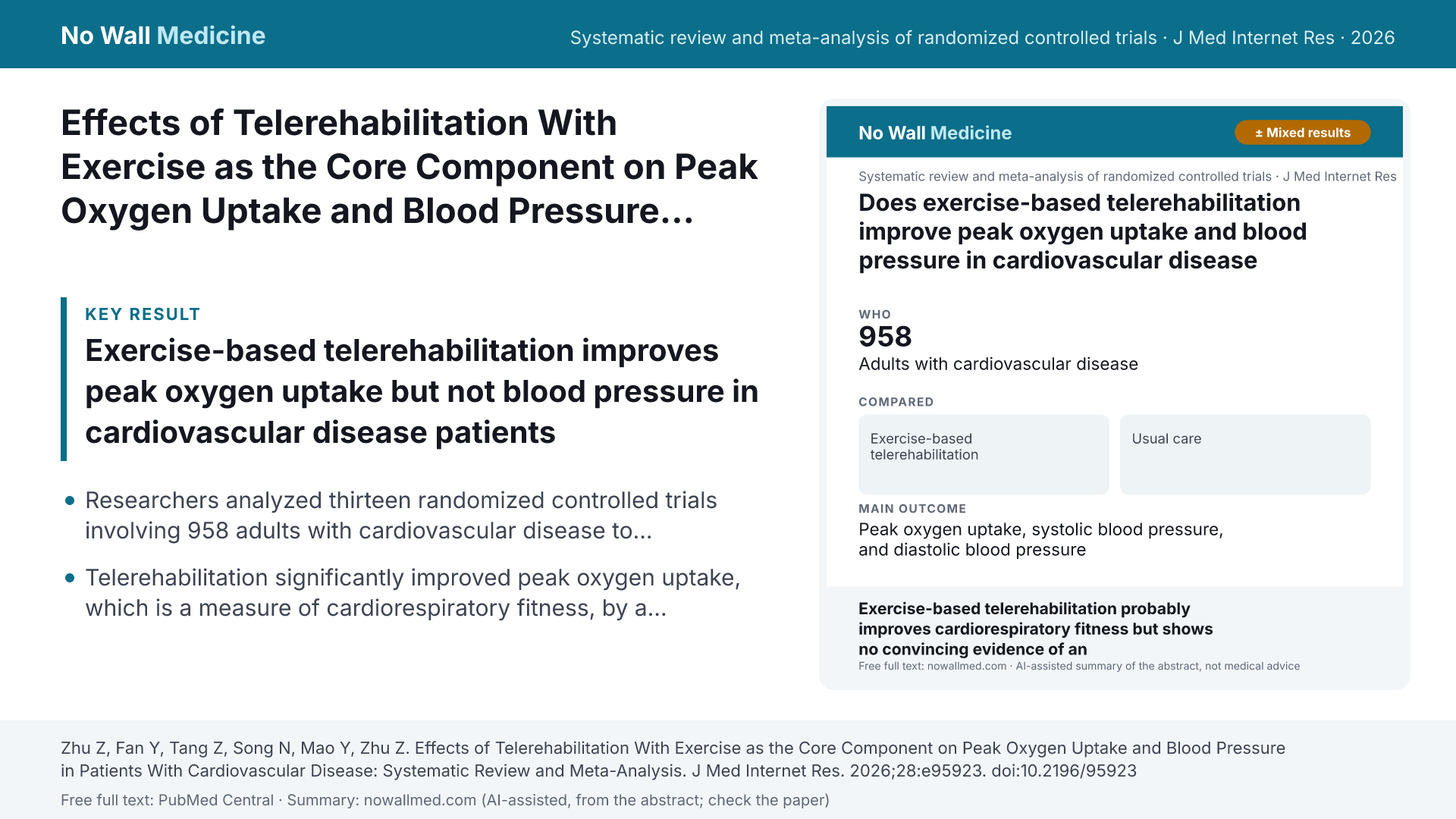
Exercise-based telerehabilitation improves peak oxygen uptake but not blood pressure in cardiovascular disease patients
Effects of Telerehabilitation With Exercise as the Core Component on Peak Oxygen Uptake and Blood Pressure in Patients With Cardiovascular Disease: Systematic Review and Meta-Analysis
Systematic review and meta-analysis of randomized controlled trialsMixed results
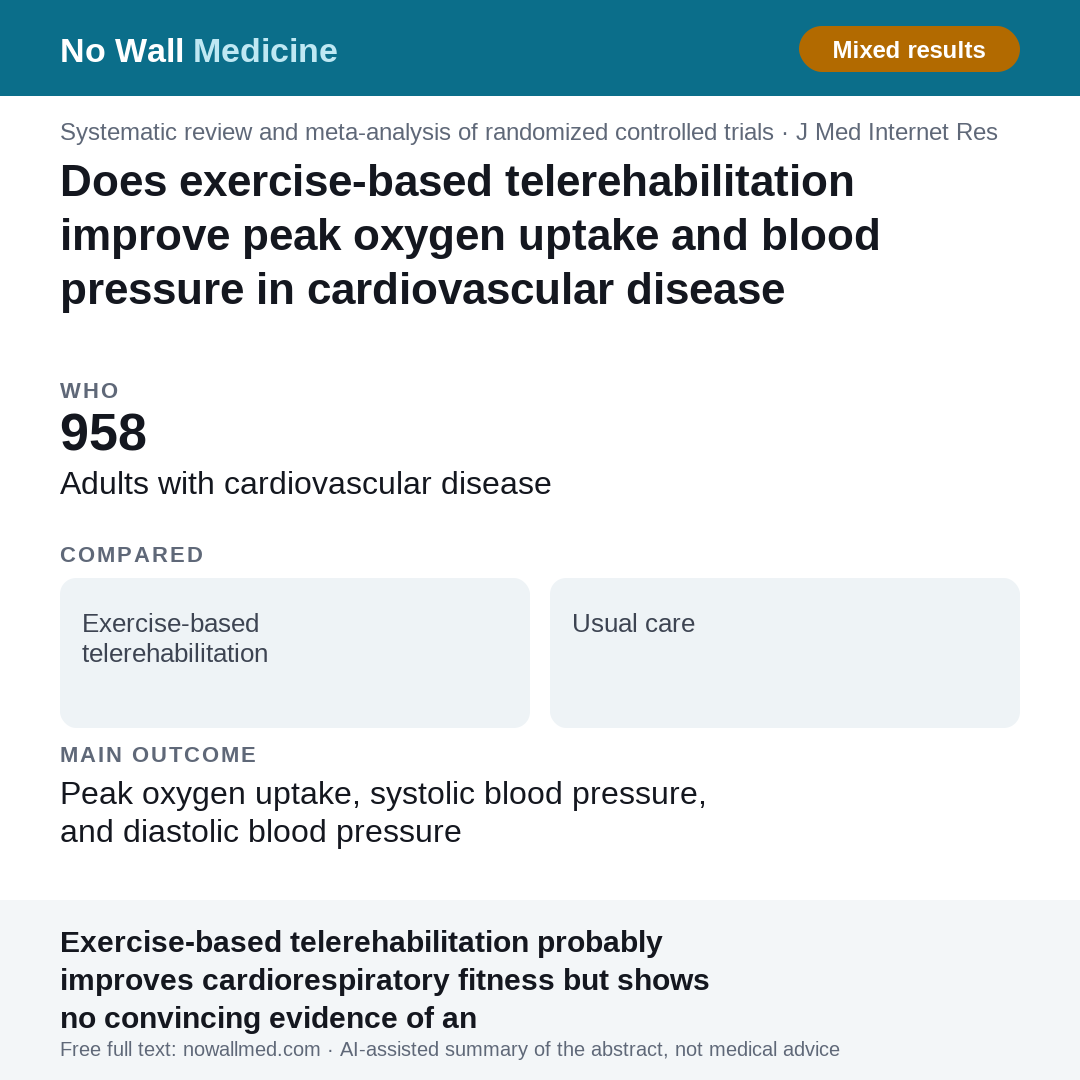
Does exercise-based telerehabilitation improve peak oxygen uptake and blood pressure in cardiovascular disease patients?
Who
958
Adults with cardiovascular disease
Compared
Exercise-based telerehabilitation
Usual care
Main outcome
Peak oxygen uptake, systolic blood pressure, and diastolic blood pressure
Result: mean difference 2.58 mL/kg/min (95% CI 1.16 to 4.00) for peak oxygen uptake
Bottom line: Exercise-based telerehabilitation probably improves cardiorespiratory fitness but shows no convincing evidence of an antihypertensive effect.
Limitation: GRADE certainty was very low across all outcomes and possible small-study effects were detected.
J Med Internet Res · 2026-09-21Download image
Clinical question: Does exercise-based telerehabilitation improve peak oxygen uptake and blood pressure in cardiovascular disease patients?
Why it matters: Previous reviews often bundled exercise with other lifestyle components, making it difficult to isolate the specific effects of exercise itself.
Key points
- Researchers analyzed thirteen randomized controlled trials involving 958 adults with cardiovascular disease to compare exercise-based telerehabilitation with usual care.
- Telerehabilitation significantly improved peak oxygen uptake, which is a measure of cardiorespiratory fitness, by a mean difference of 2.58 mL/kg/min.
- No significant changes were found for systolic blood pressure or diastolic blood pressure following the telerehabilitation interventions.
Limitation the authors note: The authors stated that the certainty of evidence was very low across all outcomes.
Headline and key points written with AI from the paper’s abstract, with every number checked against it. Read the paper before relying on them.
Was this summary helpful?
Subject terms
Cite this article
Zhu Z, Fan Y, Tang Z, Song N, Mao Y, Zhu Z. Effects of Telerehabilitation With Exercise as the Core Component on Peak Oxygen Uptake and Blood Pressure in Patients With Cardiovascular Disease: Systematic Review and Meta-Analysis. J Med Internet Res. 2026. doi:10.2196/95923
Spotted a mistake? Suggest a correction