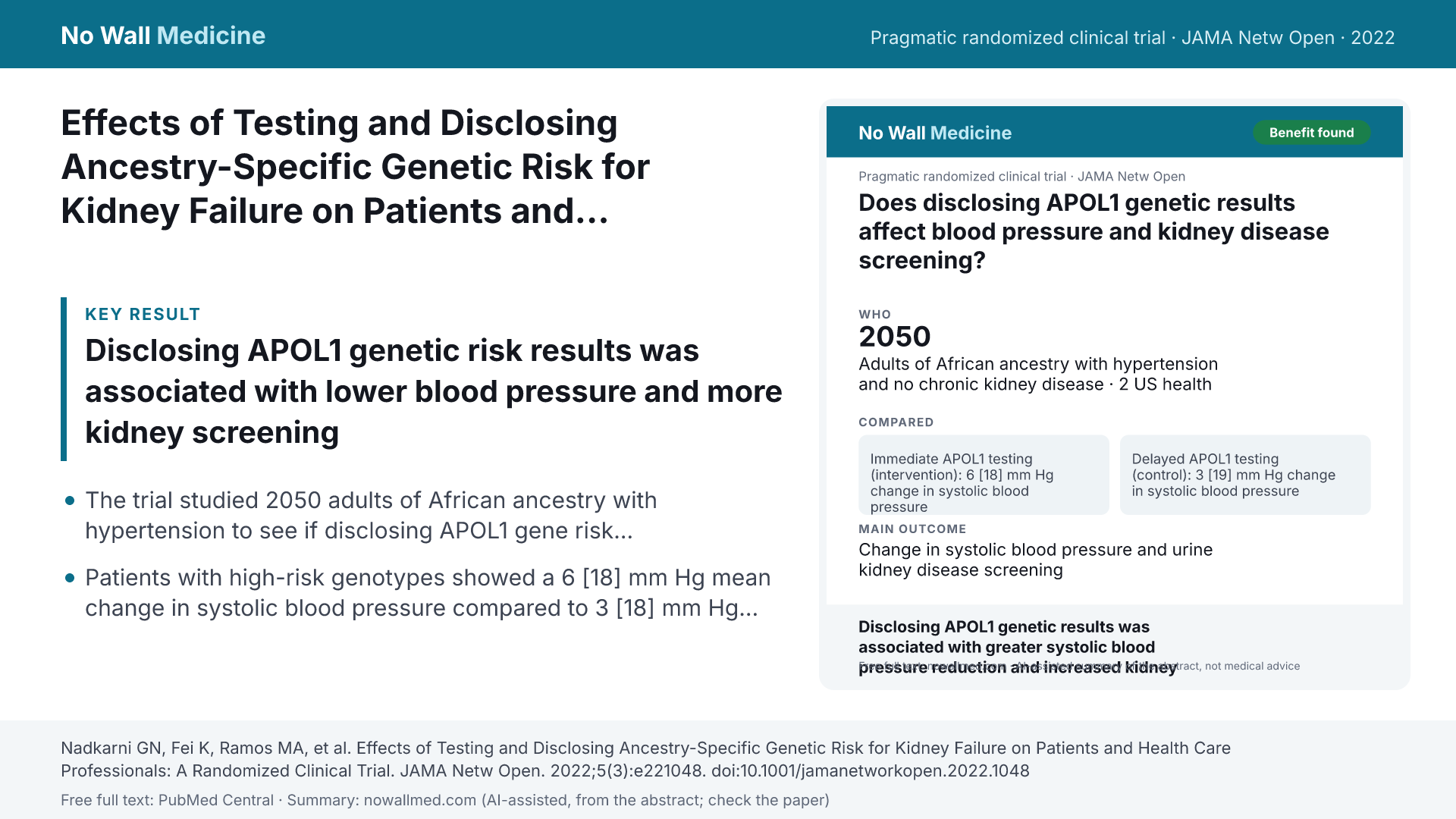
Disclosing APOL1 genetic risk results was associated with lower blood pressure and more kidney screening
Effects of Testing and Disclosing Ancestry-Specific Genetic Risk for Kidney Failure on Patients and Health Care Professionals: A Randomized Clinical Trial
Pragmatic randomized clinical trialBenefit found
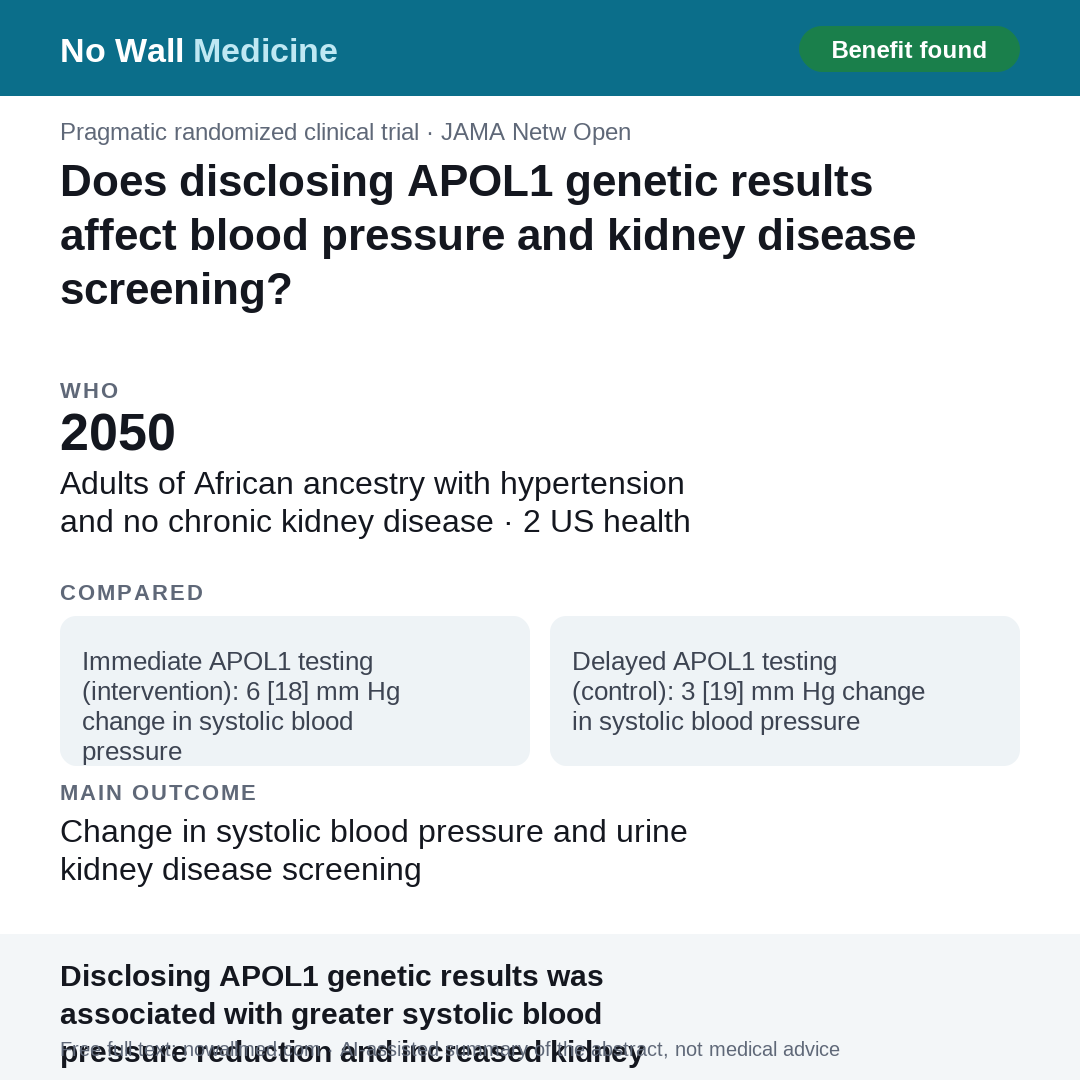
Does disclosing APOL1 genetic results affect blood pressure and kidney disease screening?
Who
2050
Adults of African ancestry with hypertension and no chronic kidney disease · 2 US health care systems
Compared
Immediate APOL1 testing (intervention): 6 [18] mm Hg change in systolic blood pressure
Delayed APOL1 testing (control): 3 [19] mm Hg change in systolic blood pressure
Main outcome
Change in systolic blood pressure and urine kidney disease screening
Bottom line: Disclosing APOL1 genetic results was associated with greater systolic blood pressure reduction and increased kidney disease screening in high-risk patients.
JAMA Netw Open · 2022-03-01Download image
Clinical question: Does disclosing APOL1 genetic results affect blood pressure and kidney disease screening?
Why it matters: It was unknown if sharing APOL1 genetic testing results for kidney failure risk with patients and clinicians affects blood pressure, kidney screening, or patient behaviors.
Key points
- The trial studied 2050 adults of African ancestry with hypertension to see if disclosing APOL1 gene risk results affected health behaviors.
- Patients with high-risk genotypes showed a 6 [18] mm Hg mean change in systolic blood pressure compared to 3 [18] mm Hg in low-risk patients.
- High-risk patients had a 12% increase in urine kidney disease screening, while low-risk patients had a 6% increase and controls had a 7% increase.
Headline and key points written with AI from the paper’s abstract, with every number checked against it. Read the paper before relying on them.
Was this summary helpful?
Subject terms
Cite this article
Nadkarni GN, Fei K, Ramos MA, et al. Effects of Testing and Disclosing Ancestry-Specific Genetic Risk for Kidney Failure on Patients and Health Care Professionals: A Randomized Clinical Trial. JAMA Netw Open. 2022. doi:10.1001/jamanetworkopen.2022.1048
Spotted a mistake? Suggest a correction